The Supreme Court’s emergency intervention temporarily blocks a state restriction on abortion pills, raising questions about federal authority versus state sovereignty in ongoing legal battles after the Roe case.
Story Overview
- Justice Samuel Alito issued a one-week emergency stay restoring nationwide mail and telehealth access to mifepristone after a lower court blocked it
- The May 1, 2026, appeals court ruling imposed in-person testing requirements in Louisiana, threatening to disrupt more than 10,000 weekly medication abortions.
- The temporary order maintains the status quo while judges consider emergency appeals from drugmakers.
- Medication abortions via telehealth and mail now account for approximately 63% of all abortions in the United States.
Emergency order ends state restrictions
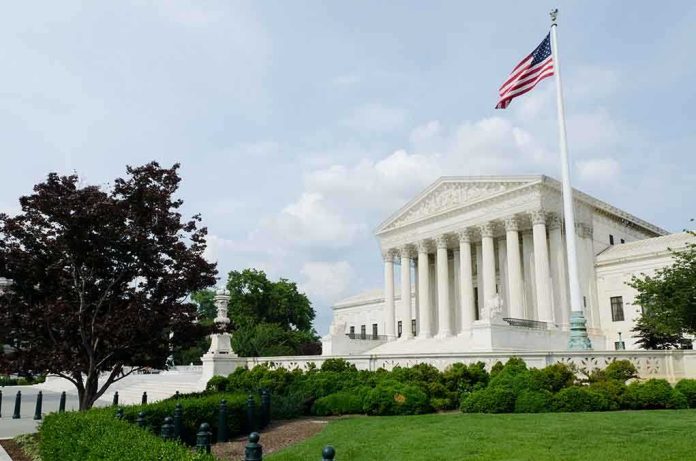
Justice Samuel Alito signed an emergency order on May 4-5, 2026, temporarily restoring nationwide access to mifepristone, an abortion pill, through mail delivery, pharmacies and telehealth prescriptions. The order suspends a May 1 federal appeals court ruling that blocked remote access to the drugs, citing Louisiana’s requirement for in-person medical exams. The Supreme Court’s intervention averts an immediate disruption to access to medical abortion while the justices consider emergency appeals from pharmaceutical manufacturers. This procedural approach through the Court’s shadow docket buys time for a more complete review of competing claims between state authority and federal drug regulation.
Louisiana demands spark federal clash
The appeals court’s initial ruling stems from Louisiana’s enforcement of in-person review requirements for abortion medications, challenging FDA regulations established in 2021 that expanded access to telehealth during the COVID-19 pandemic. Louisiana officials and anti-abortion groups say the FDA overstepped its authority by removing safety protocols requiring physical doctor visits. The state’s position reflects broader efforts by red states to reassert control over abortion access following the 2022 Dobbs decision that overturned Roe v. Wade. This represents another front in the federalism debate, pitting state sovereignty claims against federal regulatory power over pharmaceutical distribution.
The issues concern the majority of abortion procedures
Medication abortions performed by mail and telehealth now account for about 63% of all abortions performed in the United States, according to 2024 data from the Guttmacher Institute. The appeals court’s restriction threatens to immediately affect more than 10,000 women per week who rely on remote access to mifepristone, particularly affecting residents of the 14 states where abortion is almost completely banned. Mail delivery saves patients between $100 and $200 per procedure compared to travel costs for in-person clinic visits. The pharmaceutical industry that supports access to mifepristone generates more than $100 million a year, with manufacturers Danco Labs and GenBioPro issuing emergency appeals to preserve their FDA-approved distribution methods.
Broader implications for federal authority
The case extends beyond abortion policy and extends to fundamental questions about federal regulatory power and interstate commerce. Louisiana’s approach invokes principles of the 19th-century Comstock Act targeting mail delivery of abortion-related materials, potentially setting a precedent for state interference with federally approved pharmaceuticals. Similar logic could theoretically apply to other telehealth medications, including controlled substances like certain painkillers. The Supreme Court’s 2023 decision in Alliance for Hippocratic Medicine v. The FDA unanimously confirmed the FDA’s approval of mifepristone, although the current case focuses on distribution methods rather than the underlying approval of the drug. Conservative states say they are protecting their citizens from what they say are insufficiently supervised chemical abortions, while critics say it undermines both federal authority and women’s access to health care.
NEW: Supreme Court temporarily expands access to abortion pills by mail
READ: https://t.co/neuAZkwIFh pic.twitter.com/6USGjvShrh
– The Gateway Expert (@gatewaypundit) May 11, 2026
The temporary stay lasts approximately one week beginning May 5, 2026, with both parties required to submit responses before the Court determines whether to extend the pause or allow Louisiana’s restrictions to take effect. Drugmakers celebrated the order as crucial relief avoiding patient confusion and pharmacy disruptions, while pro-life advocates described it as a temporary setback in their campaign to restore what they see as necessary medical oversight. The outcome will indicate whether the Court’s conservative majority prioritizes state authority to regulate abortion access or defers to federal drug safety determinations, which could influence the 2026 midterm elections, where abortion access remains a central issue dividing voters.
Sources:
Source link