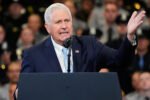


With U.S. forces “locked and loaded” and a fragile ceasefire in place in Iran, lawmakers are now demanding to know exactly what taxpayers are being asked to fund — and for how long.
Quick take
- Pentagon leaders Pete Hegseth and Gen. Dan Caine testified at a Senate defense budget hearing as Iran-related operations remain active.
- Officials have described Operation Epic Fury as severely damaging Iran’s nuclear and military infrastructure, while acknowledging the limits of publicly available details.
- Project Freedom is presented as a separate mission focused on restoring trade across the Strait of Hormuz, supported by an ongoing blockade.
- Congressional control faces unanswered questions about costs, burden-sharing among allies and what “success” looks like after the ceasefire.
Capitol Hill focuses on war spending as operations continue
Secretary of War Pete Hegseth and Chairman of the Joint Chiefs General Dan Caine appeared May 12 before the Senate Appropriations Committee’s Defense Subcommittee for a budget hearing related to ongoing operations involving Iran. The central question was not whether America could project power, but rather how the Pentagon planned to maintain readiness while Congress funded the government on a day-to-day basis. The hearing highlighted the practical tradeoffs: operational tempo, force protection, and the length of time a high alert posture can be maintained.
Officials entered the hearing with a clear message: The ceasefire may hold, but the U.S. position remains deliberately primed for escalation. Hegseth said the department was “locked and loaded,” reflecting the administration’s view that deterrence requires visible capability, not just diplomatic statements. Caine stressed that Iran’s command and control has been significantly degraded, an important point because it determines how quickly Tehran could coordinate further attacks or respond to pressure in the region.
Two operations, two objectives: Epic Fury against Project Freedom
The research describes two distinct lines of effort. Operation Epic Fury is billed as a strike campaign against Iran’s nuclear facilities and associated military infrastructure, following earlier U.S. actions outlined in June 2025 briefings. Hegseth called the strikes “devastating” Iran’s nuclear program, while public documents do not give a full account of remaining capabilities. This discrepancy is to be expected in wartime, but it also leaves lawmakers and voters judging the results with limited transparency.
Project Freedom, in contrast, is described as a separate operation ordered by President Trump to revive free trade across the Strait of Hormuz. In practical terms, the research focuses on a continued blockade posture under the leadership of CENTCOM, with Admiral Bradley Cooper described as implementing an “ironclad blockade.” For Americans who remember years of energy price shocks and global supply shocks, the Strait of Hormuz is not a lesson in abstract geography. Disruptions can impact fuel prices, shipping costs and household budgets.
Leverage of the ceasefire, negotiations and the credibility problem
The administration continues negotiations with a new Iranian regime while maintaining military pressure. In the research, the ceasefire is described as fragile, and Pentagon leaders say U.S. forces are positioned for rapid escalation if the terms are violated. This approach reflects a harsh reality of governance: ceasefires are valid when both parties believe violations will be punished. At the same time, the public filing provided here does not include a clear timetable or defined “exit criteria,” leaving uncertainty about the duration.
The same credibility problem applies to allied participation. Hegseth criticized some allies for offering “talks” without action, while praising some regional partners for their “phenomenal” support. What is missing from the available research is a detailed breakdown of who contributes what: troops, base access, intelligence support, air defense or maritime enforcement. Without these details, it becomes harder for Congress to assess burden sharing and for taxpayers to know whether America is once again bearing the bulk of the burden.
Fiscal Oversight Meets Public Distrust of Washington
The budget hearing format is supposed to reinforce accountability, but the research highlights major unknowns: specific funding levels, long-term cost projections and a full transcript of questions and answers. This lack of information fuels a broader frustration shared on both the right and the left: the government is asking for trust and money while only disclosing partial details. Conservatives tend to focus on fiscal discipline and mission clarity, while many liberals focus on humanitarian risks and inequality. Regardless, vague spending demands can increase cynicism about Washington.
https://t.co/Gv7A907ZnW Secretary of War Pete Hegseth and Chairman of the Joint Chiefs of Staff Gen. Dan Caine face questions from lawmakers about military funding amid the war with Iran.
-KM (@KM5436681152801) May 12, 2026
For now, the available facts suggest a unified civil-military front seeking funding to maintain readiness, maintain force protection, and support a trade-related blockade posture of Hormuz. The strategic bet is that pressure and diplomacy will prevent an Iranian nuclear breakthrough without a long and bitter war. But Congress has yet to translate this strategy into appropriations, and the public will judge it based on measurable results: stable energy markets, fewer threats to U.S. forces, and a clear definition of what “success” looks like after the ceasefire.
Sources:
Fox Business video segment: Hegseth and Caine face questions from lawmakers on military funding
Source link