After crowning a new champion and with the 2026 NBA Draft now in the rear-view mirror, the NBA-watching world now turns its attention to the start of a new league year — and, with it, the highly anticipated game of musical chairs that will reset rosters, pecking orders, and expectations for next season and beyond.
Welcome, friends, to the 2026 NBA offseason … which, if we’re being honest, actually kicked off in a pretty major way last week, but officially begins in earnest at 6 p.m. ET on Tuesday. We recommend keeping your head on a swivel out there. Things might get weird.
Advertisement
Which teams will look to take big swings aimed at entering the championship conversation? Which players are mere days away from grabbing a generational bag? And who might be on the verge of a big decision they’ll come to view with deep, penetrating regret?
The answers to those questions, and many more, will come in the days and weeks ahead. While we’re waiting, please accept this offseason primer as a means of setting the table and trying to get our arms around the biggest-ticket issues around the NBA as the annual feeding frenzy of acquisitions commences.
Are the Knicks really not going into the second apron to keep their title team together?
It sure sounds like it!
Advertisement
It took 53 years for the Knicks to win a third NBA championship. It took just four days for the storm clouds to begin gathering. The day before their championship parade down the Canyon of Heroes in Lower Manhattan, team owner James L. Dolan went on New York radio station WFAN and made it clear that he did not intend to approve an offseason spending plan that would increase the team’s total salary commitments for the 2026-27 season past $222 million — about $21 million above the projected luxury tax line, a threshold called the “second apron.”
“If we could bring back the whole team, exactly as it is, why wouldn’t you?” Dolan said. “But I don’t know if we’ll be able to. […] We’re willing to stretch, right? But there’s certain things in the NBA that you’d have to be, you know, suicidal to do, and we’re not going to do those. One of them is called the second apron. Cannot go into the second apron.”
Introduced in the 2023 collective bargaining agreement between the league’s owners and the players union, the second apron was intended as something of a nuclear deterrent to the sort of high-revenue teams with deep-pocketed owners for whom high luxury tax bills registered more as a fleeting consideration than an existential threat. (Think Steve Ballmer’s Clippers and Joe Lacob’s Warriors.) Go over the second apron and you’re not just paying a higher tax rate; you also start losing team-building and roster-management tools, like access to salary cap exceptions such as the midlevel exception, biannual exception or traded player exceptions, the ability to aggregate players’ salaries in a trade, the option of sending cash to another team to grease the skids on a swap, and the freedom to acquire players in sign-and-trade deals, among other limitations.
Advertisement
Stay over the second apron by season’s end, and you lose the ability to trade your first-round draft pick seven years into the future. (Meaning: A team that’s in the second apron at the end of the 2025-26 season will have its 2033 first-rounder frozen.) Linger there even longer — for two of the next four seasons after first crossing the threshold — and that pick is not only frozen; it’s moved to the end of the first round. Combine those far-future penalties with the immediate limitations on adding outside players, and the second apron starts to look like an awfully frightening boogeyman for teams intent on spending big to stack talent. (Which is, of course, its primary utility in Commissioner Adam Silver’s “parity of opportunity” era.)
Whether motivated by fear of those prospective roster-building restrictions, or using the specter of them to justify some measure of belt-tightening after having shelled out more than $83 million in luxury tax payments over the past two seasons, Dolan went on the radio the day before the parade and drew a line at the second apron. This reportedly “blindsided” the Knicks front office, which wants to go over the second apron, according to Fred Katz of The Athletic — in large part because they understand that not doing so will almost certainly mean losing one or more key contributors off head coach Mike Brown’s bench — but which instead went into last week’s draft operating as if they had a mandate to stay below that line, as SNY’s Ian Begley reported.
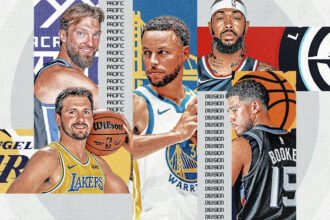
(Joseph Raines/Yahoo Sports Illustration)
As it stands, after reported multi-year agreements with guard Jose Alvarado and forward Mohamed Diawara, the Knicks have an estimated $14.1 million in space below the second-apron line, with five open roster spots. (Four, really, since they’re likely to keep one spot open heading into the season.) That does not include new deals for unrestricted free agents Mitchell Robinson, Landry Shamet and Jordan Clarkson or restricted free agent center Ariel Hukporti. Nor, for that matter, does it include the two players they selected in the 2026 NBA Draft, German guard Jack Kayil and Vanderbilt shooter Tyler Nickel — whom New York picked in the second round after making multiple trades to drop down the draft board, seemingly with an eye toward saving every dollar it could with the apron mandate looming.
Advertisement
Even with few teams profiling to have significant cap space to spend in free agency, $14 million won’t be enough to bring back Robinson, the league’s best offensive rebounder and a high-level defensive center relegated to a backup role primarily by a history of injuries, and Shamet, who drastically outperformed his minimum salary en route to shooting 47.5% from 3-point range during New York’s dream postseason. Robinson, the longest-tenured Knick, made $15 million last season, and figures to have suitors on the unrestricted market. If Shamet finds a deal at something more than the minimum, the Knicks likely won’t be able to match it and find a palatable replacement for Robinson, so long as they’re artificially hard-capping themselves at the second apron.
On one hand, you can look at a Knicks roster that will return a top six of Jalen Brunson, Karl-Anthony Towns, OG Anunoby, Mikal Bridges, Josh Hart and Deuce McBride and say that, with a core that strong, seventh, eighth and ninth men won’t prove to be the difference between winning and losing a title. On the other, when you look back at New York’s championship run — at McBride’s 25-point explosion in Game 4 against the Philadelphia 76ers, at Shamet’s torrid shot-making against the Cleveland Cavaliers in the Eastern Conference finals, at Alvarado’s critical contributions to the historic Game 4 comeback against San Antonio, at Robinson’s defensive stand against Victor Wembanyama in Game 2 and his game-sealing offensive rebound in Game 5 — you can argue that it’s precisely the difference. Which is why not going above the second apron in this case doesn’t really seem like a basketball-first call.
Dolan said on WFAN that the decision on which players to bring back and at what price points were “up to Leon” — team president Leon Rose, the architect of New York’s championship roster. But only, it seems, up to a point.
“I’m just telling him how big of a check I can write,” Dolan said. “I’ll write as big of a check as possible. But I can’t write a check that goes into the second apron.”
Advertisement
If that doesn’t change, then the Knicks’ roster almost assuredly will.
What about the other hopeful contenders? What questions do they have to answer?
For the Western Conference champion San Antonio Spurs, the first big question is, “What color pen will Victor Wembanyama use to sign the extension of his rookie-scale contract for which he is now eligible, and which will pay him a full 30% of the salary cap, since he qualified for the Rose Rule escalator by winning Defensive Player of the Year?” (My guess: black. Can’t argue with a classic, you know?) Beyond that — barring a trade to move off De’Aaron Fox following his frustrating Finals, which is tough to see returning commensurate value since he’s about to start a four-year max extension — we could see a Spurs team that just invested in a pair of new rookie big men largely stand pat, betting on internal development from bright young things like Wembanyama, Stephon Castle, Dylan Harper and Carter Bryant.
“The point is, if you’re waiting for [Spurs general manager Brian] Wright to make a big splash this summer, you’re probably going to be disappointed,” San Antonio Express-News columnist Mike Finger recently wrote. “There’s a good chance that the most significant addition next season’s Spurs will have is their own familiarity with each other. That is, after all, how championships are won.”
Advertisement
The 2025 champion Thunder have already been busy, trading reserves Aaron Wiggins (to Atlanta) and Isaiah Joe (to Detroit) in deals that returned a handful of second-round picks to open up roster spots … and, more importantly from ownership’s perspective, slashed an estimated $185 million in total salary and luxury tax spending. OKC boss Sam Presti re-worked Isaiah Hartenstein’s deal, keeping the center in the fold for three more years but at a slightly lower average annual salary; with the Thunder still projecting to be a move or two away from ducking the second apron, can they still find a way to add talent? Or is the most likely path for the West’s No. 1 seed something more like bidding farewell to the likes of Luguentz Dort and Kenrich Williams, extending Cason Wallace, leaning harder on Jared McCain, betting on bounce-backs for Jalen Williams (after an injury-ravaged season) and Chet Holmgren (after a conference finals to forget), and trusting that back-to-back MVP Shai Gilgeous-Alexander’s got the goods to push them back to the top of the conference without any major infusions of talent?
Questions abound elsewhere, too. Coming off an exhilarating 60-win season followed by a disappointing second-round exit, and after shedding backup center Isaiah Stewart’s salary, the Detroit Pistons seem to be loading up for something. Does Trajan Langdon have a big swing lined up to add some offensive firepower to his elite defensive crew? (Keep an eye on the aftermath of the Giannis deal; Detroit’s been rumored to have interest in Tyler Herro and Norman Powell to slot in at off-guard next to Cade Cunningham.)
The Heat and Timberwolves already took their home-run cuts, adding Giannis Antetokounmpo and LaMelo Ball, respectively, to try to vault themselves into the upper echelons of title contention. They still have holes to fill, though, with Miami needing to round out its starting five and reserve corps — a new deal for Andrew Wiggins seems like a nice start — and Minnesota, after its pre- and post-draft wheeling and dealing, now seemingly in the market for a new starting power forward. Where will Tim Connelly find him? (If his tenure in the Twin Cities has shown us anything, it’s that the answer will probably be, “From a place you least expected it to come from.”)
Advertisement
ESPN’s Dave McMenamin reported earlier this month that Luka Dončić’s “first and foremost desire is an A-list center.” After the Lakers re-signed backcourt running buddy Austin Reaves for more than $46 million per year, incumbent big man Deandre Ayton picked up his $8.1 million player option for next year, and I’m going to be honest: I’m not sure that will satisfy Luka’s deepest desires. Nor, you’d imagine, would a mid-tier unrestricted free agent option like Robinson (if he shakes loose from New York), the oft-injured-but-always-alluring Robert Williams III, once-upon-a-time-Laker Moe Wagner, or aging vets Brook Lopez, Nikola Vučević and Jusuf Nurkić. Making a bid for one of the higher-tier restricted free-agent options — Pistons All-NBA selection Jalen Duren (whose extension talks don’t sound like they’re going too hot) and Jazz shot-swatter Walker Kessler — figures to be tough, too, with the bulk of L.A.’s theoretical cap space currently tied up in the $59.5 million cap hold of LeBron James …
… unless, of course, LeBron’s either going to come back at a lower number, or — gasp! — go someplace else.
Wait, what’s the deal with LeBron and the Warriors again?
As I’m sure you recall, the Warriors and Lakers reportedly discussed a LeBron-to-Golden State deal ahead of the 2024 NBA trade deadline, though no deal ever came to fruition. And, as you’ll undoubtedly remember, they did team up on Team USA in the summer of 2024, helping deliver gold in France thanks in part to the brilliance of both James and Stephen Curry.
Advertisement
The Lakers have signaled their intent to build around the 27-year-old Dončić, rather than continuing to prioritize the 41-year-old James, who is entering unrestricted free agency. The Warriors, after losing Jimmy Butler to a torn right ACL midway through last season and falling to the Suns in the play-in tournament, could use some more talent if they hope to mount a credible challenge to the bigger, more dangerous Colossi currently standing astride the West.
You could see the dots, and our Kevin O’Connor connected them on Monday, reporting that the Warriors are trying to not only sign James with their $15.1 million non-taxpayer midlevel exception, but also trade for Anthony Davis — currently employed, in case you forgot, by the Washington Wizards — to form a veteran quartet aimed at trying to maximize the latter days of the future Hall of Famers’ careers. Longtime Curry partner and LeBron pal Draymond Green did his part to help make the fever dream a reality, coming through in the Klutch clutch by declining his $27.7 million player option for next season to give Golden State’s brass more financial flexibility with which to complete the myriad machinations that this would all require.
From there, all the Dubs would have to do is get Washington on-board with dealing Davis — who has yet to play a second for the Wizards! — for the still-rehabbing Butler (plus, you’d suspect, some draft capital), get LeBron to sign for what will probably be the smallest contract he’s played on since his rookie deal, and fill out the rest of the roster around an exceedingly seasoned core collective. Easy-peasy.
Advertisement
As the Warriors try to line up one last job, the Lakers now ask themselves just how far they want to extend themselves for a player who delivered them their most recent championship, but who is now a literal graybeard who no longer represents their future. (Even if he did just average 23-7-7 in the postseason while serving as the best player on a team that won a first-round series.) Pretty big question!
On the plus side, though, the Lakers aren’t the only ones facing those these days. In case you hadn’t heard, the Lakers’ ancestral rivals — fresh off a 56-win season and a devastating first-round ouster — have some issues of their own to figure out. To wit:
Well, after he didn’t actually get traded to Milwaukee for Giannis, and then subsequently spent the next few days making headlines for continuing to fight with both Stephen A. Smith and the field of analytics, it seems prudent to politely decline to predict where the Jaylen Brown story goes next. There’s too vast a universe of possibilities to consider. (Weirdly, I feel like The Matrix might be involved? Though that might just be because of the sunglasses in the Twitch ads.)
Advertisement
After the Antetokounmpo deal didn’t come to fruition, Celtics president Brad Stevens told reporters that Brown remains “a big part of us,” but also said that he never tries to predict the future. (Maybe he’s seen the glasses, too.) He apparently is trying to shape that future, though, by reportedly asking for “four and even five first-round picks in some deals” for the All-NBA swingman — raising the possibility that, ultimately, all the chatter around Brown is really about the Celtics finding a way to reorient their roster and, possibly even more importantly, their balance sheet. ESPN’s Vincent Goodwill reported Monday that the L.A. Clippers, Denver Nuggets and Portland Trail Blazers have all “registered interest” in Brown, though it’s unclear if they’re willing to pony up the kind of pick package that Stevens is reportedly pursuing in exchange for a player who’s still owed more than $183 million over the next three seasons.
If Stevens can’t find a satisfactorily massive return on the market, will both sides be able to let bygones be bygones and get Brown back into camp to continue plying his trade for the Celtics next season? Or has all the noise just gotten too loud for everyone to quiet down, make peace and move on with business as usual?
“All the people that’s doubting me, that want me to do this, or want me gone, or whatever,” Brown said during a recent stream, “you’re turning me into a monster.”
Advertisement
All eyes, now, are on whether Brown takes that frustration out on opponents wearing a Celtics uniform or, for the first time in his career, some brand new colors.
Who actually has money to spend?
According to ESPN’s Bobby Marks, only the Brooklyn Nets and Chicago Bulls project to be able to create more than $30 million in salary cap space this summer. It’s unclear exactly how much they’re actually working with right now, though; after participating in the three-team swap with Minnesota that brought Julius Randle to Brooklyn and sent Nic Claxton to Chicago, it’ll depend on how they structure and order the deals they’re agreeing to (like the Nets’ Monday moves to bring back Day’Ron Sharpe and Josh Minott).
Several other teams could crack open significant cap space, too, though it would require renouncing their own free agents to remove their cap holds, like LeBron James in L.A., or by renouncing sizable trade exceptions, like the $28.9 million one that the Grizzlies created by sending Jaren Jackson Jr. into Utah’s cap space at the 2026 NBA trade deadline back in February.
Advertisement
For the most part, though, the days of teams keeping their books clean to be able to go hunting for high-profile free agents come July are largely behind us — primarily because the days of those high-profile players actually making it to free agency are largely behind us.
The steady rise in basketball-related income over the years has driven steady increases to the salary cap — and, with it, what players can earn on the max-level deals that pay them 25%, 30% or even 35% of the cap, depending on how many years of service time they have. Many non-max players have found richer deals sooner, too, thanks to a change in the 2023 collective bargaining agreement that increased how large a raise a team could give a veteran player over his previous contract in the first year of an extension from 120% to 140% — a sizable-enough bump that a number of players who in years past might have decided to bet on themselves and hit the open market have chosen instead to take the bigger payday that’s right in front of them.
That’s led to more marquee players tending to move in trades than in free agency — a la Giannis going to Miami and LaMelo going to Minnesota last week, among many others — and comparatively fewer landing on the unrestricted market.
How many big-name free agents might actually be on the move?
Well, there’s that LeBron guy, but we’ve already covered him. James Harden, too, though it seems like him opting out of his $42.3 million deal for next season is just a precursor to him signing something longer and more lucrative overall to stay in Cleveland … which is pretty much how we all figured this would work out going back to February.
Advertisement
Can I interest you in a Norman Powell? Fresh off making his first All-Star appearance, the 33-year-old scorer — who made $20.5 million last season in Miami — may be too rich for the blood of a Heat team working to round out its roster on the cheap after bringing in Giannis. Or a Tobias Harris, if Detroit’s intent on going big-game hunting for offensive upgrades elsewhere? Maybe a lightly (OK, not-so-lightly) used Kristaps Porziņģis, if he winds up sitting on the dock of the Bay after the Warriors thread their aging superstar needle?
If you’re looking for somebody younger — ideally either entering or squarely in their prime — you’re looking at names like the aforementioned Robinson, Anfernee Simons, Quentin Grimes, Trendon Watford, Bones Hyland, Keon Ellis and Sandro Mamukelashvili. Those are all fine players who may very well make a new employer very happy. They’re probably not changing the face of your franchise, though … which is why we’re seeing so much more focus on trades and extensions entering free agency than on, y’know, free agency.
While there’s still no resolution to the ongoing independent investigation into whether the Clippers deliberately sought to circumvent the salary cap by funneling tens of millions of dollars to Leonard through an endorsement deal, that apparently isn’t impeding discussion on deals involving the seven-time All-Star and All-NBA selection.
Advertisement
Jake Fischer reported last week that the Toronto Raptors — the team that made a calculated gamble on Leonard in the summer of 2018, which paid off in the franchise’s first NBA championship 11 months later — had “registered interest” in trying to bring Kawhi back to the Great White North, even with one year and $50.3 million remaining on his contract, and with unrestricted free agency once again looming in the summer of 2027. (History doesn’t repeat itself, but it rhymes.) Fischer also reported that, “when it comes to potential trade talks, there are only two other teams that Leonard would consider signing an extension with: The two teams he played for before becoming a Clipper. Toronto and San Antonio.”
The Spurs just made an ahead-of-schedule appearance in the NBA Finals, already have an MVP finalist and, as we discussed earlier, appear to be structured to continue their organic growth without needing to introduce Leonard into their ecosystem. The Raptors, on the other hand, have won one playoff series since Kawhi left for L.A., and had reportedly kicked the tires on a number of names (Domantas Sabonis, Trae Young, Jaren Jackson Jr., LaMelo Ball) in recent months in search of another star-level talent to pair with Scottie Barnes.
Advertisement
It stands to reason, then, that the Raptors would be more interested in renewing pleasantries with the two-time NBA Finals MVP — and, in fact, reportedly continued negotiations toward that end over the weekend. They’re evidently not alone, though; old pal Masai Ujiri, now running the show for the Dallas Mavericks, reportedly made his bid for a reunion over the weekend, too.
Would the Clippers — who, we remind you, just drafted 19-year-old guard Keaton Wagler fifth overall in last week’s draft, less than five months after trading the 36-year-old Harden for the 26-year-old Darius Garland, as they continue to pivot away from last season’s “Let’s Have The Oldest Team Ever” approach — be more amenable to a Dallas package headlined by PJ Washington, Klay Thompson and draft picks or a Toronto offer featuring some combination of Brandon Ingram, RJ Barrett, Immanuel Quickley, Gradey Dick and draft capital? If Leonard is truly on the table, might more suitors throw their hats (and best offers) into the ring? Or would that reported interest in re-upping in Toronto — which ESPN’s Shams Charania echoed Monday — limit the market of prospective suitors, potentially steering Leonard back to the city he left seven summers ago?