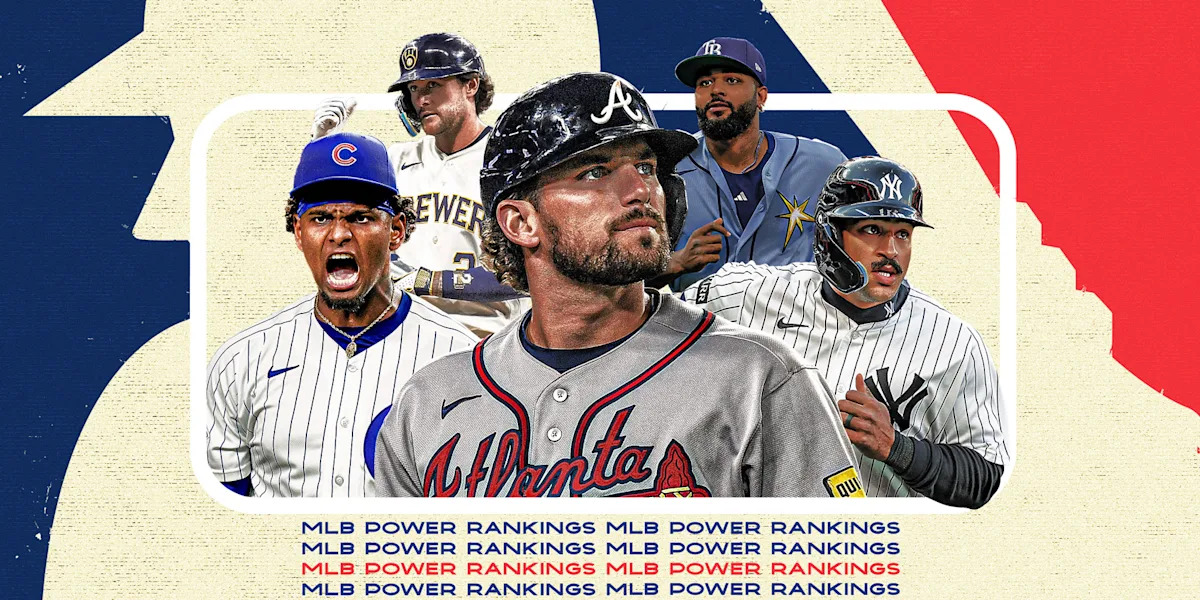
As we approach the quarter-mark of the regular season, there remains a stark divide in quality between the American and National League, with the AL featuring only four teams above .500 and the NL accounting for eight of the 10 best records in the majors. For the previous edition of our power rankings, we took a look at the clearest strengths for each team, from the standout traits of the clubs at the top of the sport to the rare bright spots on the scuffling teams at the bottom. This week’s power rankings explore the opposite, reviewing every team’s weaknesses, whether they are outlier shortcomings on a stacked roster or the biggest blemish on a team full of them.
Let’s get to it.
Jump to a team by clicking on the links below:
Advertisement
Third base. Left field — handled mostly by free-agent signing Mike Yastrzemski, still looking for his first Braves home run after 125 plate appearances — has been a problem. But the lackluster performance of Austin Riley — owed $22 million annually through 2032 — has been far more troubling, and stands out as the most glaring disappointment amid a season when so much else is going right for Atlanta. Riley was the model of consistency for three years after his initial breakout in 2021 before spending the past few seasons declining across the board. Plate discipline and defense have never been Riley’s strong suit, but he always slugged more than enough to make him a well-above average player anyway. That power production hasn’t been there lately, and it has sunk to a new low (.355 SLG%) in 2026, sliding him down the lineup while the other Braves stars do the heavy lifting. Let’s see if he can get back on track.
2. Los Angeles Dodgers (24-17)
Age in the lineup. Weighted by playing time, the Dodgers have the oldest position player group in baseball, an ominous reality that will continue to loom over the organization as its core group of superstars in the lineup try to maintain its championship window as long as possible. Some of these older players, like 35-year-old Max Muncy, are thriving, but we’ve yet to see the best from the likes of Freddie Freeman, Will Smith, Mookie Betts, nor Shohei Ohtani at the plate, while Teoscar Hernández has been flat-out struggling. Fortunately, the few mid-20’s contributors, like Andy Pages, Dalton Rushing and Hyeseong Kim, have played well. The older veterans are going to have to start performing like the stars they are if the Dodgers want to get to where they want to go.
Advertisement
3. Chicago Cubs (27-14)
Pitching depth. Immaculate vibes at Wrigley Field and a boatload of runs have covered up for a lot in recent weeks, but the Cubs’ pitching staff is about to seriously be tested in the coming weeks with how many key arms remain on the injured list, either temporarily or for the long run. Credit to those who have filled in recently for Cade Horton, Matthew Boyd, Justin Steele, and a slew of hurt relievers. But the Cubs don’t have a ton of quality depth to turn to at this stage, putting immense pressure on the few key healthy arms to perform in order to keep pace in the ultra-competitive NL Central.
4. New York Yankees (26-16)
The bullpen. Yes, the Yankees have the second-lowest bullpen ERA in baseball at 3.28. But New York’s relievers have been asked to cover only 140 innings — the fifth-lowest mark in MLB — because of how good the starting pitching has been. From a personnel standpoint, the Yankees’ bullpen projects as far shakier than any other part of the roster, and we saw that over the weekend in Milwaukee and again in Monday’s series opener against Baltimore. While the rotation’s strength should continue to limit the required workload for the relievers, the bullpen is going to need to step up to support the starters more frequently moving forward, and that might require an addition or two at the trade deadline to solidify the unit.
5. Milwaukee Brewers (22-16)
Elevating the baseball. The Brewers are a good team, as evidenced by their sweep of the Yankees over the weekend and their suddenly stellar record after an underwhelming start. But hitting the ball over the fence has not been easy for this squad. The Brewers rank last in MLB with just 26 home runs in 38 games, and a quick glance at their batted ball profile helps explain why: Milwaukee bats have produced a 52% ground ball rate, far and away the highest mark in the majors (Pittsburgh and Boston are tied for second at 47%). It’s hard to homer on the ground, folks (unless you’re Bobby Witt Jr.).
Advertisement
Hitting the ball hard. Junior Caminero, Yandy Díaz and Jonathan Aranda can do only so much: the rest of this lineup packs such little punch that the Rays rank last in MLB in barrel rate, hard-hit rate, average exit velocity and 29th in xwOBA, ahead of only the Giants. Their speed and contact skills have enabled a competent offense nevertheless (17th in OPS, 11th in runs per game), but these paltry power metrics could catch up to Tampa Bay eventually, especially if its stars at the top of the order start slumping.
The Braves have overtaken the Dodgers for the No. 1 spot in this week’s MLB power rankings. (Bruno Rouby/Yahoo Sports)
Offense. Despite the bevy of famous names up and down the lineup, this squad is struggling badly at the plate. Fernando Tatis Jr.’s bizarre home run drought might be grabbing headlines, but he’s far from the only accomplished San Diego slugger doing minimal slugging, as Manny Machado (.647 OPS), Jackson Merrill (.665 OPS) and Jake Cronenworth (.468 OPS) have scuffled as well. The Padres have just two hitters (Xander Bogaerts, Miguel Andujar) with at least 100 plate appearances and an OPS+ of 100 or better (above league-average), the second-fewest in MLB ahead of only the Mets (who have only Juan Soto above that mark).
Advertisement
8. St. Louis Cardinals (23-17)
Swing-and-miss stuff. The Cardinals’ pitching staff is tied with the Nationals for the lowest strikeout rate in MLB at 18.8%. St. Louis does not have a single starting pitcher who strikes out at least a batter per inning, and only closer Riley O’Brien and Ryne Stanek boast above-average strikeout rates in the bullpen. Having the third-highest ground ball rate (46.8%) in MLB and a stellar defense helps compensate for the lack of whiffs, but all those balls in play could catch up to the Cardinals eventually.
Outfield defense. To the surprise of absolutely no one, a Pirates outfield consisting of Ryan O’Hearn, Oneil Cruz and Bryan Reynolds has graded out poorly so far, with -7 Outs Above Average that ranks 28th in MLB. Perhaps more surprising is that O’Hearn has actually been a positive defender by OAA (+1) in right field, while speedy defensive specialist Jake Mangum has registered a -2.
Advertisement
10. Philadelphia Phillies (19-22)
Catching — on offense, anyway. A lengthy staredown over the offseason ended with free-agent JT Realmuto returning to Philadelphia on a three-year deal, but Realmuto has not shown well offensively (80 wRC+) to begin his age-35 season, continuing a decline that already seemed to be in progress last year. Add in backup Rafael Marchan’s abysmal 4-for-54 start — and the fact that Marchan has even had to play that much at all due to Realmuto’s nagging injuries — and the Phillies’ backstops have combined for a 38 wRC+, the worst mark in the majors. On the bright side, Philadelphia’s catchers rate as elite behind the plate, which helps offset the offensive woes a bit.
11. Seattle Mariners (20-22)
Defense. Seattle’s stellar group of pitchers have performed well to start the season, but it’s worth noting they haven’t gotten much help from the fielders surrounding them. Other than second-year second baseman Cole Young, who has been outstanding by multiple metrics, and catcher Cal Raleigh, who has excelled defensively amid his miserable offensive slump, the rest of the Mariners’ defense has been downright bad, ranking 30th in Statcast’s all-encompassing Fielding Run Value. This most notably includes a poor early showing from center fielder Julio Rodríguez, who ranks in the 4th percentile in Outs Above Average after ranking in the 90th percentile or better in each of his first four seasons.
Advertisement
12. Cincinnati Reds (22-19)
Strikeouts, on both sides of the ball. Strikeouts aren’t everything, but the Reds are too often on the wrong side of the equation in that particular part of the game: their hitters’ 24.5% strikeout rate is tied with the White Sox for fourth-highest in MLB, while their pitchers have struck out only 19.4% of batters, the third-lowest mark in MLB. There’s plenty else that goes into good offense and effective run prevention, but the lopsided distribution of punchouts can at least in part help explain why Cincinnati ranks 23rd in team ERA at 4.55 and 27th in OPS+ at 90.
13. Athletics (21-19)
Pitching. The A’s have been in sole possession of first place in the AL West every day since April 18 despite never being more than three games above .500. That says more about the teams chasing them than their own quality of work, but credit to them for doing just enough to stay ahead of the pack and remain in the mix to challenge for a postseason spot nevertheless. However, even in a weak American League, their chances of staying relevant will require a more dependable performance on the mound than what they’ve shown, as A’s pitchers’ 4.42 ERA ranks 21st, 4.70 FIP ranks 26th and 1.44 WHIP ranks 27th. That is not a first-place pitching staff.
Advertisement
The leadoff spot. All-Star Steven Kwan’s prolonged slump stretching back to last May is concerning enough on its own, but the bigger issue is that Cleveland has kept him at the top of its lineup the whole time, meaning the Guardians have gotten very little out of that crucial spot in the batting order relative to the rest of the league: Cleveland’s 73 wRC+ out of the leadoff spot (the vast majority of which has been Kwan) ranks 26th in MLB.
15. Arizona Diamondbacks (20-20)
The offense. The pitching staff may actually be a bigger issue over the long haul, but relative to expectations, it’s hard not to look at the lineup as a more notable shortcoming through 40 games. A reliable run-production unit for several years running, the Snakes are tied for 19th in runs per game (4.25) and 24th in OPS (.687), a surprisingly meager output considering the personnel involved. Corbin Carroll (.861 OPS) has been doing his thing, but fellow recent MVP candidates Geraldo Perdomo (.712 OPS) and Ketel Marte (.640 OPS) have yet to get going, resulting in a top of the order that has been stuck in neutral so far.
Advertisement
Hitting at home. After getting shut out by Arizona at Globe Life Field on Monday, Texas’ slash line in home games this season fell to a shocking .211/.290/.314, amounting to a .605 OPS that is tied with the 2022 Oakland Athletics for the lowest mark in the past 50 years. There is a positive side to this park effect, of course — the Rangers’ 2.42 home ERA is the lowest in the majors — but Texas will need to find more ways to score in Arlington if it wants to stay in the postseason race.
Speed. Wheels weren’t often on display last year for the Blue Jays and it didn’t stop them from nearly winning the World Series, but they remain one of baseball’s least impactful baserunning clubs. Toronto is the third-slowest team in MLB by average sprint speed, and that shows in their lack of ambition on the basepaths, where the Blue Jays have swiped just 14 bags in 41 games (second-fewest in MLB ahead of only San Francisco at 12) and their 35% Extra Bases Taken percentage is also one of the lowest marks in the majors.
Advertisement
Designated hitter. In theory, the plan to rotate franchise icon Salvador Perez and top prospect Carter Jensen between catcher and DH was a sound one. But Perez’s ice-cold start and Jensen’s strange splits — he has hit much better when playing catcher than when he is DHing — has resulted in the Royals ranking last in DH production by a stunning margin. Royals designated hitters have produced a combined line of .159/.233/.276, amounting to a 38 wRC+, nowhere near the next two worst clubs in that category (Minnesota and Miami at 52).
Defense. The rash of injuries on the mound sure haven’t helped Detroit’s run prevention efforts, but neither has its defense, which has regressed from league average a year ago to one of the worst units in the majors. The Tigers rank 30th in MLB in Outs Above Average at -21, an ugly mark contributed most heavily to by rookie Kevin McGonigle (-5) bouncing between third base and shortstop, Kerry Carpenter in right field (-4) and Spencer Torkelson at first base (-3). That said, Dillon Dingler’s fantastic glovework behind the plate has been a saving grace, keeping Detroit out of the basement in Fielding Run Value.
Advertisement
20. Baltimore Orioles (19-23)
The rotation. Baltimore was banking on Trevor Rogers’ breakout, the return of Kyle Bradish, and a pair of additions in Shane Baz and Chris Bassitt to power an improved starting staff, but that has not been the case whatsoever so far. The Orioles’ rotation ranks 28th in ERA (5.03), 29th in WHIP (1.53) and 29th in OPS allowed (.816), ahead of only the Rockies. That’s not going to get the job done.
21. Boston Red Sox (17-23)
ABS challenges. This might not be the most consequential shortcoming for this squad, but Boston’s complete disinterest in participating in MLB’s new in-game technology has remained one of the stranger storylines of the season. The Red Sox have challenged just 52 ball or strike calls this season, by far the fewest in the league (the Rangers are next-fewest at 64, while the Twins lead the majors at a whopping 110 challenges). And on the rare occasion when Boston has challenged, it hasn’t been especially successful, either, with a 50% overturn rate that is tied with Colorado for 22nd.
Advertisement
22. Chicago White Sox (18-21)
The outfield. Rookie Sam Antonacci (117 wRC+) has helped matters as the regular left fielder since his call-up in mid-April, but on the whole, Chicago’s outfield production has been brutally bad. White Sox outfielders have combined for a 73 wRC+, the worst mark in the majors. It’s been easy to overlook because of the incredibly positive developments in the infield (Munetaka Murakami! Colson Montgomery! Miguel Vargas!), but this unit will need to be upgraded substantially for Chicago to take the next step in its rebuild.
The outfield. Unlike the White Sox, who were projected to be weak in the outfield and have been exactly that, there was real optimism surrounding Miami’s group of young outfielders entering this season. But All-Star Kyle Stowers began the year injured and hasn’t done much since returning, while other recent trade acquisitions Jakob Marsee and Owen Caissie have each scuffled offensively in the early going, with the whiffs an obvious red flag across the board: Miami outfielders have combined for a 27.6% strikeout rate, the highest mark in the majors.
Advertisement
Run prevention. With an overmatched pitching staff and a poor defense, the Nationals are surrendering more runs per game (5.61) than any team in baseball. This has managed to offset an upstart offense that ranks second in the majors in runs per game (5.29) behind only Atlanta, resulting in one of the more laughably lopsided statistical profiles in recent history. The chief culprit on the mound has been a proclivity to surrender the long ball, as the Nationals have allowed 59 homers in 41 games, tied with Colorado for the most in MLB.
The bullpen. Surprise, surprise: trading away five good relievers (Jhoan Duran, Griffin Jax, Brock Stewart, Danny Coulombe and Louis Varland), at the trade deadline and then doing very little to replace them may lead to problems at the ends of games. Twins relievers rank 29th in ERA (5.54), 29th in WHIP (1.61) and 29th in OPS allowed (.805), ahead of only Houston in all three categories. And about those Astros …
Advertisement
26. Houston Astros (16-26)
Pitching. It’s no secret that injuries have wrecked this roster, but it is still staggering to see just how bad things have gotten on the mound for a franchise that has been such a paragon of run prevention for years. Houston ranks at or near the bottom of every pitching category imaginable: 30th in ERA (5.50), 30th in WHIP (1.58) and 30th in OPS allowed (.801). Its league-average 22.4% strikeout rate contributes to a FIP (4.98) and fWAR that rank 29th, barely ahead of the Nationals, but that sole decent peripheral stat keeping the Astros out of the basement in those measures isn’t much solace when so much else is going wrong.
27. New York Mets (15-25)
Offense. This is another case where you could point to all the payroll on the injured list (Francisco Lindor, Luis Robert Jr., Jorge Polanco), but there are still plenty of accomplished position players available who are not getting the job done. Whether those more recent injuries or the continued underperformance of the rest of the lineup are more to blame can be debated, but it’s telling that Juan Soto’s return hasn’t improved matters at all: Since he rejoined the lineup on April 22, the Mets still rank 29th in OPS at .643. For the whole season, New York ranks 30th in OPS (.628) and 29th in runs per game (3.48). It’s bad.
Advertisement
Drawing walks. The league-wide walk rate has jumped to 9.6%, the highest mark we’ve seen since 2000 and at least partially the product of the introduction of the ABS challenge system, which has seemingly shrunk home plate umpire’s strike zones, at least subtly. And yet, the Giants do not appear to have gotten the memo, as the most glaring deficiency amid their meek offensive efforts has been their complete inability to draw free passes. San Francisco’s 5.7% walk rate isn’t just the lowest in the majors in 2026 by a mile — only one team in the last 100 years has registered a lower mark, the 1934 Reds at 5.4%. Yikes!
Advertisement
29. Colorado Rockies (16-25)
The rotation. The good news is that Colorado’s revamped starting staff has performed much better than it did last season when its 6.65 rotation ERA was quite literally the worst in modern baseball history. The bad news is that said improvement to the current mark of a 5.27 ERA still amounts to the worst in MLB in 2026, though not too far behind Houston’s 5.06 rotation ERA. Colorado starters’ 16.1% strikeout rate and 1.77 HR/9 also rank 30th in the majors.
Run prevention. The Angels have some premium talent on the mound, as evidenced by José Soriano’s exciting breakout, but the depth is still sorely lacking, and this team notably struggles to throw strikes, with an 11.9% walk rate that is second-highest in baseball only to the Astros. And in tandem with one of baseball’s worst defenses — the Angels rank 27th in Statcast’s Outs Above Average and Fielding Run Value — this team has a tough time keeping runs off the board, making it extra challenging for its decent offense to keep up.