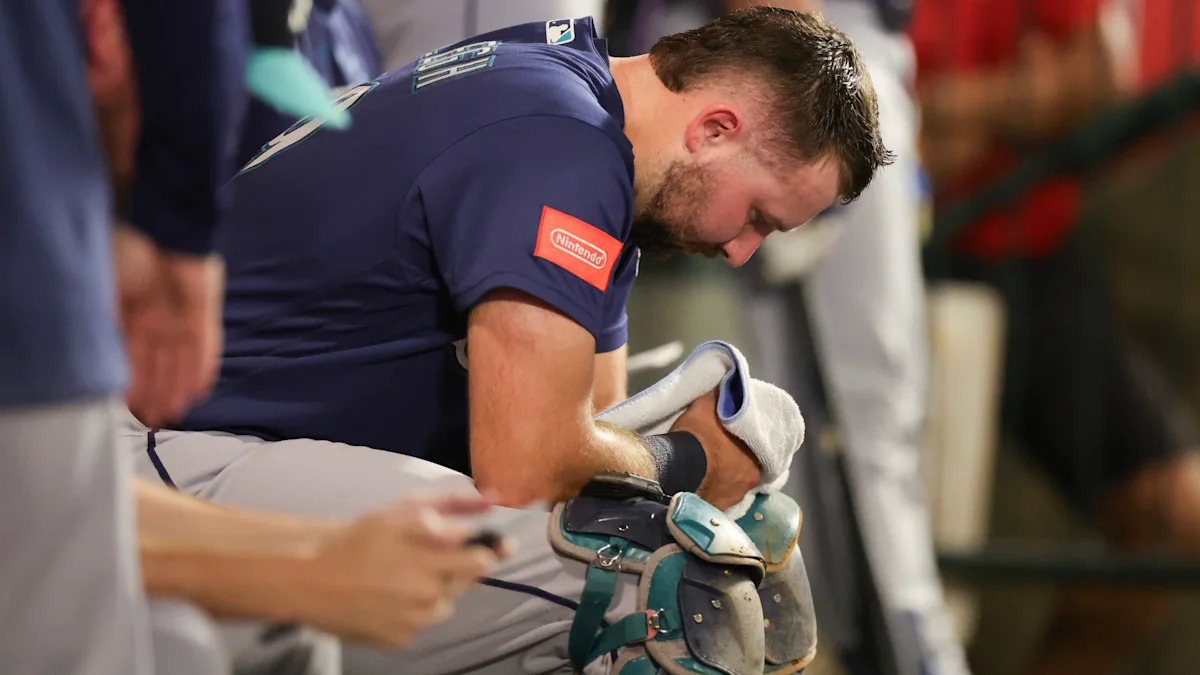
Just 11 months ago, the Seattle Mariners were on the doorstep of the franchise’s first World Series appearance. On Thursday, the Mariners were eliminated from playoff contention, the mathematical conclusion of a months-long march toward arguably the most disappointing finish for any MLB team in 2026.
Where to even begin? When a team triumphs, we hear refrains about how it takes everybody — from players to coaches to front office to ownership to behind-the-scenes personnel — to achieve something great. On the flip side, a letdown of this magnitude is also undoubtedly a group effort.
Advertisement
In 2026, catcher Cal Raleigh endured a historic regression from MVP candidate to a multi-month mega-slump that sank his season’s statline beyond repair. Without an offensive anchor, the Seattle lineup never found momentum, withering into one of the league’s weakest run-production outfits. A rotation that served as the backbone of the franchise’s success over the past half-decade failed to provide a sturdy foundation, and for the first time in years, the bullpen was downright bad. Amplifying the pitching staff’s shortcomings was a sloppy defense that ranked among MLB’s worst by every available metric. Manager Dan Wilson, coming off one of the most confounding and widely criticized managerial maneuvers in recent postseason memory, did little to inspire confidence with his demeanor or in-game management. Heck, even the ballpark’s newest statue celebrating franchise icon Ichiro Suzuki was dysfunctional.
It was a lot.
Subscribe to Yahoo! Sports MLB on YouTube for videos, podcasts and more
Advertisement
Last October, the Mariners sojourned deeper into the postseason than ever before. Seattle arrived in the playoffs as AL West champions for the first time since 2001. They toppled the Detroit Tigers in the division series, advancing on a walk-off single from Jorge Polanco in the 15th inning of Game 5. A week later, the home crowd at T-Mobile Park enjoyed another epic moment when fan favorite Eugenio Suárez smacked a dramatic, go-ahead grand slam in ALCS Game 5 against the Blue Jays, putting Seattle one win away from the World Series.
But back in Toronto, the Blue Jays took Game 6. And in Game 7, eight outs away from their first trip to the Fall Classic, the Mariners fumbled as they approached the goal line. A 3-1 lead turned into a 4-3 deficit when George Springer flipped the script with a seismic, seventh-inning swing. The Mariners were unable to respond, and the Blue Jays were American League champions. The Mariners’ wait persisted.
That Game 7 gut punch was a brutal blow for the organization. But once the sting of the loss subsided, it was clear the Mariners’ October showing signaled positive momentum, on which the front office looked to capitalize. They re-signed first baseman Josh Naylor to a five-year, $92.5 million deal, by far the most lucrative free-agent contract handed out since Jerry Dipoto took over baseball operations after the 2015 season. Seattle bolstered the bullpen with the acquisition of hard-throwing lefty José Ferrer. They added Rob Refsnyder, a right-handed bat with an impeccable track record of mashing left-handed pitching. And to punctuate their offseason, the Mariners swung a trade with St. Louis to acquire Brendan Donovan, whose defensive versatility and stellar on-base skills fit perfectly on both sides of the ball.
The solid upgrades to the strong foundation already intact earned the Mariners the unfamiliar status of bona fide championship contenders from the moment they arrived in Arizona for spring training. Projection systems and oddsmakers pegged them as favorites to repeat as AL West champs, with FanGraphs giving Seattle the second-best World Series odds, behind only the Dodgers. It was a rare position for the franchise, but given the personnel, it felt deserved. At that point, it was on the team to embrace the high expectations and make the most of the opportunity.
Instead, the vibes were off before Opening Day even arrived. In the World Baseball Classic in March, Team Mexico outfielder Randy Arozarena attempted to greet Team USA catcher Raleigh with a handshake before an at-bat and got snubbed by his Mariners teammate. Just like that, two of Seattle’s biggest names were making headlines for the wrong reasons. Raleigh was far from the only Team USA player to adopt an overly antagonistic attitude during the tournament, but his rejection of Arozarena attracted a wave of negative attention that felt foreign coming off a storybook 2025 that earned Raleigh the adoration and respect of both fans and fellow players.
Advertisement
Raleigh attempted to downplay the situation, but Arozarena was reportedly less forgiving. Still, it felt like a storyline that could’ve been laughed about in retrospect, had the Mariners played up to their potential. Instead, it became a strange cloud hanging over the first part of the season, all the more so as Arozarena surged to a career-best campaign while Raleigh slumped to an unthinkable degree. Of course, these were just two of the main characters in a comprehensive letdown involving so many others, but the moment made for an inauspicious start to the season.
Even so, it took a while for things to spiral beyond repair. For the first few months, several other teams with high hopes took turns in the spotlight as shamefully underperforming ballclubs. The Red Sox and Phillies fired their managers before the end of April. The Mets entered the season with the largest payroll in the league and played so poorly that they dismissed their skipper in June. The Tigers went 6-22 in May to doom their chances of chasing a World Series in Tarik Skubal’s final season before free agency. The same Blue Jays that toppled the Mariners in the ALCS haven’t been more than one game over .500 all season and will also miss October. (In case you’re wondering: The last time both teams from a championship series failed to qualify for the postseason the following year was 2008, when neither the Rockies nor the Diamondbacks returned to October after clashing in the 2007 NLCS. The last time both ALCS teams finished the following season with a losing record was 1987.)
But as this season wore on, Boston and Philadelphia were able to recover in time to secure postseason spots. The Tigers and Mets accepted their discouraging trajectories and offloaded major pieces at the trade deadline. The Mariners, meanwhile, treaded water in the mediocre American League (and even more mediocre AL West) for months before their fate started to crystallize.
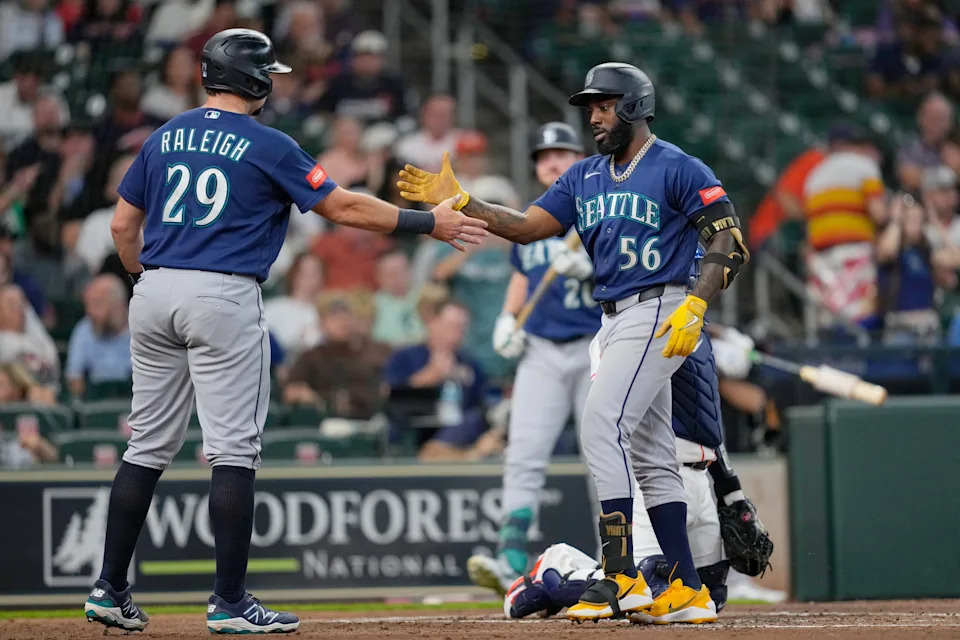
Cal Raleigh (L) and Randy Arozarena, seen here celebrating a Mariners home run, set a bizarre tone for the 2026 season with their non-handshake in the WBC.
(ASSOCIATED PRESS)
Even as Seattle clumsily managed its crowded starting staff by oscillating between a six-man rotation and a so-called “piggyback” strategy, the team enjoyed an eight-game winning streak as the calendar flipped from May to June. A victory in Baltimore on June 9 earned them a three-game cushion atop the AL West. The rest of the month was a bit bumpier, but on July 5, the Mariners were 47-44 and still alone in first. At that point, FanGraphs pegged Seattle’s chances of qualifying for October at 87.5%, with the third-highest World Series odds behind the Dodgers and Yankees.
Advertisement
This was remarkable considering how little they’d gotten from Raleigh, who missed a month due to an oblique strain that placed him on the IL for the first time in his career. And it wasn’t just the missed time; Raleigh was hitting shockingly poorly both before and after his absence. Last season, Raleigh entered the All-Star break as the starting catcher for the American League and one of the biggest stories in baseball, with 38 home runs and a 1.011 OPS. This July, the Midsummer Classic went on without him, as Raleigh hit only nine home runs in 65 games before the break, with a .581 OPS.
Seattle making it that far into the season with minimal contributions from its best player could’ve been viewed as an opportunity for the team to really heat up if and when Raleigh started to look more like himself. And Raleigh did eventually find his footing — he ranks top-10 in MLB in fWAR and wRC+ since Aug. 16 — but by the time the star catcher reemerged, it was far too late, and the Mariners were too far out of the race.
Besides, Raleigh wasn’t the only Mariner who notably underperformed at the plate. Julio Rodríguez, the other de facto face of the franchise, registered career lows in batting average, on-base percentage and slugging, making his latest power-speed milestone unusually unsatisfying. Naylor’s slugging output has lagged far behind almost every other every-day first baseman, and his overly aggressive approach with minimal pop — only three qualified hitters have seen fewer pitches per plate appearance — made him more of a rally-killer than a run-producer. Top prospect Colt Emerson looked overmatched in his first taste of the majors, posting a .246 OBP across 241 plate appearances before he was shut down due to a wrist injury that the 20-year-old belatedly admitted had been bothering him for a while.
Advertisement
Outside of Arozarena’s All-Star efforts and solid seasons from underrated slugger Dominic Canzone and 22-year-old second baseman Cole Young, silver linings in Seattle’s lineup have been tough to identify. Scoring has been a chore for much of the season, as evidenced by top-line markers (28th in runs per game, 29th in OPS) as well as more subtle indicators of offensive ineptitude. The Mariners rank 30th in doubles with just 199, which has them on pace for their fewest in a full season in franchise history.
The Mariners lost eight of 10 to finish July five games below .500. But because the AL standings were so unintimidating — and because there was so much invested in this season for Seattle — the team was a buyer at the trade deadline, adding outfielder Taylor Ward from Baltimore and reliever Seranthony Dominguez from Chicago. These additions, though, did little to alter the troubling trajectory. Ward promptly plummeted into the worst slump of his career — he has quite literally the worst batting average in the league since the deadline — and Dominguez has hardly solved the bullpen woes.
Seattle then lost seven of eight after the trade deadline, including getting swept at home by the Rays, a resounding demonstration of how far the Mariners had fallen from the upper class of the league. A late comeback in Houston on Aug. 14 dissolved into another walk-off defeat against an Astros team that had surged back into first. Four days later in Milwaukee, the Mariners lost 22-0, the most lopsided loss in franchise history. The lowlight of that embarrassing showing was a total brain fart from Rodríguez, who forgot how many outs there were while trailing by 19 runs and tossed the ball into the stands, assuming an eternal eighth inning had finally ended.
Advertisement
While that Rodríguez gaffe came long after the game had been decided, the 25-year-old has had a few other, far more costly miscues in the outfield, including a massive blunder in Boston a few weeks later while protecting a one-run, ninth-inning lead that eventually lead to — you guessed it — a walk-off loss. These were just a few snapshots in a season in which Rodríguez showed huge regression as a defender, grading out as below average by most metrics after his glove rated as one of the best at his position across his first four seasons. Rodríguez’s surprising step back contributed to a Mariners defense that not only ranks last in MLB in Outs Above Average by a wide margin but also currently has the lowest team OAA since Statcast began tracking the stat in 2016, at minus-56.
That porous defense did few favors for a pitching staff that struggled in its own right. Occasional gems from Seattle’s homegrown starters came here and there, but on the whole, the rotation was inconsistent, too often serving up backbreaking homers and struggling mightily away from pitcher-friendly T-Mobile Park. And on the rare occasion when the starting pitcher and offense combined to conjure a late lead, the bullpen — both ill-equipped and often mismanaged by Wilson — regularly bungled the later frames, amassing an agonizing collection of walk-off defeats.
All of these issues compounded in the second half: Seattle’s 5.15 ERA since the All-Star break is the fourth-highest mark in MLB behind only the A’s, Rockies and Reds, and the Mariners have allowed a jaw-dropping 101 homers across those 61 games — 13 more than the next-highest total (Colorado with 88).
In hindsight, an offseason that looked like a smash hit turned out to be a dud. Naylor took a sizable step in the wrong direction, making the four years and roughly $80 million remaining on his contract look rather onerous. Refsnyder was a disaster, hitting .140 across 114 at-bats before being released midseason. Donovan was reasonably productive when available, but injuries limited him to 39 games. Ferrer has been serviceable, but the hard-throwing lefty has not taken the step forward many hoped to see with his move from Washington to Seattle; his strikeout rate has actually dropped.
Advertisement
Add these disappointing additions to a group of holdovers who failed to elevate their games in arguably the most important season in recent Mariners history, and this team turned out to be not nearly good enough.
Since a series win over Toronto in early July, the Mariners are 27-40, the fourth-fewest wins in that span, ahead of only the Angels, A’s and Rockies. Still, that cohort of bad ballclubs represented one final safety net in the schedule for the Mariners as they stumbled into September while still holding on in the underwhelming AL West and wild-card races. Seventeen of Seattle’s final 22 games came against that aforementioned trio with the three worst records in the sport, offering the Mariners a final glimmer of hope.
But after Seattle played like a last-place team for much of July and August, it should’ve been no surprise that when those “favorable” matchups arrived, the Mariners slipped again. They dropped five of seven against the A’s and two of three in Anaheim, clinching the franchise’s first losing record since 2020. Another loss against the lowly Rockies followed this past weekend. And on Thursday, it was finally, officially over, as the Mariners were eliminated with the Rangers’ 79th victory of the season.
The Mariners were actually eliminated from wild-card contention on Sunday, but it took four more days for them to be eliminated in the AL West race. That is a product of Texas’ and Houston’s own poor showings atop the division. So if the totality of this Mariners team’s disappointment weren’t enough on its own, the fact that Seattle failed to take advantage of what could go down as the worst division in league history is the ultimate indictment of this catastrophe of a campaign.
Advertisement
This fall, the Mariners enter the offseason not with postseason heartbreak but with uncertainty all around.
How could one of the most promising seasons in franchise history disintegrate into such a disjointed mess? Can Raleigh and Rodriguez restore their status as unquestioned franchise cornerstones? Can the pitching staff regain its once-vaunted reputation? Wilson is reportedly not expected to return as manager, so who will be the skipper in 2027? Could there be more significant changes coming to the coaching staff? What should we make of Dipoto’s front office, which has seemingly built a strong foundation but has reached the postseason only twice since taking over more than a decade ago? And assuming Dipoto and general manager Justin Hollander stay put, what moves will they be able to make before the expected lockout begins Dec. 1?
Advertisement
At the outset of 2026, few franchises looked to be trending more positively than the Seattle Mariners. As the season comes to a close, few teams face a wider range of questions that need to be answered.