If you didn’t know any better, you might think Jacob Misiorowski was a baseball prodigy.
Over the past 12 months, the Milwaukee Brewers’ ace has had a meteoric rise, going from hard-throwing top prospect (and surprise All-Star addition) to arguably the best pitcher in baseball. This season, as we watch him light up radar guns with his 100-plus-mph fastball and dominate lineups across MLB, every start he makes seems to be more and more jaw-dropping. The man known around the sport as “The Miz,” already a two-time All-Star at age 24, is now a household name.
Advertisement
But Misiorowski’s ascent to baseball superstardom was far from a guarantee, and his road to becoming baseball’s most electric pitcher was anything but linear.
‘Like a baby giraffe’
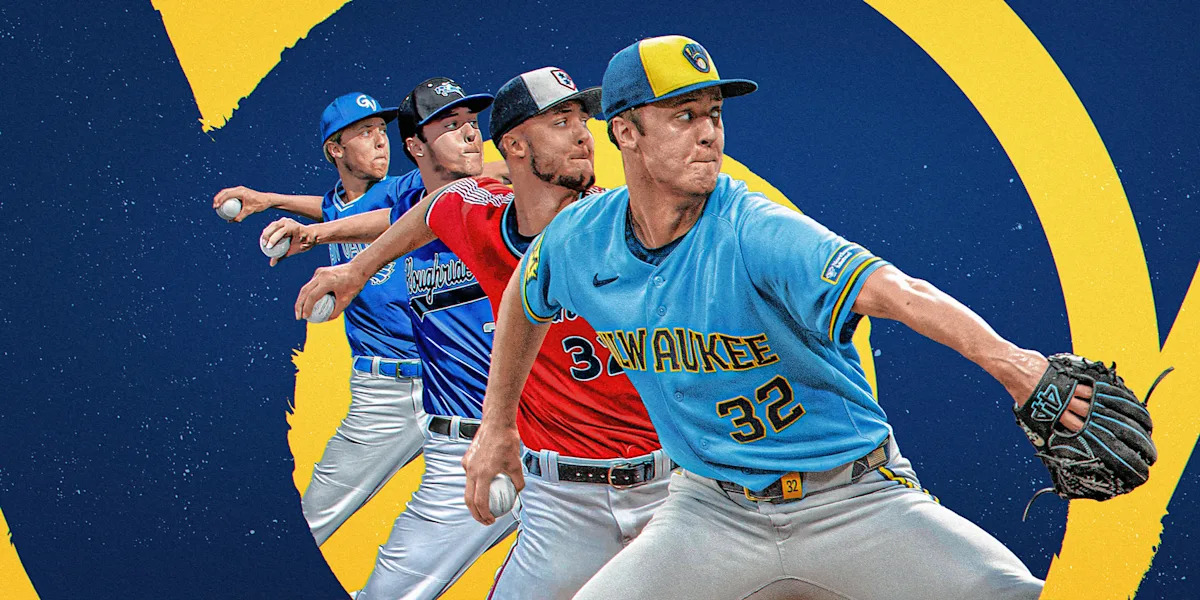
The journey began about 30 minutes outside of Kansas City, Missouri, at Grain Valley High School, where Misiorowski started to make a name for himself. Entering his freshman year, he was already generating interest from Division I programs such as Oklahoma State. Who was the lanky 14-year-old who would set the sport on fire a decade later?
“The best way for me to describe him would be like a baby giraffe,” said Brian Driskell, the head baseball coach at Grain Valley during Misiorowski’s time there. “He was about 6 feet tall, maybe 6-foot-1. Just long limbs and skinny. He played right field. He actually was a catcher growing up playing summer ball. … He still has one of the fastest exit velocities off of a tee that I’ve ever had in tryouts. Just an explosive athlete.”
Advertisement
A lean frame with such height would make most freshmen stand out, but for Misiorowski, it was more like a bonus. And while he was athletic enough to be a position player, it was clear that his future was as a pitcher. Because what he did when he took the mound for the freshman team at Grain Valley really made an impression.
“I remember him hitting 82 mph on the gun his freshman year, which, as a freshman, is probably within the top 5% of kids nationally,” Driskell said. “There’s a lot of varsity teams in our area that don’t have four or five kids in the whole program that throw 82 mph. So that definitely jumped, but he didn’t quite have a lot of location at the moment.”
The velocity was already an outlier for Misiorowski, but at that point, throwing strikes was a challenge.
“He pitched on the freshman team that year and had a lot of strikeouts and had a lot of walks,” Driskell said. “It was probably 50/50. The next year, that’s when he took a big jump.”
‘It was a decent growth spurt, for sure’
During Misiorowski’s sophomore season, the slender right-hander grew — a lot. As he did, he began to develop the traits that would soon make him a tantalizing draft prospect.
Advertisement
“I probably grew 5 inches, somewhere around there [between freshman and junior year],” Misiorowski told Yahoo Sports. “It was a decent growth spurt, for sure.”
Said Driskell: “I’ve got videos of him in high school throwing bullpens, and I built our mounds to be 7 feet in length, and he was stepping off the front of the mound. Half of his foot was on the ground instead of on the mound. It was such a unique experience.”
Importantly, Misiorowski’s growth spurt led to a big jump in his velocity. After he hit 82 mph his freshman year, his velo jumped 6 mph to sit around 88 his sophomore season. The following summer at the Junior Sun Belt Classic — an annual summer ball tournament that has featured several former and current big leaguers including Mookie Betts and Austin Riley — Misiorowski showed that he could be one of the best players in the nation.
“He had impressed me so much early on that I had really pushed to get him on the [Sun Belt Classic] roster, and that summer [he] hit 94, so that jumped off the page,” Driskell said. “… and he was still developing. He grew to around 6-foot-6, 6-foot-7 at that point, his velocity obviously jumped. And even then, he was still refining.”
Advertisement
As Misiorowski went from about 6-foot-1 to nearly 6-foot-7 by the end of his junior year, his body started doing things that other high school pitchers couldn’t do. His long arms gave him unique extension for his age and the ability to hide the baseball in his delivery, making him a difficult at-bat for hitters.
With that, he began to really take to pitching, and the results followed. Misiorowski dominated his junior year for Grain Valley, going 9-2 with a 1.48 ERA and 67 strikeouts in 47 innings, including two no-hitters. At the end of the season, he was named a Missouri Class 5 Second-Team All-State selection.
“I’d never seen anything like it to that point, and I haven’t seen anything like it since,” Brewers area scout Riley Bandelow said of Jacob Misiorowski.
(Taylor Wilhelm/Yahoo Sports)
‘This was MLB The Show create-a-player stuff’
By the summer of 2019, entering his senior year, Misiorowski was generating buzz. Known for his 6-7 frame and a fastball with velocity increasing almost by the day, he began to garner attention from scouts ahead of the 2020 MLB Draft, and one team in particular took interest.
Advertisement
Enter Milwaukee Brewers area scout Riley Bandelow and scouting supervisor Drew Anderson. That summer, Bandelow and Anderson were boots on the ground for Milwaukee in the Kansas City area. As they began to do their scouting report on Misiorowski, it didn’t take long for Bandelow to decide that this 17-year-old had something that couldn’t be ignored.
“I had heard the name, but I really didn’t know anything about Miz until his draft year,” Bandelow told Yahoo Sports of his first impression. “I still remember the first time I saw him pitch. It was my second year as an area scout, so I’m still figuring stuff out, getting my feet wet. But watching him pitch and watching him move on the mound, this was MLB The Show create-a-player stuff.
“The delivery was kind of funky. His arms and legs were all over the place, and it wasn’t the prettiest-looking thing. But when you saw him, especially from the open [third-base] side, the way his body just moved down the mound, the athleticism, the flexibility, the explosiveness and the power. Even though he was maybe a buck-60 at the time, I’d never seen anything like it to that point, and I haven’t seen anything like it since.”
While continuing to pitch for Grain Valley, Misiorowski appeared on the showcase circuit as the hype grew. The opportunities to pitch against better competition allowed him to be seen by more scouts and teams. Even with his top-tier traits, the young right-hander was extremely raw and wild compared to other draft-eligible players. That didn’t stop the Brewers from continuing their evaluations.
Advertisement
“You have all these notes from events you go to, and with Miz, he was always interesting,” Anderson said. “He got a little bit more interesting. There was always just, like, a steady climb.
“It was consistently 89-91. He would touch 92 or 93 with scattered commands. Still really long and wiry, kind of like he is now, but like a lot more long-range projection back then. There were a lot more concerns with strikes. There was a lot to like, but there were also a lot of concerns at that point about how far he probably had to go. But we loved the projection with him from the very first time.”
With his senior season on the horizon, Bandelow and Anderson knew there was a lot to like — and a lot of room for improvement. They had belief in the player and, the more they got to know him and his family, even stronger belief in the person. But what would happen over the next 24 months was anything but predictable.
‘It was more like competing with myself’
Misiorowski’s senior season was supposed to be spring 2020, but due to the coronavirus pandemic, that season was canceled. For Misiorowski, unable to pitch in games coming off a breakout junior year, that meant there was no way for him to continue to build his draft stock. Making matters worse, MLB cut the draft from 40 rounds to just five that year, giving fewer players than ever the opportunity to go pro and significantly decreasing his chances of being drafted.
Advertisement
Not pitching his senior year with so much momentum could’ve been devastating for a young player, but Misiorowski didn’t see it that way. Instead, he used the time to hone his craft.
“There was a lot more thinking personally about it,” he said. “When that 2020 season got canceled, the workload went way down. So it was honestly a time to recover. Looking back on it now, I’m happy for it. I got to really focus on little things on the mound instead of competing [against teams]. It was more like competing with myself.”
Misiorowski had originally committed to Oklahoma State, but after losing his senior season, he decommitted and chose to pitch at nearby Crowder College. The junior college in Neosho, Missouri, also produced his current Brewers teammate Aaron Ashby.
Then 18 years old, the 6-foot-7 right-hander went into his first season at Crowder College ready to compete and continue his transformation into one of the nation’s best arms. Instead, Misiorowski faced another setback when he tore his meniscus, forcing him to undergo surgery and miss his freshman season.
Advertisement
Two years without competing in games plus rehabbing a knee injury is a lot for a player to overcome — and a lot for a scout to overlook. But even as the setbacks mounted, Bandelow and Anderson maintained faith in their guy. Even so, with no recent track record to speak of, Misiorowski becoming a Brewer was far from a guarantee.
“I’m basically sitting there for two years saying this is the best kid,” Bandelow recalled. “I’m all-in on this kid and have nothing to really back it up with. So, it was more me and Drew just trying to, like, keep him alive in the organization.”
‘The velocity was always there’
Everything was at stake for Misiorowski going into his sophomore season at Crowder. Entering a new draft cycle in 2022, he had to prove that he could stay healthy coming off a serious injury. And he had to show that his elite traits would translate more than two years after he last pitched in a game.
Advertisement
Despite the setbacks and the extended time off, Misiorowski’s belief in his abilities was never shaken. In fact, he only grew more confident.
“Fall ball going into my sophomore year, I think it really helped,” he said. “That was the moment where I was like, ‘OK, I can do this. I’m doing it here, and I think I can do it at the next level.’ Obviously, the competition is maybe not as good [as other collegiate levels], but it still felt like I had a real chance at it.”
After building some momentum in the fall, Misiorowski started in the rotation for Crowder that spring. He made his first start against Johnson Community College on a cold February day, hitting about 92 mph, according to scouts in attendance. And while his 3 1/3 innings with seven strikeouts didn’t jump off the page, what he showed over the next month changed his trajectory forever.
“I remember Riley called me like a month later, and he’s like, ‘Hey, I just saw Miz again. He was 96 to 99 and touched 100,’ and I was like, ‘What?! No, he wasn’t. There’s no way,'” Anderson recalled. “I went to the very next start, and it happened to be Kansas City, and dude, when I tell you he was 96 to 99, touching 100 — like the whole game. I couldn’t believe it.”
Advertisement
Seemingly just like that, the lanky kid from Grain Valley, Missouri, was a flame-thrower and dominating. His sophomore season at Crowder, he went 10-0 with a 2.72 ERA and 136 strikeouts in 76 innings pitched, including an 18-strikeout performance.
“I think the velocity was always there,” Misiorowski told Yahoo Sports. “I was always touching mid-to-upper-90s in high school. But I think it was more just like controlling the velocity and being able to repeat it and not just be a one-and-done type of thing.”
As he hit his stride, Misiorowski’s outings started to draw crowds, and he earned a commitment to Division I powerhouse LSU. Perhaps more importantly, he was flying up draft boards as word spread.
“He flipped the switch,” Bandelow said. “He’s throwing 100 every game. And he rode that way the rest of the spring. From that point on, everyone knew about Miz, and you know, everyone came in to see him, from cross-checkers and national guys, scouting directors got in to see him leading up to the draft. Everybody.
Advertisement
“He just got so much better that year. He certainly rose up the rankings around baseball. Internally, Drew and I, we had him at the top of our list in 2019, 2020, 2021 and 2022. We just didn’t have anything to back it up until he got to pitch that year.”
‘A lot of people said, it just screams reliever’
Leading up to the draft, Misiorowski was a hot name, and the hype grew even more with his showing at the 2022 MLB Draft Combine, in which he threw the eight hardest pitches of any draft-eligible player.
With his name creating so much buzz, there was a good chance the Brewers weren’t the only team willing to take Misiorowski in the first two rounds, even with the bust risk inherent in his profile. But one key thing worked in Milwaukee’s favor: Most teams had the lanky flame-thrower pegged as a reliever, not as a starter.
Advertisement
“A lot of people said, it just screams reliever. He’s gonna throw enough strikes,” Anderson said of the chatter leading up to the draft. “But we always bought in, thinking this dude could be a frontline type of guy. … Teams that were on it were on it, but I would say three-quarters of teams weren’t.”
Finally, after more than three years of Anderson and Bandelow banging the table, the Brewers’ front office was sold, and Milwaukee drafted Misiorowski with the 63rd overall pick in the second round.
Once Misiorowski got to pro ball, it was time to see what his electric arm could do. And much like during his rise in the amateur ranks, the growth was incremental and methodical. But across four levels from 2023 to 2025, Misiorowski showed that his big-time fastball could dominate. Over that span, the right-hander struck out 320 batters in 233 2/3 minor-league innings with a 3.04 ERA.
On June 12, 2025, less than three years after he was drafted, “The Miz” made his major-league debut, throwing five no-hit innings and hitting 102.3 mph on the radar gun. In his second start, he threw six perfect innings. He finished the 2025 regular season with a 5-3 record, 4.36 ERA and 87 strikeouts in 66 innings pitched.
‘Your s***’s good enough to not have to nibble’
This year, Misiorowski has taken his game to yet another level, pitching like the best hurler in the sport. After his outing Tuesday, the Brewers’ ace is 10-4 with a 1.62 ERA and an MLB-leading 167 strikeouts in 111 innings. His elite velocity has reached new heights in 2026, hitting 105.5 mph, the fastest pitch by a starter since pitch tracking began in 2008. While Misiorowski still has a slender frame, the Brewers credit his efforts to gain strength in his lower half as the reason behind the jump.
Advertisement
Besides the eye-popping velocity, one of the most noticeable differences in Misiorowski’s game this year has been the reduction in walks allowed while he has continued to increase his strikeout rate. Walks had been a concern with Misiorowski since high school, and they were a red flag for some teams throughout his draft process. In his three seasons in the minors, he walked 140, something he and his coaches knew had to change in order for him to have big-league success.
This season, he seems to have figured that part out. With the All-Star break around the corner, he’s sporting a very respectable 6.8% walk rate to go with his ridiculous 39.3% strikeout rate, which leads baseball.
“I think the biggest thing this year has been aiming middle-middle,” Misiorowski said. “That sounds dumb, but when I first got up, I was like, ‘Oh, I have to aim at corners and nibble.’ But I had teammates tell me, ‘Hey, your s***’s good enough to not have to nibble. Go middle.’ And I trusted it.”
Perhaps the scariest thing for batters is that Misiorowski continues to show that he’s still adjusting and improving, just as he has done at every stop since the Brewers first laid eyes on him. It appears that the best is still to come.
Advertisement
“Credit to Riley for being able to stick with him for all three years,” Anderson said. “I think that that makes the story even better, knowing that it wasn’t like we just saw him throw 100 and we bought in. We were buying in when he was just learning how to pitch.
“Nine different people saw him in the organization before we drafted him, and to this day, I cannot think of a player in my 15 years of doing this where we covered someone that extensively. I’m really glad we did.”
‘A really nice kid that somehow throws 105’
Misiorowski has quickly become one of MLB’s top attractions, and he has gained popularity because of his dominance on the mound and status as the game’s hardest-throwing pitcher. But when you discuss the two-time All-Star with those around the Brewers, you’ll hear a slightly different story about the team’s young superstar.
Advertisement
“He’s just so wholesome,” Bandelow said. “He’s just a very real person. There’s no fluff about him. A really nice kid that somehow throws 105.”
Whether it’s his love of collecting Pokémon cards or his unfiltered excitement running off the mound following a big strikeout, Misiorowski’s personality has emerged along with his success and has helped endear him to fans in Milwaukee. As he cements himself as an engine behind the Brewers’ success, they have no problem letting him be himself.
“I think that he has an incredible ability to be competitive in the circle and between the lines,” Driskell said. “But I would tell people what you hear about him and what you see on TV is real. It’s been a pleasure to have gotten to watch these last few years.
“I think he can be a face of baseball that baseball can be really happy with.”