
A Justice Department lawyer’s response to the Statue of Liberty turned a ballroom brawl into a warning about how far the Trump administration believes it can reach into the judiciary.
Quick take
- The Justice Department told a federal appeals court that judges could not stop the White House ballroom project if the government acted quickly enough.[1][2]
- Judge Patricia Millett pressed Senior Assistant Attorney General Yaakov Roth for a hypothetical regarding the Statue of Liberty, and Roth responded, “Yes, I think that’s correct.” »[1]
- The panel’s questions showed obvious skepticism about the administration’s assertion that the alleged harm was not repairable.[1][2]
- The dispute now focuses on standing and appeal, not the assertion that the government has the legal authority to tear down monuments.[1][2]
Why the note is important
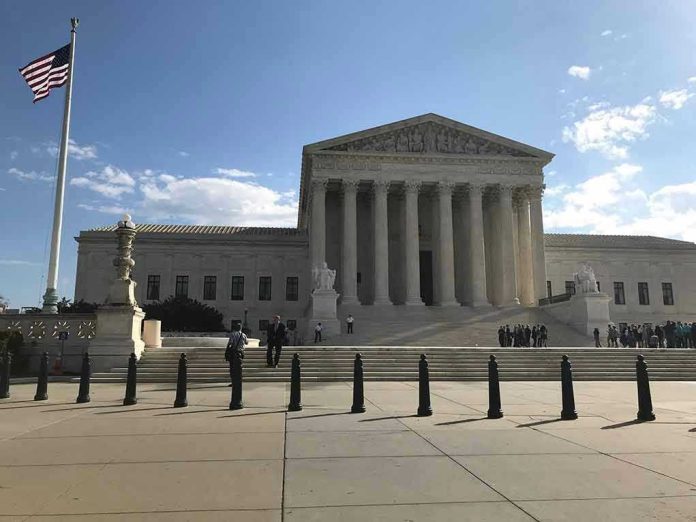
In oral argument before the U.S. Court of Appeals for the District of Columbia Circuit, Roth said the administration believed no court could stop the ballroom’s work and that the harm would become irreparable if the government acted too quickly.[1] When Millett brought up the example of the Statue of Liberty, Roth acknowledged that if the government acted fast enough, “nothing can be done.”[1] The exchange happened because it presented the case as a direct test of whether the courts can still provide a remedy after demolition begins.[1][2]
This is the central legal question behind this title. The Justice Department’s position, as noted, was not that the president has autonomous power to destroy national icons, but that once a project reaches a certain stage, legal remedies may no longer be available.[1][2] Politico reported that the appeals panel expressed doubt about the administration’s assertion that court intervention would be futile, suggesting that the justices were not prepared to accept that theory at face value.[2]
What the court was testing
The ballroom dispute reached the appeals court after a district judge had already ordered construction to stop, and the appeals panel then stayed that order so work could continue during the appeal.[1][2] This procedural history is important because it shows that the courts were actively involved in the dispute, even though the government argued that the case was too late for effective relief.[1][2] The result is a well-known public law battle over whether a court can still act after officials have already taken irreversible steps.[1][2]
For readers frustrated by government overreach, the broader concern is obvious: If the executive branch can act quickly enough to render a lawsuit moot, then legal boundaries become much harder to enforce in practice.[1][2] The reports available here do not include the full district court order or appellate briefs, so the precise doctrinal boundaries remain unclear.[1][2] What is clear is that the justices treated the administration’s request as questionable law, not established law.[1][2]
Why the story blew up
The Statue of Liberty line spread quickly because it turned a technical argument into a cultural flashpoint.[1][3] ABC News, Politico and other media outlets pointed out the same basic exchange: The government said the courts couldn’t stop the project, and the judge took that logic to the hypothetical extreme.[1][2] This is why the story resonates well beyond a simple legal conflict; it reflects a broader fear that bureaucratic or executive action could trump meaningful scrutiny.[1][2]
eee
Trump Could Also Tear Down Statue of Liberty, DOJ Says in Defense of White House Ballroom https://t.co/fVgQNADdUY .
–Bobby Coggins (@ThunderPig) June 6, 2026
The available material still leaves significant limitations. The sources do not provide a final substantive ruling on the legality of the ballroom project, nor do they provide the full transcript or briefing necessary to fully evaluate the issue of redressability.[1][2] Even so, public records show that a Justice Department lawyer conceded a surprising hypothesis while the justices expressed doubts, leaving the administration open to the charge of stretching the existing doctrine to its breaking point.[1][2]
Sources:
[1] Web – DOJ lawyer argues in court that Trump could tear down the Statue of Liberty…
[2] Web – DOJ says Trump could ‘destroy’ Statue of Liberty during white period…
[3] Web – Trump could also demolish the Statue of Liberty, DOJ suggests in…
Source link