With Yahoo Sports opening the 2026 College Fantasy Football last week, we assembled a team of 12 analysts from around the industry to conduct a Yahoo Standard 1QB League draft. In an effort to give you a variety of different perspectives, here is a collection of thoughts from the 12 experts regarding their draft strategy and roster construction. Here is a look at each’s team’s final roster.
Play Yahoo’s new College Fantasy Football game: Create or join a league now!
Advertisement
John Laub, Fantrax
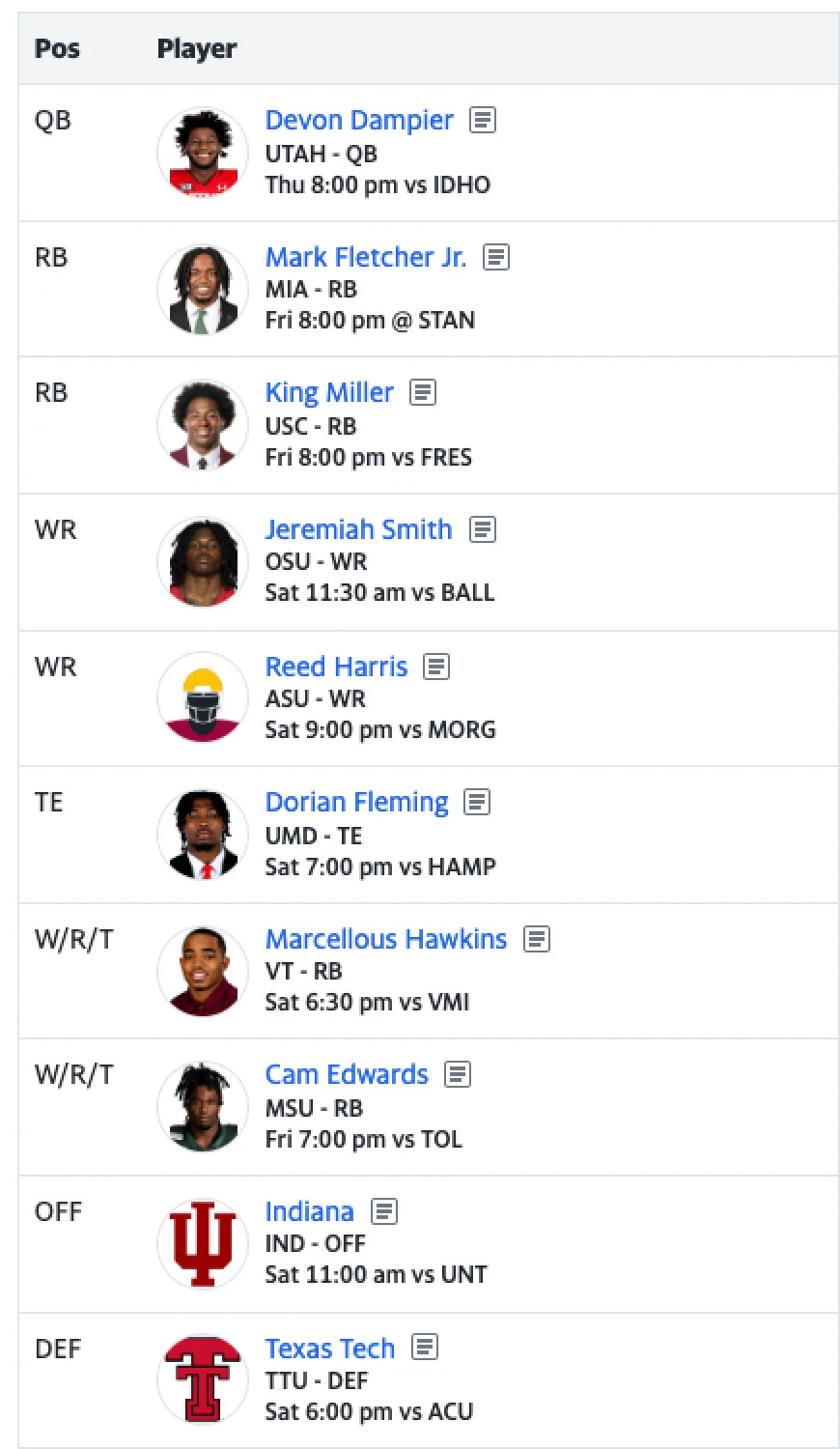
For the fourth time this year, I got the first overall pick, and in the previous three drafts, I selected Ohio State WR Jeremiah Smith twice. Once again, I opened by taking Smith and knew that I would need to play catch-up at running back throughout the draft. Watching runners fly off the board until my pick in the second round, I needed to pivot my strategy and wanted to acquire a top-five quarterback with high-end rushing ability. I was ecstatic when Utah dual-threat signal-caller Devon Dampier remained on the board, showing how adapting to draft flow can pay off.
Of course, I had to address my backfield and drafted Miami RB Mark Fletcher. Not settled with my runners, I selected three in a row—USC’s King Miller, Virginia Tech’s Marcellous Harkins and Michigan State’s Cam Edwards—to provide a sense of security. I couldn’t believe so many tight ends were coming off the board, so I grabbed Maryland’s Dorian Fleming illustrating how reacting to positional runs.
Advertisement
Starting lineup
CFF Lists
Our team assembly strategy focused on positional scarcity. With a deep QB pool, and only needing one starter, we waited until Round 11 for Maiava (and also managed Barnett as a bargain with our last pick). Conversely, a more shallow RB pool made them an early priority; so, we used our first back-to-back picks on Haynes and Williams and added Davison with our third pick. This allowed us to secure top-tier RBs (all in our top 11) before the talent dipped.
After securing our RBs, we drafted four consecutive WRs, landing three of our top 12. Finally, we targeted historically strong systems for our team offense and defense, selecting Tennessee and Clemson. This balanced approach maximized value across every starting slot while prioritizing the most competitive position groups.
Advertisement
G5 Hive
Yahoo CFF! Let’s go! I opened with a swerve nobody saw coming, taking quarterback Trinidad Chambliss in Round 2. With four-point passing touchdowns, mobile quarterbacks can rack up points. Looking back, though, I had some regret. Quarterback value kept sliding down the draft board, with players like Michael Hawkins Jr. still available in Round 16. In a 1QB league, I’d rather roster just two signal-callers and let the running backs headline the card, because that’s where the real value lives in a half-PPR format.
My late-round running backs are long-shot prospects like Lee Beebe Jr. and Lloyd Avant, each hoping for their breakout moment. If I got a chance to reboot this draft, I’d lean into a three-WR strategy while loading up on running backs in Rounds 1-4. By passing on the Round 2 quarterback and my Round 3 receiver, Wyatt Young, I could have gathered RB talent and still assembled a solid WR room like I did: Ryan Coleman-Williams (fifth), Dezmen Roebuck (eighth) and Evan Stewart (14th). This trio could emerge from the middle rounds and carry the roster all the way to the championship match.
If those three hit and the running backs carry the day, this roster could deliver a memorable season for years to come.
Half-point per reception rankings
Advertisement
PPR rankings
Steve Bulanda, RotoWire
Here’s my Yahoo draft writeup. Appreciate the invite!
I entered this draft knowing that I’d start by grabbing the top-two running backs available. I got the lucky draw of the 11th pick, which allowed me to get two potential league-winning workhorse backs before a tier drop.
Then the plan was to just go with the flow and get “My Guys” when it felt right. Especially when you’re slotted near the turn, you can’t get too hung up on ADP because you can’t predict if a player you are targeting will make it back to you. That led me to take guys like Arizona State RB Kyson Brown and SMU WR Yamir Knight, who we love at RotoWire, ahead of the market.
Advertisement
The biggest mystery to me was when everyone would start drafting Team Offense and Defense. I ended up being one of the last to fill those positions, which is fine because I’ll just stream based on matchups. Hello, Eastern Illinois and Tennessee State!
Chris Kay, Campus 2 Canton
With an early pick in the draft, I wanted to secure a top receiver and landed Malachi Toney with the 1.02. From there, running back was my focus as I knew running backs would go off the board quickly the first few rounds. Quarterback wasn’t of concern due to starting just one weekly and tight end was not worth targeting early with multiple flex spots. With this being a redraft league format, I had no issue taking riskier options with late picks. Daniel Hill, Luke Dehnicke, Duke Watson and Louis Brown IV are all guys I think could have a lot of value or could have none. I’ll use the first few weeks of the season to see their roles and ultimately drop them for surprise players on waivers at that time. The plan was executed flawlessly and Yahoo agrees with my A+ grade.
Advertisement
Josh Chevalier, Fantasy Points
My strategy in this draft was shaped heavily by Yahoo’s unique format. This is a 1-QB, P4-only league with four-point passing touchdowns and 0.5 PPR, which changes how I value positions considerably. I wanted to hammer RB early, where I believe the player pool gets thin much faster than WR or QB. That led to starting Kewan Lacy, Kendrick Raphael, Joe Jackson, Ahmad Hardy and Jamal Roberts before attacking WR depth throughout the middle rounds.
The biggest difference from traditional CFF was my willingness to punt QB. In a 1QB league with four-point passing TDs, I simply don’t see the need to pay the normal CFF premium at the position. Ironically, I didn’t even intend to take CJ Bailey in Round 8. My preferred approach was reflected by Bear Bachmeier in Round 12 and Darian Mensah in Round 16.
Overall, I wanted to invest in high-end RB production up front while trusting the depth at QB and value at WR throughout the draft.
Advertisement
Justin Leo, Volume Pigs
Surprise, surprise, I went with a RB-heavy strategy early on. Even more so than usual, P4 drafts further emphasize the need to secure that position early on, lest you be left wandering astray with a group of backs trapped in committee city as your key contributors.
I think by now, we all understand that there is a premium on this position, because an astounding 19 of the first 24(!) picks were spent on RBs. And 25 of the first 36 picks.
And you can just imagine the perverted smile that was perched on my face when I noticed Josh Chevalier (CFFGuys) had five-tapped RBs right off the bat. That’s gangster, and I’ve done it many times myself.
Advertisement
Personally, with what was left on the board by my fifth pick, I simply could not countenance selecting another back there, and opted for Louisville’s Tre Richardson. Of course, being the Godfather of the #VolumePig doctrine, I wasn’t happy about it. But if you’re going to hang with elite drafters, you must demonstrate the ability to adapt on the fly and take what the board gives you.
Final thought: I was plum chuffed to see Bothwell make it back to me there in the seventh round. These other drafters will rue the day they let Jeff Lebby’s 2026 bellcow fall in my lap, I tell you. Rue the day.
CFF Jacko
My draft strategy was to secure high-volume running backs early and then layer in upside throughout the roster. DeSean Bishop and Adam Mohammed gave me a strong foundation, while Nate Frazier, Reuben Owens and Savion Hiter added high ceiling at a position that dries up quickly in P4-only formats. At quarterback, I was content to wait for value and came away with several players who fell well beyond their FantasyPoints ADP, including Drew Mestemaker, Kevin Jennings and my boy, Bryce Underwood. At wide receiver and tight end, I targeted proven producers early with Cam Coleman and Trey’Dez Green, then “reached” for upside later with players whose stock has been rising during camp. Winston Watkins has been working with LSU’s top offense and drawing praise in fall camp. Drelon Miller is expected to have a significant role in Baylor’s passing attack and has generated positive camp buzz.
Advertisement
Mike Bainbridge, TheCFFSite.com
You won’t find a group as overly obsessive about the running back position than college fantasy football analysts. That should be the case, within reason, in a 1QB, 0.5 PPR scoring format, but this group takes it a step further with 20 running backs chosen in the first 30 selections. Whether that’s the optimal strategy will be determined this fall, but one takeaway is clear: when entering Yahoo CFF drafts this summer, plan on securing 2-3 running backs within the first several rounds or you’ll be dumpster diving at the position earlier than you’d like. The other extreme was how far quarterbacks slid as drafters continued to prioritize the skill positions. Potential top-10 fantasy QBs like Darian Mensah and Keelon Russell weren’t selected until Round 16 and beyond, creating great value for patient managers. Pair those discounted quarterbacks with a few savvy mid-round wide receivers from explosive offenses and you’ll be in excellent shape heading into September.
Eliot Mays, Fantasy Points
Drafting against some of the sharpest minds in college fantasy football, my strategy was straightforward: lock in running back talent early, as the talent pool drops off quickly in the P4 environment. Given the four-point passing touchdown scoring, I prioritized securing a top-tier, dual-threat quarterback on a competitive offense as my QB1. I was also willing to reach for my top-ranked tight end, as consistent production at that position can be a huge weekly differentiator, especially if they are utilized in scoring situations.
Advertisement
At wide receiver, I looked for value and avoided too many speculative picks in crowded situations, targeting offenses with high volume or concentrated target shares. I waited until the later rounds to draft my team defense and offense, as the scoring gap between top-five and top-15 units is minimal, making streaming based on weekly matchups a viable strategy. Looking back, my plan worked well, but in hindsight, I would have waited a couple more rounds to grab my first quarterback, using that earlier pick to further strengthen my running back room. Thank you to Eric Froton for putting it on, and more importantly, Yahoo, for bringing the game we all love to the masses!
Jared Palmgren, Campus2Canton.com
I just want to start off by saying how cool it is to have college fantasy on another major platform. Not only that, but with Yahoo keeping it to Power 4 only schools AND adding in Team Offenses, these drafts will have their own feel to them. I walked into the draft expecting things to go similar to other P4-only drafts, where quarterbacks go quickly due to the supply of them being cut short after a certain point. That did not happen. I wish I had waited on the position and let someone else start the run. It made me miss out on some early value at running back and put me in a tough spot at the position the rest of the draft. Last note, for Team Offenses and Defenses, once the first one goes in the draft, just hit both of those positions with your next two picks and just grab strong dependable teams. You’ll likely stream both at some point during the season, but having some consistency at the relatively unknown positions should help.
Eric Froton, Yahoo Sports
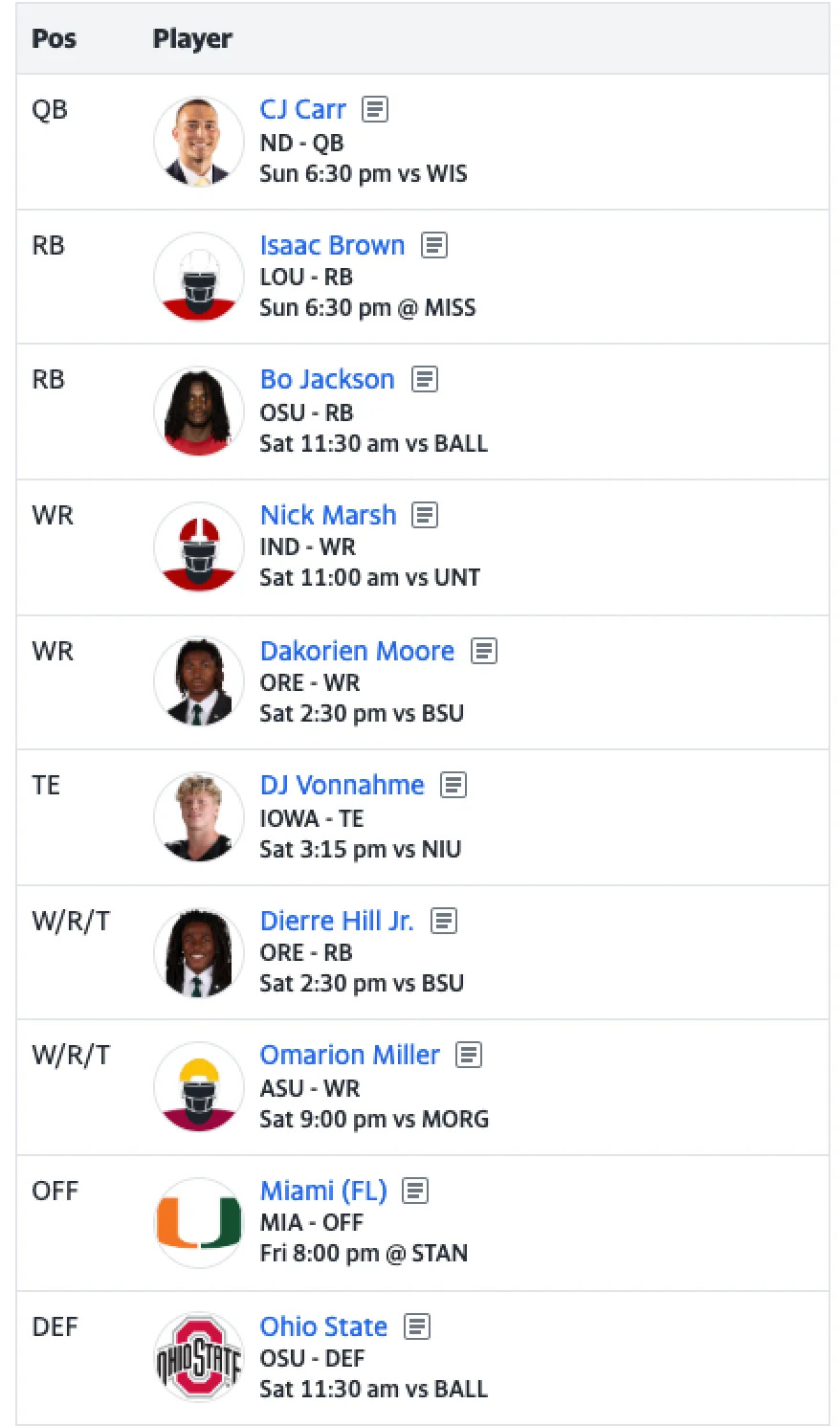
Locking down a good base of starting RBs was top of mind before swinging for the fences with Oregon sophomore sensation, Dierre Hill in Round 4. I locked down the Indiana and Virginia RB duos later on rather than throw darts at high-variance WRs. I couldn’t resist taking my WR3 Nick Marsh at 3.10 before rounding out a lean top-five WR build with a pair of rising playmakers in Chris Barnes and Dallas Wilson. Vonnahme is the only TE worth taking after the top-three, and you could argue he should be considered Elite. I was happy to get Notre Dame QB CJ Carr and Pitt QB Mason Heintschel in the late stages of the draft, while securing an alpha Offense/Defense tandem of Miami and Ohio State at reasonable cost. I should be able to stream a running-QB from the wire and be competitive with this balance, but RB-heavy, build.
Starting lineup