With the bulk of the 2026 NBA offseason’s player movement now concluded, and with the calendar now flipped to August, it’s time to start looking ahead to what’s coming next in the NBA, both this season and afterward.
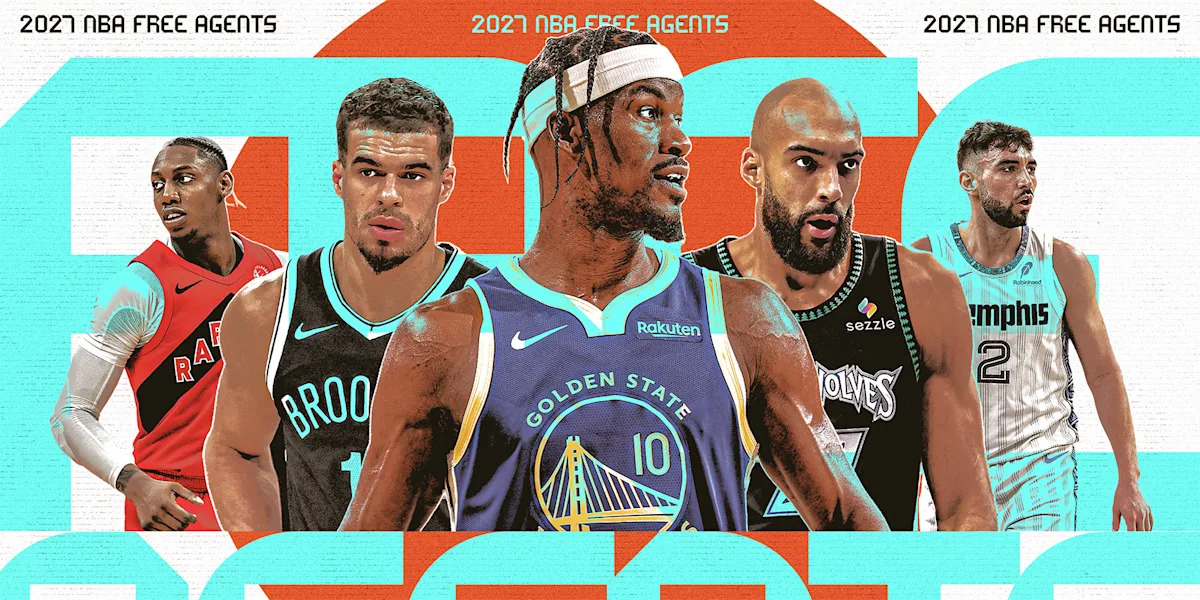
In that spirit, and in the interest of killing some time in the depths of the summer, let’s take a look at the five most interesting players — to me! — who could wind up on the open market next summer.
Advertisement
For the purposes of this exercise, I’m excluding players that I expect to sign extensions with their franchises when they become eligible to do so before hitting free agency (like Stephen Curry in Golden State later this month or Giannis Antetokounmpo in Miami in February) or whenever they decide it’s most contractually advantageous for them (like Nikola Jokić in Denver), and players whose whole deal currently feels up-in-the-air enough to make projecting what might be coming next for them something of a fool’s errand (like Kawhi Leonard in Los Angeles, Toronto or Parts Unknown).
We begin with the other perennial All-Star and All-NBA performer in the Bay Area:
When the Golden State Warriors open the 2026-27 NBA season, Butler will be 37 years old, with one season and $56.8 million remaining on the two-year extension that he signed with the Warriors after they dealt for him at the 2025 trade deadline. He will also most likely be in street clothes, continuing to rehabilitate his surgically repaired right knee; while he’s reportedly “turned the corner” in the process of coming back from a torn anterior cruciate ligament in January, we probably won’t see Jimmy back on the court until midseason at the earliest.
Advertisement
That would leave about half a season for a Warriors team that floundered after his injury, and that has essentially seemed to be killing time this summer, to make a case that there’s still something worth investing in when it comes to the graybeard core of Curry, Butler and Draymond Green. Since Butler’s arrival in February of 2025, the Warriors have gone 45-20 in games in which that trio has suited up — a 57-win pace across portions of two regular seasons and one postseason, which included a seven-game victory over a dogged Rockets squad in 2025’s opening round before Curry suffered a hamstring injury in Game 1 of the conference semifinals that effectively submarined their chances of further advancement.
In non-garbage-time minutes, the Warriors have outscored opponents by more than seven points per 100 possessions in Steph/Jimmy/Draymond floor time, by more than 10 points-per-100 when Curry and Green play without Butler or when Butler and Green play without Curry, and by more than nine points-per-100 when Jimmy flies solo without the Warriors’ longtime cornerstones. Butler’s presence unlocked Curry and elevated the Warriors; his absence, combined with myriad other injuries and inconsistencies, left Golden State relatively rudderless.
Amid a swirl of summertime speculation about whether the injured Butler’s expiring contract — acquired in exchange for Andrew Wiggins, who came from D’Angelo Russell, who came from Kevin Durant, in the grand transactional chain tethering Golden State’s dynastic days Warriors to the present day — might serve as ballast for Mike Dunleavy Jr.’s next big swing, the Warriors have held firm, insisting that what they want is to get Jimmy healthy and back on the court. What will they look like when he does return? More to the point: What will he look like?
According to Stathead, only six players in the NBA last season averaged at least 20 points, 5 rebounds and 4 assists per game while shooting 50% from the field: four former league MVPs (Jokić, Antetokounmpo, Durant and LeBron James), Alperen Şengün and Butler. At the time of his injury, Butler graded out as a top-15-to-20 player this past season according to advanced metrics like estimated plus-minus, LEBRON, DARKO, value over replacement player, player efficiency rating, win shares per 48 minutes, box plus-minus and regularized adjusted plus-minus. The Warriors were 12.5 points-per-100 better with him on the court than off it when he went down, according to Cleaning the Glass; among players who logged at least 1,100 minutes last season, only Jokić, Leonard and Victor Wembanyama had a larger on/off split.
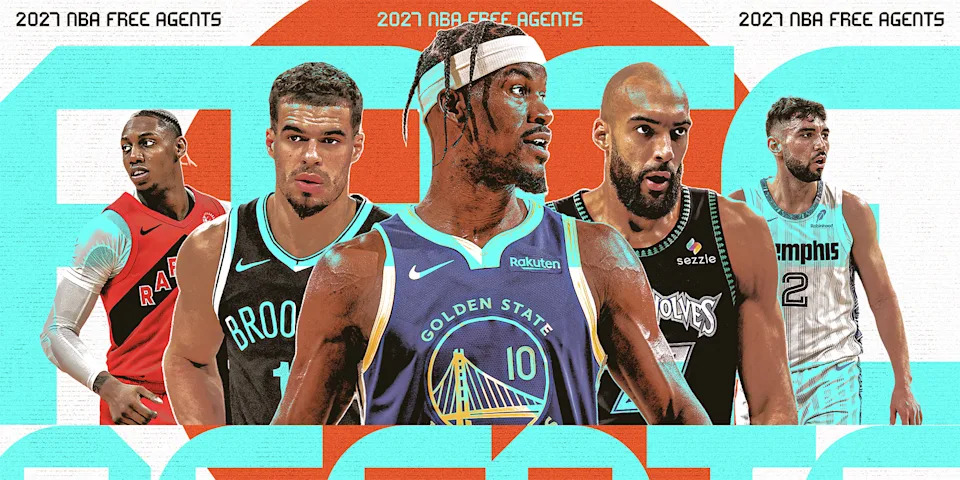
(Mallory Bielecki/Yahoo Sports Illustration)
It would be unreasonable to expect that Jimmy will take the court and immediately look like that. If he shows signs of it, though, will the Warriors — who are set to potentially have “between $50 million and $100 million in cap space,” according to ESPN’s Bobby Marks — commit to ponying up to keep him around in an attempt to give Steph (at least) one more honest shot? If not — if a Golden State braintrust seemingly keeping one eye on life after Steph prefers to let Butler’s next deal become someone else’s problem — well, what will the market look like for an about-to-turn 38-year-old a year removed from major knee surgery who has displayed what we’ll charitably call an interesting approach to conflict resolution at multiple past stops?
Advertisement
Different front offices will likely have differing opinions on whether what Butler provides at this stage in his career would be worth what he might cost, and whether the proverbial juice would be worth the squeeze for their respective organizations. In a world where legitimate game-changers rarely hit free agency, though, the prospect of adding a big-wing playmaker with a track record of raising teams’ floors and ceilings — and of being one of the best postseason performers of his generation — could be mighty enticing for would-be contenders looking for the missing piece that can tie everything together.
Especially considering, as he sees it, it doesn’t even really matter what the rest of the puzzle looks like. As Butler put it shortly after arriving in Golden State: “Honestly — in the most humble way possible — I’m a good fit everywhere.”
For a minute there, MPJ was one of the hottest names on the rumor mill ahead of February’s trade deadline, with a number of teams reportedly interested in the services of the high-scoring 6-foot-10 forward. No such deal materialized, though, and the eight-year veteran finished out his first season in Brooklyn as one of just seven players to average at least 20 points and seven rebounds per game with a true shooting percentage (which factors in 2-point, 3-point and free-throw accuracy) north of 59% — a list that included superstars like Jokić, Antetokounmpo, Wembanyama, Luka Dončić, Joel Embiid and Karl-Anthony Towns.
Entering the final season of the five-year maximum-salaried rookie-scale extension that he signed as a member of the Denver Nuggets back in 2021, Porter has maintained his interest in staying in Brooklyn, saying he’d like to stick around as part of what he believes can be an improved roster bolstered by the arrivals of multiple-time All-NBA forward Julius Randle and No. 6 overall pick Mikel Brown Jr. With Randle’s $35.8 million player option and the final year of Terance Mann’s deal representing the only significant salary obligations on the Nets’ books for 2027-28, they could certainly afford to keep MPJ.
Advertisement
If the two sides can’t find common ground on a long-term re-up, though, Porter would once again seem to be a player of interest for playoff hopefuls eager for an offensive jolt: a high-volume, high-accuracy, quick-trigger, extremely willing shooter who doesn’t need to dominate the ball to contribute on offense. Porter tied for 21st in the NBA in frontcourt touches per game last season, but tied for 152nd in total time of possession, 322nd in average seconds per touch, and 359th in average dribbles per touch, according to Second Spectrum tracking. A Nets offense that finished the season ranked dead last in offensive efficiency scored like a No. 20-ranked offense in MPJ’s minutes, despite a near total lack of other bankable offensive talent.
Players with Porter’s combination of size, shooting, rebounding and complementary off-ball game rarely hit the market in their primes. (He’ll be 29 at the start of 2027 free agency.) If he gets there, he could wind up being the belle of the ball in a free-agent class otherwise skewed toward older players who don’t provide the same kind of offensive zip.
To wit:
Gobert is scheduled to make $36.5 million next season and holds a $38 million player option for 2027-28, the final year of the $110 million extension he signed with the Timberwolves on the eve of the 2024-25 season. In that deal, Gobert — fresh off winning his fourth Defensive Player of the Year trophy and helping lead Minnesota to its first Western Conference finals in two decades — tore up a player option that would’ve paid him $47 million in favor of locking in more guaranteed money over a longer term.
Advertisement
That deal worked out well for the Wolves, who finished sixth in defensive efficiency in each of the two ensuing campaigns with Gobert manning the middle, and who won three more playoff series in that span — more than they’d won in the history of the franchise prior to the Frenchman’s arrival. It also worked out OK for Gobert, who’s earned $71.5 million over the last two seasons, who has continued to operate as one of the NBA’s premier rim protectors and rebounders … and who now finds himself even more central to Minnesota’s roster construction and hopes of contention than he was when Tim Connelly sent the moon and stars to Salt Lake City for him back in 2022.
The wheeling and dealing that brought LaMelo Ball to the Twin Cities to pair with Anthony Edwards in a supercharged backcourt also saw the Wolves bid farewell to both Julius Randle and Naz Reid. Those frontcourt stalwarts played a combined 10,674 minutes over the last two regular- and postseasons; the Wolves played a grand total of 198 non-garbage-time minutes without one or the other on the floor last season, according to PBP Stats.
After missing out on LeBron James, the Wolves’ best answers at power forward appear to be the 6-foot-6-and-under crew of Terrence Shannon Jr., Jaylen Clark and Josh Green, veteran journeyman Trey Lyles, and more frequently bumping small forward Jaden McDaniels up to the 4 — which head coach Chris Finch recently suggested would be more of an occasional off-speed pitch than an every-night fastball. In the absence of a more dependable and sizable option at the 4, and with Ball’s defensive work tending to skew more toward gambling for deflections and steals than locking up at the point of attack, having an elite mistake-eraser and glass-cleaner at the 5 seems more important than ever.
Advertisement
As excited as the Wolves appear to be about rising sophomore Joan Beringer, he’s still a 19-year-old with a grand total of 337 NBA minutes under his belt; it seems awfully optimistic to expect him to step into a primary role so soon, especially on a team that continues to harbor championship aspirations. That could lead to Gobert getting taken off the market by way of another extension like the one he signed in 2024, ripping up that $38 million player option in favor of another multi-year deal that guarantees more than twice that amount.
If not, though — if Gobert’s pick-and-roll chemistry with Ball doesn’t develop as quickly as anticipated, perhaps, or if Wolves brass decides that a team going all-in on the 25-and-under trio of Edwards, Ball and McDaniels can’t continue to devote more than 20% of the cap to a center entering his late-30s — then what sort of market might there be for the services of a player who just finished fourth in Defensive Player of the Year voting, made his ninth All-Defensive First Team, ranked fourth in offensive rebounding rate and eighth in defensive rebounding rate, and led the NBA in field goal percentage?
If the Wolves stall out shy of the Finals again, might Gobert decide to seek the answer to that question? And with the rest of its contending-hopeful young core — Edwards, Ball, McDaniels and the just-extended Ayo Dosunmu — all under contract through 2029, would Minnesota really want to chance letting him find out?
After arguably the best regular season of his NBA career — at or near career highs in 2-point accuracy, 3-point attempt rate, free-throw attempt rate, and a slew of all-in-one advanced impact metrics — Barrett stepped his game up even further when the Raptors made the postseason. The Mississauga product averaged 24-7-4 in Toronto’s seven-game first-round playoff slugfest with the Cleveland Cavaliers, shooting 48% from the floor and 39% from 3-point range, and hitting an iconic game-winner that helped the upstart Raps push the favored Cavs to the brink:
After Toronto fell short in Game 7, Barrett made his intentions clear: He wants to stick around for the long haul. With one year and $29.6 million remaining on the four-year, $107 million contract he signed with the New York Knicks in the summer of 2022, Barrett is eligible for an extension that could keep him with his hometown team for the foreseeable future. Given his production (one of just 18 players last season to average at least 19 points, 5 rebounds and 3 assists per game on above-league-average true shooting, a list laden with All-Stars), his age (he just turned 26), and his central role for a Raptors team coming off its first playoff appearance in four seasons, reaching such an agreement would seem like something of a no-brainer in a vacuum.
Advertisement
In the context of the Raptors’ roster build, though, the margins are a little tight. Scottie Barnes, Immanuel Quickley and Jakob Poeltl are set to combine to make more than 60% of the salary cap in 2027-28 and 2028-29. Stellar young defender Collin Murray-Boyles will be eligible for a rookie-scale extension between those seasons. And, of course, there’s The Whole Kawhi Thing hanging over not only the Raptors’ roster, but also its balance sheet.
The reported structure of the deal, with Leonard coming in while Brandon Ingram and Gradey Dick go out, would add about $3.2 million to the Raptors’ books for next season; with Toronto currently estimated to be about $3.5 million under the luxury tax, and with the franchise having not paid the luxury tax since Leonard’s previous one-year stay in Canada, every dollar counts there. (As Sportsnet’s Blake Murphy noted, Leonard’s 15% trade kicker bears watching on that front, too.) On top of that: By taking in more money than they send out in the deal, the Raptors will hard-cap themselves at the first apron, meaning they can’t spend a cent over $209 million next season, further restricting the Raptors’ ability to maneuver if they feel it necessary to try to make a tweak or two to a roster that they hope will be competing for a championship with Leonard back on board.
One potentially useful tool with which to make said tweak? A 26-year-old starting wing on a $29.6 million expiring contract — and one whom, according to Sportsnet’s Michael Grange, the Raptors “were very much open to trading in February.”
Advertisement
“The good thing is, he’s under contract,” Raptors general manager Bobby Webster told reporters during his end-of-season media availability when asked about extension talks with Barrett. “So that’s also something we can talk about at the end of next season.”
On one hand, delaying a new deal until after you’ve had the opportunity to see how this hopefully Kawhi-ified roster comes together and gauge whether Barrett might be more valuable as a trade chip than an every-night contributor makes sense. (Well, not quite every night; the former Duke standout has played fewer than 60 games in each of the last three seasons.) On the other, though, if the Raptors don’t find a trade they like, keep Barrett through the deadline and let things play out through the end of next season, they run the risk of Barrett turning in an even stronger campaign and putting himself in position to be an increasingly rare commodity on the unrestricted market: a 20-point-scoring wing who can play starter’s minutes and a significant role on a good defense, who’s proven he can perform in the playoffs, and who’s about to enter his prime.
I don’t blame you if you didn’t watch a second of Ty Jerome last season. By the time he actually made his debut after missing the first 46 games of the season with a right calf strain, the Memphis Grizzlies were already 10 games under .500, in 12th place in the West, mired in the morass of another injury-ravaged season and even more Ja Morant turmoil, and mere days away from trading cornerstone big man Jaren Jackson Jr. It’s understandable if you didn’t think there would be much to get excited about when you tuned into the Grizz.
Advertisement
And yet!
After returning to the floor in late January, Jerome was one of the most productive players in the entire NBA on a per-minute basis, averaging 19.7 points, 5.7 assists and 2.8 rebounds in just 22.7 minutes per game, while shooting 52% on 2-pointers, 42% on 3-pointers and 88% from the foul line. He did it cleanly, too, posting a 3.2-to-1 assist-to-turnover ratio, and while contributing to the chaos on the defensive end, snagging a steal on more than 2% of opponents’ offensive possessions and coming away with a block on more than 1% of their trips. The Grizzlies scored 8.3 more points per 100 possessions with Jerome on the floor than off it, according to Cleaning the Glass — the largest offensive on/off split on the team, and one of the largest of any player in the league.
The combination of high-volume scoring, high-efficiency shooting despite a sky-high usage rate and consistent turnover avoidance made Jerome something of an analytics marvel in his late-season surge. Among players who logged at least 300 minutes, Jerome finished seventh in the NBA in estimated plus-minus and box plus-minus, eighth in player efficiency rating, and either in or just outside the top 25 in win shares per 48 minutes, ESPN’s net points added per 100 possessions, and The BBall Index’s LEBRON.
Advertisement
That’s eye-popping stuff for a player who hasn’t exactly rubbed shoulders with the elite of the world for the bulk of his time as a professional. It’s worth noting, though, that last year’s 15-game explosion continued a sudden sharp spike in production that began one year earlier in Cleveland, when Jerome — finally healthy for a full season after a frustratingly injury-packed first five seasons of his career — broke out as an instant-offense maestro whose scoring and playmaking off the bench helped fuel the Cavaliers to a remarkable 64-win season that, like Jerome himself, few saw coming.
That stellar 2024-25 campaign earned Jerome a third-place finish in Sixth Man of the Year voting, and a three-year, $28 million contract with the Grizzlies. The final season of that pact is a player option, which means Jerome could re-enter the market next summer.
Jerome has played more than 50 games and 1,000 minutes just once in his seven-year career; another injury-plagued or curtailed season could see him just decide to pick up that $9.7 million player option and kick the can down the road. If Jerome stays healthy and balls out at anywhere near the clip he did last season, though — a level that Kostya Medvedovsky’s DARKO projections pegs as worth more than $32 million in on-court value, which would make him one of the biggest bargains in the sport — he could opt to bet on himself on the open market.
Advertisement
What would you offer an about-to-turn-30-year-old with a thick medical file and a spotty record of availability who’s also shown flashes of being able to produce on a per-possession basis like a downmarket Shai Gilgeous-Alexander or Luka Dončić? I don’t know, and I’m not sure many NBA teams do right now, either. But depending on how Jerome plays, and how often he plays, this season, we might be about to find out.
Other persons of interest: Tyler Herro, who seems like he’s either about to be the foundation of whatever comes next in Milwaukee or an intriguing transplant to a team that already has its identity set; Jalen Green, who’s both a career 20-point-per-game scorer and someone whose proper breakout we’re still waiting on entering Year 6; Donte DiVincenzo, whose Achilles rehab and midrange salary might make him an odd man out in Minnesota; Deuce McBride, who could wind up being the next key Knicks reserve squeezed out in service of avoiding the second apron; Fred VanVleet, whose return after missing all of last season with a torn ACL will be one of the biggest storylines to watch for a Rockets team with its sights set on contention.