

Kyle Bonagura

Multiple Authors
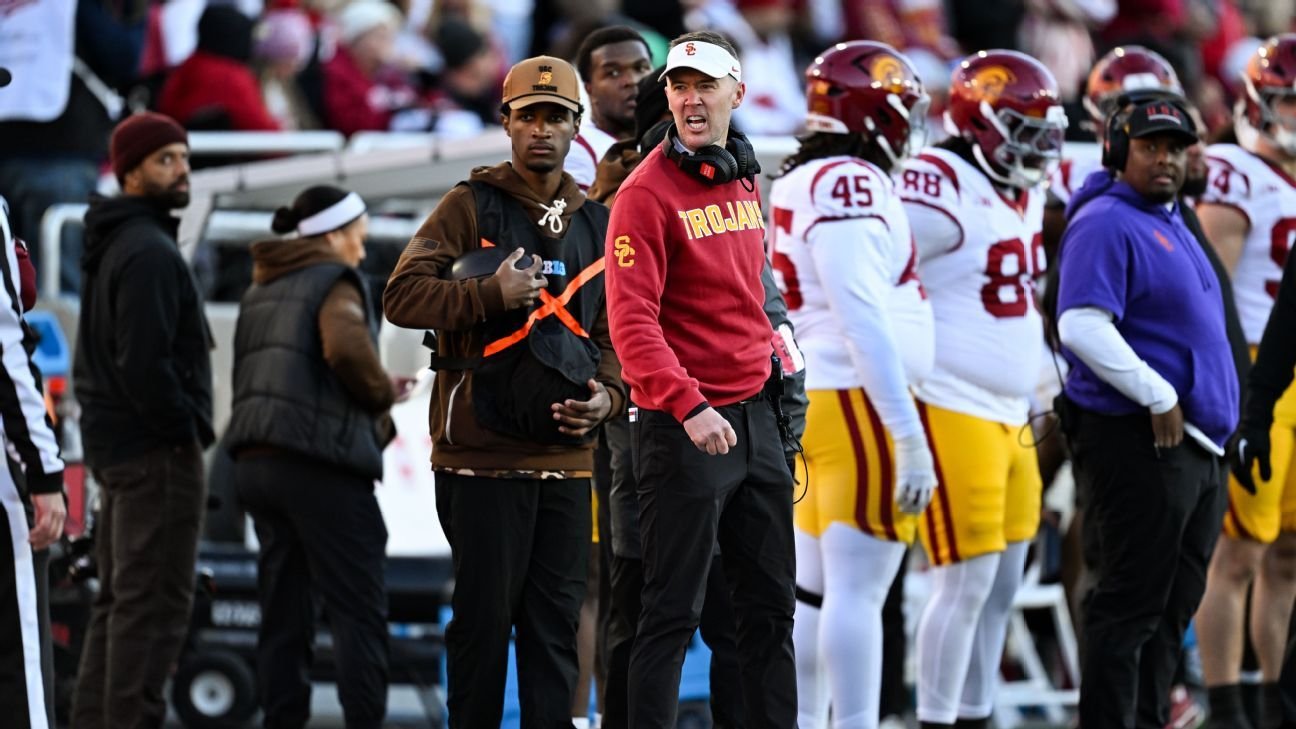
For a couple of weeks, it looked as if Lincoln Riley and USC might have turned the corner. Their win against then-No. 2 Ohio State on Halloween breathed new life into a season that was on life support and allowed for the possibility of the Trojans sneaking into the College Football Playoff.
But as quickly as the Trojans appeared on the cusp of being competitively relevant, they faded back into obscurity, losing 27-13 at No. 9 Indiana, all but ensuring they won’t be playing meaningful football in December.
This has been the Lincoln Riley experience in Los Angeles. They show up in fits and starts, dazzling with individual performances, but wilt before accomplishing anything meaningful.
In Year 5, Riley is 42-21, putting his winning percentage (66.6) only fractionally better than his predecessor, Clay Helton (65.7). Riley’s reported annual salary is more than $11 million, meaning he has been paid more than $50 million to oversee an extended period of stagnation.
Speaking after the loss to Indiana, Riley framed things differently.
“We’ve definitely come a long way as a program,” Riley said, “but we’ve still obviously got a little ways to go.”
A long way? USC might fall out of the CFP top 25 this week. The determination that this somehow represents progress is a curious calculation, especially because after last season, he said the program’s championship window was finally open.
“Honestly, now it’s just time to go do it,” he told ESPN’s Adam Rittenberg in the spring. “It’s time. The program’s ready for it.”
What’s especially damning about these comments is how disconnected they are from the reality of modern college football. The days of needing multiple seasons to build a championship-caliber program are over.
Asking USC fans to remain patient while Bob Chesney has UCLA undefeated in Year 1 almost comes off as insulting. Especially in the immediate wake of a loss to Indiana, which just won a national title in Curt Cignetti’s second season.
This is a cruel business. Had USC beaten Indiana, the Trojans would have remained in the playoff conversation, and the narrative surrounding Riley might have shifted dramatically. Instead, he’s squarely back on the hot seat after losing a road game in which USC was the underdog against the reigning national champions.
With a reported buyout that could exceed $70 million, though, he’s hardly a sympathetic figure.
The problem, of course, is that changing coaches doesn’t guarantee anything. Look at Michigan. The Wolverines turned to one of the most respected coaches in the business, Kyle Whittingham, and now — after a listless 31-7 loss to Oregon — will need to upset either UCLA or Ohio State to avoid a losing season.
Could Whittingham be one-and-done? It seems unlikely, but given the sharp decline, it’s a conversation that undoubtedly would be taking place if Michigan had a permanent athletic director.
While USC is grappling with a coach who has underachieved and Michigan is being forced to consider a quick hook, Clemson is facing a completely different dynamic. What happens when the coach responsible for the greatest era in program history is also the one overseeing its decline?
Clemson lost 20-6 to last-place Georgia Tech on Saturday, the Tigers’ second straight game without an offensive touchdown and their lowest-scoring performance at home since 2003.
Unlike Riley and Whittingham, Clemson’s Dabo Swinney has a vault full of goodwill. He has coached Clemson to four CFP national championship games, winning two. The idea that Clemson should move on from him seems incredibly unfair given everything he has accomplished. He set a standard that was essentially impossible to maintain and that ultimately has made back-to-back mediocre seasons qualify as failure.
For all the uncertainty surrounding these coaching situations and some others, Saturday didn’t offer much that changed the complexion of the season.
Most of the teams expected to win did exactly that. Georgia hammered Missouri, Alabama did enough to get past Vanderbilt and Texas survived a scare at LSU, as did Utah at Arizona. Kentucky’s loss to Florida was a notable exception, but for the most part, the teams in the playoff picture did little to change the conversation.
Jump to:
Vintage Pac-12 After Dark
A Sunday SEC showdown
Texas rallies vs. LSU
Rank Wake higher
UCLA’s turnaround
Closing bell

Vintage Pac-12 After Dark
The Utah Utes woke up in Salt Lake City on Saturday morning, flew to Arizona and escaped with one of the most thrilling victories of the college football season, beating Arizona 40-39.
Because of the FAA ground stop, Utah couldn’t get to Tucson on Friday as planned, forcing an unusual game day and a delayed start that resulted in the game kicking off at 8:30 p.m. local time. The logistical chaos was only the primer for how the game played out.
The game featured seven lead changes, with the final one coming on a 70-yard touchdown pass from Devon Dampier to Creed Whittemore with 2:35 left. That score came less than a minute after Arizona took a 39-33 lead.
1:11
Utah survives, takes down Arizona to remain undefeated
Instead, the Utes found another way to win, improving to 10-0 and extending the nation’s longest winning streak to 16 games. The victory also clinched Utah a place in the Big 12 title game because with only two games remaining in conference play — at TCU, West Virginia — they can finish no worse than tied with BYU for second place and hold the head-to-head tiebreaker.
In reality, the Utes probably have to win just one of their remaining two games to secure a place in the College Football Playoff. Life is good for first-year coach Morgan Scalley.
Oklahoma vs. Ole Miss
Amid Friday’s nationwide FAA ground stop that threw travel plans into chaos, credit goes to the teams and conferences that scrambled to find alternative arrangements and kept Saturday’s college football schedule largely intact. From lengthy bus rides to last-minute flight changes and delayed kickoffs, teams across the country found ways to adapt to an unprecedented logistical challenge.
And then there was Ole Miss.
1:51
The details behind Ole Miss-Oklahoma being moved to Sunday
Of all the teams impacted by the unprecedented disruption, the Rebels were the only ones unable to make arrangements to play Saturday. Instead, the SEC moved their game at Oklahoma to Sunday, a decision that understandably infuriated Sooners athletic director Roger Denny.
“I can’t wrap my mind around the fact that they can’t find a way to get here,” he said. “My concern is the level at which they were pushed to find a way to get here.”
It’s a fair line of thinking. Ole Miss explained that its charter crew ran into duty-time restrictions and that crew wouldn’t have been able to fly until Saturday afternoon “at the earliest.” No one is denying there were logistical challenges, but — to Denny’s point — it’s a bad look that even with all the money and influence in the SEC, Ole Miss was the only team unable to find a solution.
Ole Miss also said it determined it was too late to send its players on a bus trip of more than eight hours. Under normal circumstances, that would be a perfectly reasonable position. Nobody expects a major college football program to spend eight hours on a bus the night before a game.
But these weren’t normal circumstances.
Tulane, for example, was already on the runway when the ground stop went into effect. Rather than wait for another flight, the Green Wave loaded onto buses for a 5½-hour drive to Houston, where their game against Rice was pushed back a couple of hours.
The logistical challenge of moving a football game expected to draw more than 80,000 fans to a different day was exponentially greater than what Ole Miss faced in adjusting its travel plans. Instead of finding a way to get one team to Norman, the SEC chose a solution that inconvenienced tens of thousands of people, many of whom had made their own travel arrangements.
And it’s not hard to see why some might question Ole Miss’ eagerness to find an alternative. By moving the game to Sunday, the Rebels avoided an exhausting bus trip, will face a likely smaller and less imposing crowd, and have the luxury of an FCS opponent waiting next week, making the lost day of preparation and recovery less consequential.
None of that proves Ole Miss intentionally dragged its feet. But it does raise a fair question about whether the Rebels had much incentive to exhaust every possible option to play Saturday.
Texas comes back
Steve Sarkisian has long been considered one of college football’s premier offensive playcallers, but that reputation has been tested this season as quarterback Arch Manning has gone through some ups and downs.
But with No. 6 Texas’ playoff hopes potentially hanging in the balance Saturday at LSU, Sarkisian reminded everyone why he’s held in such high regard.
Trailing 22-16 in the final seconds, Sarkisian dialed up a brilliant play that sent Raleek Brown in motion before the snap. LSU struggled to recognize what was happening, allowing Brown to slip into open space for a 4-yard touchdown from Manning with three seconds left. It capped a comeback that erased an 11-point second-half deficit and kept the Longhorns on course for the playoff.
1:13
Texas pulls it out on Arch Manning’s late TD to Raleek Brown in Death Valley
The Longhorns have won four straight games to improve to 8-2, and with Arkansas and Texas A&M remaining in the regular season, a 10-2 record is well within reach. If that happens, Texas is a playoff lock.
Here’s a fun thought experiment: If Clemson or Florida State had Wake Forest’s same schedule and results this season, how differently would that résumé be evaluated?
Because it’s hard to imagine either program having to work as hard as Wake Forest to be taken seriously. The No. 13 Demon Deacons are the lowest-ranked one-loss team from a Power 4 conference and sit behind five teams with two losses.
Sure, the schedule hasn’t been the most demanding, and it’s reasonable to wonder how Wake Forest would fare against better competition. But the Deacs are doing exactly what a national championship-caliber team would be expected to do with that schedule.
Wake Forest went on the road Saturday and demolished No. 25 SMU 49-7, leading 42-0 at halftime. Over their past four games, the Deacs have outscored opponents 145-0 in the first half, the third-largest differential over a four-game stretch by any FBS team in the past 20 seasons, according to ESPN research. The last team to do better? Alabama in 2018, and the Tide went on to play for the national championship.
1:14
Wake Forest Demon Deacons vs. SMU Mustangs: Full Highlights
Over its past six games, Wake has outscored opponents 313-38, winning by at least 20 points in each game. It is also the first ACC team to score at least 40 points while allowing fewer than 10 in four straight games, something no FBS team had accomplished since Kansas State in 1998.
If a traditional power were putting up these numbers, the conversation would be about the height of its ceiling. Coach Jake Dickert assessed his team’s predicament well.
“People, they don’t know what to make of us because they don’t understand how we’re doing it,” he said. “We keep making statement after statement. Eventually, they’re going to have to say we’re a pretty good team.”
Wake has certainly exceeded most expectations, but this is not a team that came out of nowhere. Last year, Dickert’s first year in Winston-Salem, the team won nine games. But Wake didn’t get a vote in the preseason AP poll. With Georgia Tech and Duke remaining, Wake has an enviable path to the ACC championship game and the playoff.
Hopefully, the committee doesn’t let history get in the way.
UCLA’s epic turnaround
When UCLA announced that it was leaving the Pac-12 for the Big Ten, one of the prevailing thoughts was that the school was essentially punting on being competitive in football. The program, despite all its inherent advantages, had rarely been relevant over the previous three decades. The Bruins’ last outright conference title came in 1998, and in the 25 seasons that followed, they finished with a winning record in the Pac-12 just 10 times.
With that history, it would have taken a special shade of blue-colored glasses to conjure the optimism to expect improvement by joining a larger, deeper conference, even with the sizable increase in media revenue.
And yet, here we are.
The Bruins moved to 10-0 on Friday night with a 22-14 win against Illinois, UCLA’s first 10-0 start since that 1998 team coached by Bob Toledo and the third such start in program history. After winning just three games last year, UCLA’s seven-win improvement matches its best turnaround.
No matter what happens for the rest of the season, this will be remembered as a transformational campaign for UCLA. Coach Bob Chesney has been nothing short of brilliant in Year 1.
It would be easy to look at everything that comes next as a bonus. UCLA has already exceeded every reasonable expectation, and even if things go sideways from here, that won’t change.
But that shouldn’t be the mindset anymore. It’s time to get greedy.
The Bruins are thinking about winning the Big Ten. They should be thinking about competing for a national championship. In a season when there isn’t much separating the teams projected to make the playoff, why shouldn’t UCLA believe it can beat any of them?
The closing bell
Buy: Colorado
After starting the season 2-5, it was fair to question whether the end of the Deion Sanders experiment would soon be upon us. But after wins against Kansas State and Houston, the future doesn’t look as bleak. Colorado competed well against Utah and Texas Tech and now has a win against a ranked opponent. Colorado still isn’t expected to elevate to a level where it competes for conference titles, but the Buffs prevented a complete collapse. That’s something.
Sell: West Virginia
The Mountaineers needed a win against reeling Kansas to reach bowl-eligibility. Instead, they no-showed in a 37-14 loss and will now need to beat either Houston or Utah to reach six wins.
Sell: Cal
The comedy of errors that is the 2026 Cal football team delivered again against Virginia in a 36-7 loss, which was summed up with this disaster of a playcall and execution.
Brandyn Hillman with a 100-yard pick-6 🤯 https://t.co/wDlOeItBOG
— SportsCenter (@SportsCenter) November 14, 2026
Buy: Harvard
With its win over Penn, Harvard clinched at least a share of its fourth straight Ivy League title, becoming just the third program in conference history to accomplish the feat, while also securing an automatic bid to the FCS playoffs. The Crimson can claim their first outright conference title since 2014 with a win over Yale next Saturday at Fenway Park.
Buy: Fresno State’s fake field goal attempt
This was art.
0:32
Fresno State’s kicker finds the end zone on incredible fake FG
Sell: South Carolina
With a 6-3 record and one win against a ranked opponent, South Carolina was wildly overrated by the committee at No. 17. And it proved just that with a humiliating 34-6 loss to Arkansas, which came into the game just 1-5 in the SEC.
Buy: BYU
After a tough loss to Utah last week, No. 10 BYU bounced back with a solid performance in a 28-7 win against Baylor. If BYU beats Kansas and Cincinnati to finish the regular season, it should be playoff-bound. The Cougars might be better off missing the Big 12 title game if they finish 10-2 because a loss in the title game could drop them from a playoff position.
Buy: Oregon
We provided an obituary for Oregon a few weeks ago, and, all of a sudden, the Ducks are flying again. With wins against Michigan State and Washington to end the year, Oregon would finish 9-3, and considering it’s ranked No. 16, that should put it pretty close to the playoff cutoff line.
Sell: Postgame brawls
Louisville and North Carolina should be embarrassed by the brawl that marred the end of this boring game between two average teams.
1:22
Massive brawl unfolds at end of Louisville-UNC game
Buy: Boise State
The Broncos’ grasp on the Group of 6 playoff spot got even stronger with a thrilling 46-41 win against Oregon State. And coupled with New Mexico’s loss to UNLV, Boise State now stands without any peers.
Sell: Colorado State
Over the past 20 years, only two teams have allowed more points per game than Colorado State, which had allowed 47.6 points per game before Saturday’s game against Washington State. Against the Cougars, which were 1-8 and had yet to beat a FBS opponent, things got even worse as Washington State won 73-7. Jim Mora’s debut season in Fort Collins has been a disaster.
