The best time of the baseball year is finally here. The playoffs begin Tuesday, with a quadruple-header of wild-card games on tap.
Let’s break down how each team got here, how they can win, X-factors, series predictions and more before the wild-card round begins.
Advertisement
Subscribe to Yahoo! Sports MLB on YouTube for videos, podcasts and more
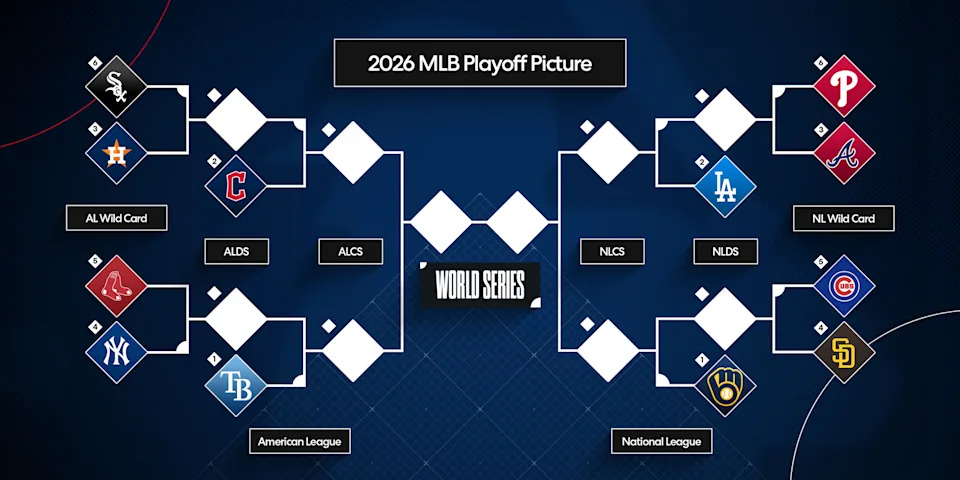
The MLB postseason begins Tuesday.
(Bruno Rouby/Yahoo Sports)
Projected starters
Game 1: Cristopher Sánchez (PHI) vs. Chris Sale (ATL)
Game 2: Jesús Luzardo (PHI) vs. Tyler Mahle (ATL)
Game 3: Aaron Nola (or Zack Wheeler on four days’ rest) (PHI) vs. Grant Holmes (ATL)
How they got here
Phillies: It was a Dr. Jekyll and Mr. Hyde type of season for the Phillies, to say the least. For the second time in five seasons, an in-season managerial firing was needed to light a fire under an underperforming veteran roster that appeared to be letting their window close. But the Phillies, like they’ve done before, found a way to get themselves going on the back of their starting rotation. The Phillies didn’t make it easy on themselves in the month of September, going 10-14 down the stretch and needing to win their regular-season finale against the Rays to punch their ticket to the postseason. But now that they’re in, this veteran group will look to show that they’re better than the past month suggests.
Advertisement
Braves: It was a reassuring year in Atlanta, a much-needed reminder that no, this era of Braves baseball was not over after their disastrous, postseason-less 2025. A change in manager, from the now-retired Brian Snitker to the endearingly pugnacious Walt Weiss, set the tone. As did a major refresh of Atlanta’s coaching staff. That turnover, in contrast with the continuity on the roster, proved crucial as Atlanta waltzed to its first division title since 2023.
Big campaigns from metronomic first baseman Matt Olson and 2025 NL Rookie of the Year Drake Baldwin shocked nobody. The same was true for ace Chris Sale, certain to be voted an NL Cy Young finalist. But few would’ve predicted Michael Harris II leading the team in bWAR with a dynamic, consistent offensive season. Role players such as Mauricio Dubón, Mike Yazstremski and Dominic Smith all delivered critical production to help offset underwhelming seasons from the likes of Ozzie Albies and Austin Riley.
Ronald Acuña Jr., that wonderfully mercurial burst of baseballing light, might’ve fit into that last group if not for an otherworldly September in which he clocked seven homers with a .950 OPS. That renaissance continuing into October would be a game-changer for the Braves, whose 2021 title came with Acuña sidelined.
X-factors
Phillies: Trea Turner
Advertisement
The regular season wasn’t kind to shortstop Trea Turner, who recorded the worst season of his career. But the thing about the postseason is that it allows players who have not yet written the final story on their season to become heroes. And if the Phillies want to move past Atlanta and reach the NLDS for the fifth straight year, Turner finding his rhythm would be a welcomed sight for the team’s offense. Turner has a .733 OPS off Sale in 25 career at-bats and a very respectable .863 OPS off Mahle in 25 career at-bats.
Braves: Tyler Mahle
Chris Sale is going to start Game 1 for Atlanta, and he’s probably going to be pretty good. That feels as bankable as anything in our topsy-turvy world. But Mahle, set to throw Game 2, has been one of the game’s most reliable starters since he joined the Braves from a zip-less San Francisco team at the deadline. The veteran righty posted a 1.99 ERA with Atlanta, allowing one earned or fewer in seven of his nine starts.
Advertisement
Mahle’s most recent start, however, was a relative stinker. He surrendered five runs and struck out just four at home against an undermanned Reds lineup. And the underlying metrics, it should be said, are a bit more skeptical about Mahle’s prospects. That’s understandable. He doesn’t throw that hard or strike out oodles of hitters. He hasn’t conjured more swing-and-miss or meaningfully lowered opponents’ hard-hit rate as a Brave. And yet, Mahle has found a way to find outs. Whether he can do so against Philly’s bats will be huge.
How they win
Phillies: Can any team in baseball go toe-to-toe with Philly’s starting rotation? With the quartet of Wheeler, Sanchez, Luzardo and Nola, the Phillies should have the advantage in a three-, five- or seven-game series. So while their offense is more of a wild card (pun intended), this team should be able to count on its starter giving them a chance to win every time out. And if that foursome gets hot, it’s not at all outlandish to believe they could carry Philly on another deep postseason run.
Braves: It has been a restful week for the Braves, who were able to sit back, relax and line up their starting rotation for this wild-card series. The same cannot be said for Philly, which needed every last out to clinch on the regular season’s final day. For the Phillies, the sense of exhaustion is real and gives Atlanta a legitimate advantage.
Advertisement
But it all starts with Sale. If he cruises like he’s capable of in Game 1, that puts Atlanta in the catbird seat. Only one team in the current playoff format (the 2025 Yankees) came back to win a wild-card series after losing the first game.
Series prediction: Braves in 3
No. 6 Chicago White Sox vs. No. 3 Houston Astros
Projected starters
Game 1: David Sandlin (CWS) vs. Peter Lambert (HOU)
Game 2: Sean Burke (CWS) vs. Hunter Brown (HOU)
Game 3: Davis Martin (CWS) vs. Hayden Wesneski (HOU)
How they got here
White Sox: The White Sox have been easily one of the best stories of the 2026 regular season, reaching the postseason for the first time since 2021. Chicago became the first team in MLB history to reach the postseason following three consecutive 100-loss seasons, capturing the third AL wild-card spot. It was the offense, led by first-time All-Stars Miguel Vargas and Munetaka Murakami, that was the driving force behind the Sox’s success, and they finished the season with a top-five offense in MLB.
Advertisement
The fact that the White Sox didn’t win the AL Central might come as a disappointment, considering they were in first place for the majority of the second half. Still, it’s undeniable that any result that puts them in the playoffs is a huge victory for the organization and a fan base that has been waiting for competitive baseball.
Astros: For a franchise that has accomplished so much over the past decade, there’s something shameful, even humiliating about raising the 2026 AL West banner. That’s because these Astros are, by record, the single worst division winner in the sport’s long past. Before Sunday, no team with a .500 record or below had ever reached the postseason. But Houston rewrote history thanks to an MVP-caliber season from Yordan Alvarez and a tidal wave of mediocrity from its AL West counterparts. Their inclusion in the October jamboree is more an indictment of the Texas Rangers and the Seattle Mariners than anything else, but the Astros at least ended on a high note with their 9-0 win over the A’s on Sunday.
Houston also deserves a morsel of credit for refurbishing its season after a disastrous April. Reaching .500 with the fourth-worst starting staff by ERA — only the Reds, A’s and Rockies were worse — is also an accomplishment worth commending, a testament to something. Where would this club be without Peter Lambert, whose 3.87 ERA in 153 2/3 innings offered the only semblance of stability for a roster constantly in flux?
Things got sad enough, discombobulated enough, that in August owner Jim Crane relieved GM Dana Brown of his duties. There’s an overwhelming expectation that skipper Joe Espada won’t be back next year, either. It’s difficult to be optimistic about Houston’s very uncertain future. But in the random present of playoff baseball, anything is possible — especially when you employ the best hitter on the planet.
Advertisement
X-factors
White Sox: Munetaka Murakami
Munetaka Murakami is a game-changer, and his presence in the White Sox’s lineup is a huge advantage in the postseason. The White Sox’s rookie slugger burst onto the scene in 2026, hitting 35 home runs and providing instant impact in his first season after coming over from Japan. But following a midseason hamstring injury, the league seemed to adjust to him; Murakami finished with a slashline of .184/.328/.423 and 11 homers since Aug 1. Still, he has the type of power that can change a series by himself, and with three homers in the final week of the season, he appears to be coming out of his second-half slump. If Murakami has rediscovered his power stroke, it could change this series.
Advertisement
Astros: Isaac Paredes
Yordan Alvarez is currently the best hitter on earth. He cannot, under any circumstances, be allowed to dictate proceedings during this series. Chicago must make somebody else in Houston’s mediocre lineup beat them. If there’s a base open with Alvarez up, he should just stroll straight to first every time.
That puts a mountain of pressure on Paredes. The stocky third baseman has been hitting right behind Alvarez for most of the season and has, for the most part, showed well. He’s a supremely weird hitter, one who rarely hits the ball hard or barrels it up. But Paredes doesn’t whiff, doesn’t punch out and has a preternatural knack for pulling the ball in the air. Expect him to come up multiple times in big spots with runners on.
Advertisement
How they win
White Sox: The White Sox’s offense has carried them all season, and if they hope to advance to the ALDS against their division rival, they’ll have to slug their way there. Vargas, Murakami and shortstop Colson Montgomery each finished the season with more than 30 longballs, and the Sox finished fifth in MLB in homers. For a team built to slug, Daikin Park in Houston isn’t the worst environment to play in on the road. Chicago’s power-packed lineup has shown that if they’re hitting the ball out of the ballpark, offensively, they can play with anyone.
Astros: Houston desperately needs offensive contributions from someone besides Alvarez. Maybe it’s the aforementioned Paredes or the en fuego Yainer Díaz. Perhaps Jose Altuve, 36 years old and in full decline, has one magical month left in his Hall of Fame career. But with such a tattered pitching staff, the Astros need to score to win. They also need to win the Hunter Brown start; he’s far and away their best starter. They need a lot, frankly. And yet, much weirder October things have happened inside that East Texas thunderdome over the past decade.
Series prediction: Astros in 3
No. 5 Boston Red Sox vs. No. 4 New York Yankees
Projected starters
Game 1: Payton Tolle or Sonny Gray (BOS) vs. Cam Schlittler or Max Fried (NYY)
Game 2: Payton Tolle or Sonny Gray (BOS) vs. Cam Schlittler or Max Fried (NYY)
Game 3: Ranger Suárez (BOS) vs. Gerrit Cole or Carlos Rodón (NYY)
Advertisement
How they got here
Red Sox: Odysseus would be proud. What a winding, bizarre and tumultuous road it has been for the Sox. Boston began the year like a snail on Unisom, posting a lackluster 9-17 record through April 24. That precipitated a dramatic, Red Wedding-style culling, in which manager Alex Cora and several other staff members were relieved of their duties. Extended injury list stints for the team’s two most important pieces, outfielder Roman Anthony and 2025 Cy Young runner-up Garrett Crochet, made a turnaround feel awfully unlikely. On July 24, the Sox lost a rubber match in Colorado and traveled home 14 games under .500. Their postseason odds wallowed around 10%.
Then, everything changed. It began with a home mop against the Yanks and fully kicked into gear when the Red Sox hit the road for a three-city swing the first week of July. They went 9-0 on that trip before winning six straight at home. That 15-game streak catapulted them back into contention and the good graces of an understandably unplugged fan base. Between July 3 and Aug. 7, the Sox went a ridiculous 32-5, trampolining from 14 games under .500 to 13 games over. Fenway was a zoo. Nothing could go wrong. Boston ballfans beamed once again.
The heater earned Cora’s replacement, Chad Tracy, the full-time gig. It also afforded the Sox a relatively comfortable September. It’s worth noting, though, that Boston has not played particularly crisply since cooling off from the volcanic run, with a 21-22 record since Aug. 8. Ultimately, their final numbers and standing in the American League are not shocking or unexpected, even though Boston’s odyssey was wonky beyond comparison.
Advertisement
Yankees: For all the stress, the drama, the hand-wringing, for all the injuries and under-performance, 2026 was a relatively straightforward season in YankeeLand. A lot, it should be said, went wrong. Reigning AL MVP Aaron Judge has played just seven games since May. Giancarlo Stanton hasn’t played since April. Max Fried and Carlos Rodón each missed about two months. Young players such as Anthony Volpe, Jasson Dominguez and Austin Wells regressed offensively. Gerrit Cole, coming back from Tommy John, didn’t fully recapture his frontline best.
And yet, here the Yankees are, with 93 wins and in an identical place to where they finished last year. That’s thanks to breakout campaigns from homegrown pieces such as Cam Schlittler (the AL Cy Young favorite) and Ben Rice (41 home runs and a .897 OPS). Closer David Bednar has been dynamite. Cody Bellinger has been a rock. Skipper Aaron Boone kept the train on the tracks. Three games at home against the Red Sox await. Beyond that looms an ALDS against a daunting division foe. We’ve been here before.
Advertisement
The largest difference, of course, is the uncertainty swirling around Judge. The Yankees’ captain missed three months due to a rib problem, came back for a week, strained his calf and went back on the shelf. Boone says he’s preparing for a wild-card round without Judge. Judge says he plans to play. What sort of magic this reduced version of Judge can conjure is easily the juiciest storyline ahead of this rivalry showdown. That said, this series, like this Yankees season, is probably going to be dictated by the pitchers.
X-factors
Red Sox: Roman Anthony
It has been an odd season for the 22-year-old, who missed last year’s wild-card festivities due to injury. In March, Anthony was a late addition to Team USA’s WBC roster. He shined on that grand stage, impressing his more established teammates and earning plaudits from a coaching staff of hardball lifers. That only ratcheted up the hype on a player expected to carry a franchise less than a year after he became legally permitted to drink a beer.
Advertisement
So when Anthony started slowly, disappointment bubbled. Then, on May 4, he tore a ligament in his finger; that kept him out of action until Aug. 30. A lot happened in the interim, most of which Anthony spent rehabbing at the team’s complex in Florida. Since returning, he has looked promising, tantalizingly close to unleashing the full assortment of his talents upon the league. Now, with Willson Contreras banged up and either unavailable or restricted, the pressure returns to Anthony’s young shoulders.
Yankees: Luis García Jr.
García was a curious character for the Yankees to shape their trade deadline around. Instead of acquiring a piece that filled an obvious void (righty stick with defensive value or versatility), GM Brian Cashman opted to add the most dynamic hitter possible. New York landed on García, who was in the midst of an offensive breakout under a new Washington Nationals regime.
Advertisement
For a month, that plan bore fruit, with the Dominican slugger posting an .846 OPS in August. But since then, the wheels have fallen off, with García’s chase rate skyrocketing. His September OPS started with a 5. He has homered just twice since Aug. 26. He doesn’t have an extra-base hit since Sept. 10. There’s a chance, given Boston’s bevy of southpaws and New York’s DH surplus, that he doesn’t start every game. But García will get his chances, and whether he comes up big might swing the series.
How they win
Red Sox: Boston’s pitching staff is the only one in baseball that ranks in the top five in both home run rate and walk rate. That’s a rare combo. Usually, throwing the ball in the strike zone more often leads to more hard contact. But these Red Sox hurlers, for whatever reason, have threaded that needle perfectly. No team in the league has allowed fewer homers. However, no team has hit more than the Yankees. Boston revitalized its season behind pitching and defense, keeping the scores low and the games close. Doing so here will give them the best chance of authoring an upset.
Yankees: No American League team can compete with New York’s starting staff. But the Yankees need more than dominance from Schlittler, Fried and whichever of Rodón or Cole starts Game 3. They need length. The bridge to Bednar is unsteady. So the longer the starters go, the rosier that path looks. Offensively, the Yankees need a big swing or two from their right-handed bats against Boston’s left-handed arms. That could come from a banged-up Judge or Stanton. It could come from veteran southpaw-killer Paul Goldschmidt, trade-acquisition Heliot Ramos or rookie shortstop George Lombard Jr. If it comes from the beleaguered Anthony Volpe, the tri-state area will lose its collective marbles. But somebody, anybody who stands on the right side of the batter’s box has to make an impact.
Advertisement
Series prediction: Yankees in 3
Projected starters
Game 1: Shota Imanaga (CHC) vs. Michael King (SD)
Game 2: Clay Holmes (CHC) vs. Nick Pivetta (SD)
Game 3: Matthew Boyd (CHC) vs. Walker Buehler or Casey Mize or Robbie Ray (SD)
How they got here
Cubs: It was Pete Crow-Armstrong’s world, and the rest of us just lived in it. Chicago’s 24-year-old center fielder went fully supersonic this year, cranking 45 homers, swiping 41 bags and delivering a .945 OPS with his typically elite outfield defense. He will win the NL MVP, and it might be unanimous. That performance shaped and guided and defined this Cubs’ season, electrifying an offense that led baseball in OPS, K/BB rate and runs per game.
Advertisement
Alex Bregman’s arrival via free agency, too, cannot be understated. He struggled mightily for the first few months, with his extended schneid at one point eliciting boos from a frustrated Wrigley crowd. But since July 12, Bregman leads all qualified National League hitters in OPS. His experience, comportment and leadership, by all accounts, have also had a meaningful impact on Crow-Armstrong.
But pitching woes, in both the rotation and the bullpen, kept Chicago from ever seriously threatening the Brewers for the NL Central title. The Cubs started the year on something of a roller coaster, with two 10-game winning streaks and a 10-game losing streak before the calendar flipped to June. They’ll enter October on something of an ice floe, with 15 runs scored in their final six contests.
Padres: San Diego has the best record in baseball since July 24. The day before, the Pads lost a rubber match in Atlanta to fall to three games under. 500. That pushed the club four games adrift of a wild-card spot, with the Cardinals, Pirates, Marlins, Nationals and Diamondbacks standing between them and a trip to October. That was the low-water mark for this team.
Since that date, the Padres have gone 41-18. They won five straight in late July, six straight in August and eight straight in September. They’ve lost thrice since Labor Day. The reason for the resurgence? Check out these numbers.
|
Padres offensive ranks before and after July 24 |
||
|
Before |
After |
|
|
Runs/game |
4.14 (25th) |
4.95 (3rd) |
|
AVG |
.230 (28th) |
.268 (2nd) |
|
OBP |
.307 (27th) |
.339 (2nd) |
|
SLG |
.383 (27th) |
.425 (2nd) |
|
OPS |
.689 (26th) |
.764 (2nd) |
San Diego’s offense went from bottom-five to top-five. Some of that is batted-ball luck and sequencing. A lot of it is Fernando Tatis Jr. turning back into a monster. Jackson Merrill had a similar rebirth. Ty France continued his bounce-back campaign. Xander Bogaerts shifted from unwatchable to capable. Unsung heroes such as Dustin Harris and Luis Rengifo got hot. The starting pitching did just enough. The game’s best bullpen never stopped dominating. It’s that unit, led by a cadre of flamethrowers in Mason Miller, Adrian Morejon and Bradgley Rodriguez, that makes these Padres a particularly formidable October opponent.
Advertisement
X-factors
Cubs: Alex Bregman — specifically, his face
One week ago, Bregman was the victim of some very painful misfortune. A check-swing foul ball off the bat of Cubs first baseman Michael Busch struck Bregman in the face while he was standing in the on-deck circle. Blood dripped from below his left eye as he scurried down the dugout steps into the clubhouse. A trip to the hospital revealed multiple facial fractures. The incident kept Bregman out of the lineup until Friday, when he went 0-for-4 with a strikeout as Chicago’s DH. He went 4-for-4 with two home runs and a walk in Sunday’s season finale.
Advertisement
There’s no doubt that Bregman, the textbook definition of a “grinder,” will take the field in October. But at what level? He has been so integral to Chicago’s lineup for the past few months that even a slightly reduced version of Bregman could unsettle things. Among active players, only his former Astros teammate Jose Altuve has taken more postseason plate appearances.
Padres: Fernando Tatis Jr.
Nothing is more meaningfully different about this year’s Padres team compared to the one that went three and see-ya at Wrigley in 2025 than Fernando Tatis Jr.’s stunning offensive reemergence. Things didn’t start so swimmingly this year for the swaggering outfielder, who needed 55 games to clock his first longball of this season. But since May 30, Tatis’ .914 OPS ranks fourth in the NL, and his 4.9 fWAR ranks second in MLB behind only Crow-Armstrong.
Advertisement
This version of Tatis looks a lot like the one who took the baseball world by storm en route to finishing third in NL MVP in 2021. Will that brilliance show up in a small October sample? It usually has throughout the 27-year-old’s career; he holds a 1.114 postseason OPS in 70 plate appearances. Tatis, though, has never advanced past the NLDS. Remember, he was in PED timeout when the Padres stampeded to the NLCS in 2022. Could this month be his path back to full-blown superstardom?
How they win
Cubs: The margins were razor thin when these teams lined up in the wild-card round last year, with a highlight reel of web gems from shortstop Dansby Swanson making the difference. Those games, oddly enough, were incredibly low-scoring, with Chicago snagging two 3-1 wins and San Diego edging out a 3-0 win. It’s hard to imagine the Cubs and their underwhelming relief group winning that way again, particularly on the road. To advance, they’ll need buckets of runs. With PCA, Bregman, Seiya Suzuki and Co., that’s a real possibility.
Padres: The Padres’ formula for success has been the same for the past few seasons: Shorten the game. San Diego realistically needs five innings from its starters. Then manager Craig Stammen gets to turn things over to the best relief core in baseball, led by southpaw Adrían Morejon and flamethrower Mason Miller. The Friars’ starting pitching has gotten stronger as they’ve gotten healthy, so if Michael King in Game 1 and likely Nick Pivetta in Game 2 can each give San Diego 15 outs, the Padres have a good chance of making quick work of Chicago.
Advertisement