
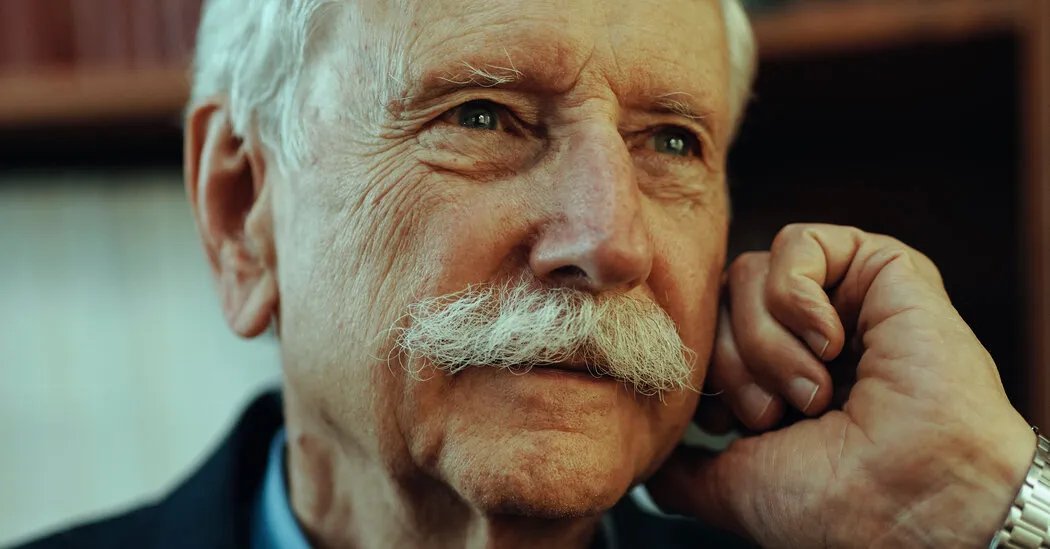
Walter Willett studies the link between diet and health, a high priority for Health Secretary Robert F. Kennedy Jr. His grants were frozen anyway.

Sheryl Gay Stolberg
Sheryl Gay Stolberg reports on the intersection of health policy and politics from Washington.
Walter Willett’s work has revolutionized diets around the globe.
His research led the United States and nearly 60 other countries to ban trans fats. He helped bust the myth that low-fat foods are always healthier; it’s the type of fat that matters. His advocacy for a “Mediterranean Diet Food Pyramid” changed the way that millions of Americans eat.
So when Health Secretary Robert F. Kennedy Jr. swept into power in the Trump administration vowing to tackle the connections between diet and disease, Dr. Willett, an internationally renowned nutrition scientist at Harvard, seemed poised to have a major influence.
Then, in May 2025, came an email from university administrators with a grim subject line: “Federal termination.”
The Trump administration, accusing Harvard of allowing antisemitism to flourish on campus, had frozen $2.2 billion in grants to the university, including two major grants awarded to Dr. Willett. After receiving National Institutes of Health funding for nearly half a century, Dr. Willett, 81, had become a casualty of policies that are upending the research system that made the United States a scientific superpower.
The $2 million to $3 million he received from the N.I.H. each year funded two massive studies tracking the eating habits of more than about 300,000 people over the past 50 years. He said his team of several dozen faculty members, data managers and research assistants supports scientists around the world.
The studies have produced findings on the role that diet plays in cancer, cardiovascular disease, diabetes and other chronic diseases, as well as findings on obesity and ultraprocessed foods — all topics of interest to the secretary.
“A staggering amount of what the world knows about diet and health is due to the work of Walter and his colleagues,” said Kelly Brownell, a professor emeritus of public policy at Duke University and the former director of its World Food Policy Center. “To pause that even for a second is a deplorable assault on the public good.”
The loss of funding threw Dr. Willett’s operation into chaos. He had freezers filled with blood and DNA from more than 150,000 study participants. He and his collaborators at academic medical centers cobbled together money from private foundations and a “bridge loan” from Harvard to keep the freezers running and continue the work. Some study participants donated money, he said. Still, they had to lay off five people.
That September, a federal judge restored the funds, five months after they were taken away. But the legal fight continues, and if Harvard loses, Dr. Willett could again lose his grants. The experienced researchers he let go have moved on to other jobs, he said, and he hasn’t hired new ones, because he can’t assure them job security.
“We are still in limbo,” Dr. Willett said.
As the Trump administration carried out its pressure campaign on universities, many institutions cut deals, paid fines or adapted their research strategies. Harvard was among those who fought back, saying that the administration’s demands — including insisting that Harvard hire an independent auditor to examine whether faculty and course offerings were “viewpoint diverse” — interfered with its academic freedom.
But as Dr. Willett’s experience demonstrates, even in victory, the damage can be hard to overcome. Some of the most groundbreaking research that the United States funds, including Dr. Willett’s studies, build knowledge over decades. Even a short interruption can put such work at risk.
“We are still standing,” Dr. Willett said. “But it makes long-term planning difficult. It makes hiring difficult, and we are losing people.”
In response to questions from The New York Times, Emily Hilliard, a spokeswoman for Mr. Kennedy, said that the N.I.H. is “under no obligation to fund the same researchers decade in and decade out.”
In an emailed statement she said, “Universities that accept taxpayer dollars must meet their civil-rights obligations and address antisemitic harassment when it violates federal law. No institution gets a pass because of its prestige or research record.”
Dr. Willett had an impressive resume — a medical degree from the University of Michigan, a master’s in public health from Harvard and a three-year teaching stint on the faculty of a medical school in Tanzania — when he returned to Harvard in 1977 to complete a doctorate in epidemiology. He was 32 at the time.
The previous year, a team of researchers there began a study of the health habits of 121,700 female nurses, with the goal of following them for years, even decades. The idea behind the landmark Nurses Health Study was that nurses, as health professionals, would be able to report information accurately. The nurses served as a proxy for the broader female population.
The study initially focused on oral contraceptives and cancer, but in 1980, Dr. Willett broadened the study to look at diet and disease. Dr. Willett later started a second study, following male health professionals. He has published more than 2,300 research papers and is widely regarded as the founding father of the field of nutritional epidemiology.
In a 1992 interview, Dr. Willett complained about the paucity of scientific data in nutrition: “Just for example, there are a lot of recommendations that we should eat fewer eggs,” he said then. “You would think there would be a handful of studies showing that people who ate more eggs have more heart attacks, but there aren’t any.”
His team did that work, and in 1999 reported that eating one egg a day was fine. In 2020, they updated their study and found that their initial findings still held.
“The epidemiological approach was the most exciting innovation in nutrition,” said Marion Nestle, one of the country’s foremost experts on nutrition policy. “These studies were absolutely invaluable because they followed people over time and could correlate their diets with the health outcome.”
Standard epidemiological studies show only correlation — not cause and effect — and Dr. Nestle said the data “aren’t perfect,” because in any study that relies on questionnaires, some people will invariably misreport their own behavior. But she said Dr. Willett’s research “indicated direction” that laid the groundwork for further studies, and turned up “correlations that nobody was expecting.”
Through those decades, the government supported Dr. Willet’s work handsomely. But from the very early days of the second Trump administration, things turned tumultuous. Elon Musk and his Department of Government Efficiency laid off and fired hundreds of federal workers. In the disarray, Dr. Willett couldn’t reach his N.I.H. “program officer,” who oversees his grants.
“We couldn’t communicate for a while there,” he said. “There were not people on the other end of the phone, and we had trouble finding out what was going on.”
In March 2025, the Trump administration notified Harvard it was reviewing $9 billion in federal grants and contracts to the university. In April, when Harvard refused to accede to its demands, the administration froze the $2.2 billion in funding. Harvard sued, and Dr. Willett submitted a declaration as part of a separate lawsuit filed by the American Association of University Professors on behalf of Harvard’s faculty.
That summer, the mild-mannered epidemiologist headlined a rally outside a Boston courthouse. Then in September came the decision to restore the funding, which the administration appealed. The administration also sued Harvard this year, accusing it of antisemitism in an effort to block its federal funding. A judge dismissed that lawsuit in August, but the administration has appealed that ruling, too.
Harvard is also fighting Mr. Trump’s decision last year to ban Harvard from hosting new international students on national security grounds. A federal judge struck down the ban, but an appeals court heard arguments in the case last month.
The administration is also seeking to limit the amount of time that international students can spend in the United States. Dr. Willett said two postdoctoral researchers in his lab, one from China and the other from Iran, fear they will have to leave before they finish their training.
Harvard’s president, Alan Garber, recently told a group of journalists that while he is concerned about scientists leaving the United States for other countries, “the real threat” is that the United States will no longer attract talented researchers from around the world.
Dr. Willett said that is already happening. One of his former postdoctoral researchers, went back to China, his home country, to Peking University.
“It was looking uncomfortable here, both from a funding standpoint and a visa standpoint,” Dr. Willett said, “and when you’re given a very, very outstanding position at the best university in China, how can you say no?”
Dr. Willett went to China in October to participate in a scientific meeting about healthy longevity, hosted by Tsinghua University, which has recruited Dr. Margaret Chan, a former director general of the World Health Organization, to lead a new School of Public Health.
While there, he said, he had to refrain from sharing unpublished research with Chinese researchers to comply with the government’s “export control” regulations, which pained him because sharing data “is the way science communicates.” He said Harvard has set up an office to “screen potential collaborations and communications,” and he is assiduous about following the guidance he receives from that office, as well as the Harvard president and his dean, partly because even a “minor violation can be weaponized against Harvard.”
Dr. Willett’s frustration with the administration was on full display in September when Calley Means, the architect of Mr. Kennedy’s Eat Real Food agenda, came to Harvard to discuss nutrition policy with Dr. Willett at a conference for journalists.
Dr. Willett’s research helped inform previous revisions of the federal government’s dietary guidelines. But he was not consulted when Mr. Kennedy updated the guidelines and turned the food pyramid on its head, putting red meat at the top.
Dr. Willet takes a dim view of the changes, which contradict his findings, including a landmark study showing that red meat is associated with a higher risk of colon cancer. He is also not a fan of Mr. Kennedy’s promotion of beef tallow, a rendered fat similar to lard. Dr. Willett says there is “not a single shred of evidence” that beef tallow is healthier than olive oil, a staple of the Mediterranean diet.
In the session with Mr. Means, he came out swinging. He said Mr. Kennedy’s team “threw out three years of very careful review of evidence and literature” that other experts had produced in preparation for the revisions, before Mr. Kennedy took office.
Mr. Means, who resigned abruptly last month, shot back that Mr. Kennedy and Mr. Trump rallied Americans around healthy eating in a way that Dr. Willett had not.
“We created a political movement using predominantly political issues that were on the left that Walter worked on for his entire life,” Mr. Means said, adding, “Because it’s partisan, you’re not joining hands with us, and I find that very sad.”
Even so, Mr. Means said he admired the longtime Harvard professor: “I want to be clear, I have so much respect for Walter. Truly, he’s impacted my life.”
