
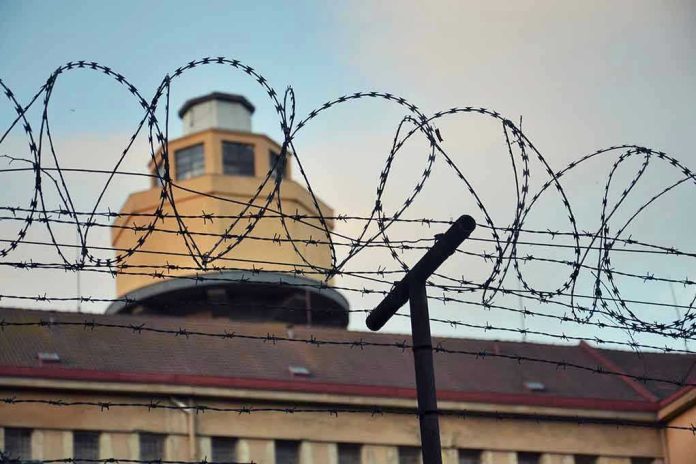
Alcatraz is back in Washington’s fiscal crosshairs, and the real fight is not over a prison, but over what America wants its most famous rock in the bay to symbolize.
Story Overview
- The White House budget request for fiscal year 2027 includes $152 million to begin reopening Alcatraz as a “state-of-the-art” federal prison.
- Alcatraz has been a major National Park Service tourist site since its prison closed in 1963, generating about $60 million a year.
- Trump first floated the idea in May 2025 and ordered federal law enforcement and corrections agencies to pursue it; senior officials later visited the island.
- Local California Democrats and Bay Area leaders have criticized the plan, calling it impractical and wasteful, while Congress holds final funding authority.
The $152 million question: Reopening Alcatraz starts as a budget line, not a plan
The Trump administration’s latest move puts a number on a long-held idea: $152 million to begin rebuilding Alcatraz into a modern federal prison for the “most ruthless and violent offenders.” The proposal is part of the FY 2027 budget released on April 3, 2026, which is important because budgets create momentum before Congress even votes. The trap is simple and decisive: the request finances a first chapter, and not the complete book, and the book could cost billions.
It is in this gap between the title and the concrete plan that skepticism grows. Reports cite widely varying estimates for the total project, ranging from hundreds of millions to more than $2 billion, and the administration has not set a clear timeline or final price tag. Fiscal conservatives generally read this as a warning label: “phase one” projects often become “phase one forever,” especially when technical challenges appear late and accountability never appears.
Alcatraz’s Inherent Problem: It Was Closed Because of Cost and Crumbling Concrete
Alcatraz operated as a federal penitentiary from 1934 to 1963, built to house inmates who were creating problems everywhere else. The legend remained: Al Capone, the cold water, the isolation, the unromantic reality of confinement. It also became expensive and physically worn, and contemporary estimates already at that time indicated millions of dollars needed for restoration alone. Reopening it now wouldn’t mean flipping a switch; it would mean building a modern facility on an old, hard and constrained footprint.
This footprint is not only small; it is surrounded by logistics. Everything comes in and out by boat. Each renovation must adhere to environmental regulations, historic site considerations, and basic structural limitations of an island facility that was never designed for modern systems. “State-of-the-art secure prison” sounds like steel and certainty. Engineering often looks like rebar, corrosion and bills. Americans who have seen the costs of public works projects skyrocket know the pattern: A romantic place never comes with a romantic purchase.
Tourism versus deterrence: the island is already making money without locking anyone up
Today, Alcatraz does not harbor criminals; it is home to tourists, and this tourism generates real income. Reports indicate that about $60 million a year is generated by the site under the National Park Service, making the island a rare government asset that behaves like a productive enterprise. Converting it back into a prison raises a direct question: Why sacrifice a functioning revenue engine for a facility that would require massive new spending and likely reduce public access?
Proponents of reopening may argue that public safety is not a profit center, and they are right in principle. Governments exist primarily to protect citizens, not to sell ferry tickets. Conservatives tend to respect this hierarchy. The problem is that budget calculations still matter and deterrence still requires credibility. If the plan turns into a multi-year construction saga with no operational results, taxpayers will bear the cost while crime policy will be reduced to tokenism – exactly the kind of governance voters say they’ve had enough of.
Politics in motion: Trump’s law-and-order signal meets California’s instant no
The timeline tells you that this proposal functions as much as a signal as a timetable. Trump publicly announced his intention in May 2025 and called on the Bureau of Prisons and other agencies to act; senior officials visited the site in July 2025; then the budget request came in April 2026. California Democrats responded with derision, calling it idiotic and wasteful. San Francisco leaders also questioned whether there was a “realistic plan” beyond a title that excites a national audience.
My reading, based on common sense and conservative priorities: the opposition’s best argument is not mockery, it is governance. If the administration wants new high-security capacity for the worst offenders, the proper approach is a costed plan with measurable results, not an iconic renovation with unknowns. Conservatives don’t shy away from controversial projects; they fear botches. Congress should demand specific details: the staffing model, transportation costs, legal constraints, construction phases, and what this prison accomplishes that existing facilities cannot accomplish.
Congress Holds the Keys: A Test of Spending Discipline and Public Safety Credibility
Congress decides whether Alcatraz becomes more than a talking point. The $152 million request forces lawmakers to choose between two competing narratives: salvaging a symbol of firm justice or protecting taxpayers from a potentially bottomless rebuild that displaces a functioning tourism asset. A serious oversight would consider both accounts incomplete without figures. A tough-on-crime policy that can’t survive a spreadsheet isn’t difficult; It’s theatrical. A budget hawk who ignores public safety isn’t serious either.
The smartest question to ask voters isn’t “Do you like Alcatraz as a prison?” » The question is: “What problem does this solve, at what cost and in what time frame?” » If the administration can clearly answer these three questions, the plan will gain legitimacy. If not, opponents will continue to win by default, not because they are compelling on public safety, but because the proposal seems like a very expensive way to make one’s point.
Alcatraz has always been bigger than its buildings: first a fortress, then a penitentiary, then a museum that seems like a reminder of an America that once believed that isolation could tame the worst impulses. This could now become a litmus test of whether “law and order” means results or relics. The island won’t vote, but Congress will – and the bill will tell the truth long before the first cell door slams.
Sources:
Trump asks Congress for $152 million to reopen Alcatraz as a federal prison – ABC30
Trump budget calls for $152 million to reopen Alcatraz as a prison – KTVU
Source link