

If you’ve come here seeking another gushing Sony WH-1000XM6 review, prepare to be disappointed. Make no mistake, Sony’s latest over-the-ear noise-canceling headphone is slightly better than its XM5 predecessor, which was slightly better (or slightly worse, depending on who you ask) than its XM4 predecessor — which was very good. The XM6 is also very good (though not without flaws), but it’s $450 and simply not worth it for most people. That’s right, I said it, and I’ll make my case below.
The exception: If you’re a tech-savvy audiophile with a budget that can accommodate these, I suspect you’ll love them — and invite you to read my esteemed colleague’s review over at Engadget for more on that perspective. My more “civilian” take is for people who merely enjoy music and wonder if fancy, high-falutin’ headphones are worth the splurge — and if state-of-the-art ANC (active noise-cancelling) can bathe them in total silence. Short answers: no and no. Here’s my Sony WH-1000XM6 review.
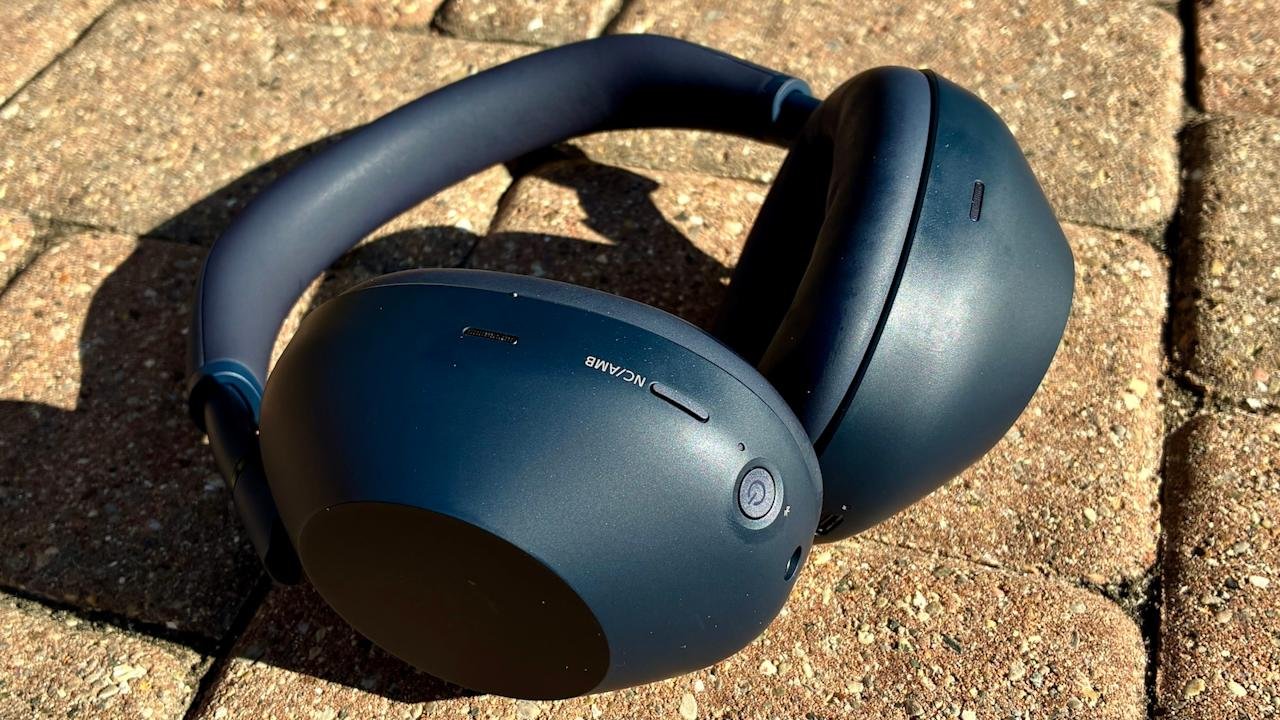
Rick Broida/Yahoo
VERDICT: Sony’s latest iteration of its popular headphone boasts a lot of sophisticated tech, but I didn’t find it demonstrably better than its predecessor. Instead, it’s priced $50 higher and still saddled with a poor companion app. It’s not the noise-canceling champ, either.
- Great overall sound
- Folding design
- Easy-to-use touch controls
- Lots of advanced features for those who want them
- Priced $50 higher than previous model
- No printed operating instructions
- Very little padding in the headband
- Some confusing operations/features
- Limited spatial-audio capabilities
Sony WH-1000XM6: Is it comfortable?
I don’t care how great a headphone sounds; if it’s uncomfortable, it’s not going on my head. Although the XM6’s earcups are cushy and pleasant about the ears, the headband has surprisingly little padding — especially compared with the XM5 and even Sony’s budget WH-CH720N. And although it’s also a little wider, which helps to “spread out” the contact with the top of your head, I think the lack of padding results in a little more pressure — not to the point of discomfort, but to the point of confusion: Why would a $450 headphone skimp out on this?
(I’ll admit to some bias here: As a general rule I find all over-the-ear headphones a bit uncomfortable, especially after extended wear. I can accommodate earbuds much more comfortably, for much longer periods. Your mileage may vary.)
Interestingly, in crafting the XM6, Sony returned to the hinged, folding design of the XM4 — ostensibly to address complaints with the non-folding XM5. But what was gained by the change? The XM6’s hard-sided carrying case is only a hair smaller than the XM5’s, so it doesn’t save any real space in your bag. I guess the upside is that now you have a choice: The XM5 is still available for purchase (and often at a discount).
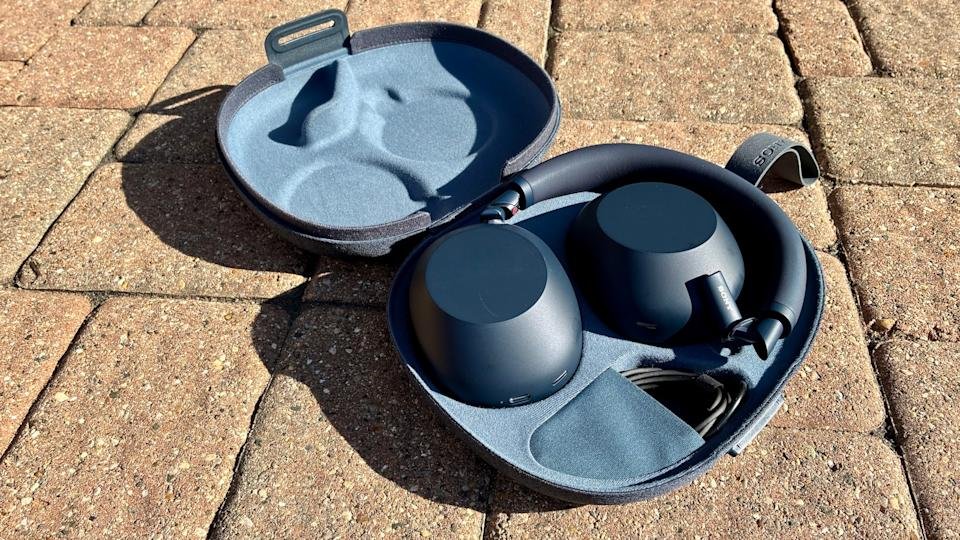
Unlike the XM5 (but like the XM4), the XM6 has a folding design. But it really doesn’t net you much in terms of portability. I do like the case’s magnetic clasp, though — much better than a zipper. (Rick Broida/Yahoo)
Sony WH-1000XM6: Is it easy to set up and use?
In a word: no. The user experience here is mediocre at best, especially if you’re someone who struggles with technology. Sony provides no useful printed instructions, just a link to an online manual (which you can also access by scanning a QR code). That manual, a PDF, is too small to read comfortably on a phone — and it spans 145 pages. Do you really want to invest that kind of time learning to use a pair of headphones? I don’t.
Granted, you don’t need to study and master every single feature. Surely it can’t be difficult or time-consuming just to pair and start using the XM6? Well… On my iPhone 16e, I experienced the same mystifying setup hiccup as with other Sony audio products I’ve tested: Within the Sound Connect app, it took well over a minute for the headphones to appear. Thankfully, there’s now a warning that it might take this long, but why does that even happen? Most Bluetooth products are detected within seconds. This inexplicable delay makes you think something isn’t working.
With that initial step done, however, you can indeed start enjoying your tunes. The XM6’s physical controls are simple enough: double-tap the right earcup to play/pause; swipe up or down to raise or lower volume, forward or back to skip or repeat tracks. (You can disable these controls if you like, but you can’t modify them. That’s unfortunate, because I’d really like some way to quickly switch between the three listening modes, without having to use the app.)
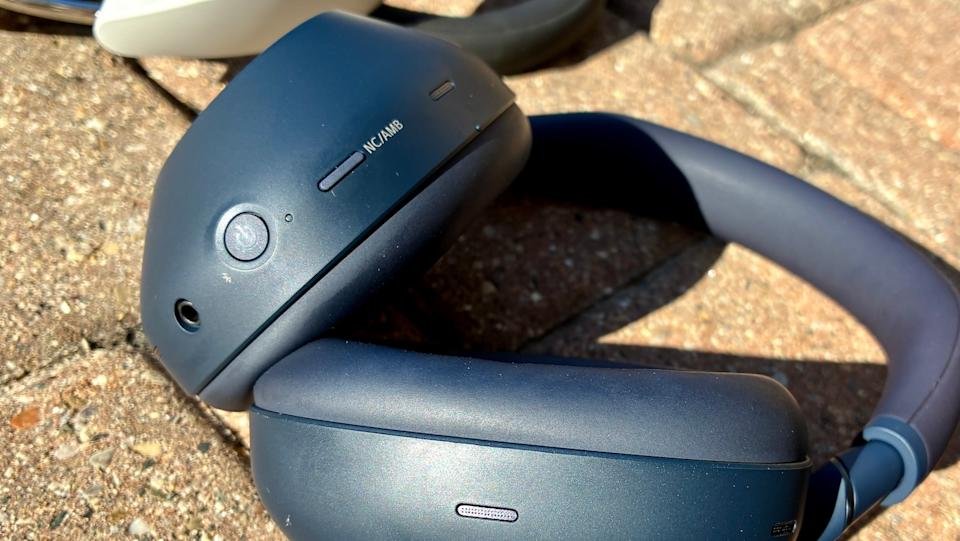
The XM6 has just two buttons: power and NC/AMB (which toggles between noise-canceling and transparency modes). The power button design is much-improved over the XM5’s, and the right-earcup touch controls work very well. (Rick Broida/Yahoo)
As expected from a premium headphone, the XM6 will automatically pause playback if you remove them and then restart when you put them on again. I especially like the Quick Attention feature: If someone approaches you with a question or you want to hear an onboard announcement from the flight crew, you can just lay your palm flat against the right earcup. Doing so instantly disables ANC, lowers the playback volume to almost zero and enables the microphones so you can hear clearly.
Similarly, the press of the NC/AMB button on the underside of the left earcup toggles between noise-cancelling and transparency modes. You can also configure that button so a double-press performs a Quick Access action (explained below) or toggles the microphones on and off (which could be helpful if you’re on a work call and just need to listen). A triple-press can engage a second Quick Access if you like, but that’s it as far as control customization.
Unfortunately, that kind of simplicity is elusive in many other aspects of the XM6, largely due to Sony’s app. Let’s litigate it before moving on to sound quality and ANC — where, I assure you, these headphones step up.
Sony WH-1000XM6: What should I know about the app?
While the XM6 itself is reasonably uncomplicated, Sony’s app makes me feel like I need a degree in audio engineering to understand the various features and terminology. Explore a bit and you’ll encounter the likes of 360 Reality Audio, DSEE Extreme, LE Audio Priority, Adaptive Sound Control and so on. (Meanwhile, why does the app have a generic, non-branded name that makes it harder to locate than would, say, “Sony Audio”?)
Indeed, while Sound Connect has improved somewhat with recent updates, it remains a usability disappointment: Too many options and features scattered across too many different screens, many of them with confusing or incomplete explanations.
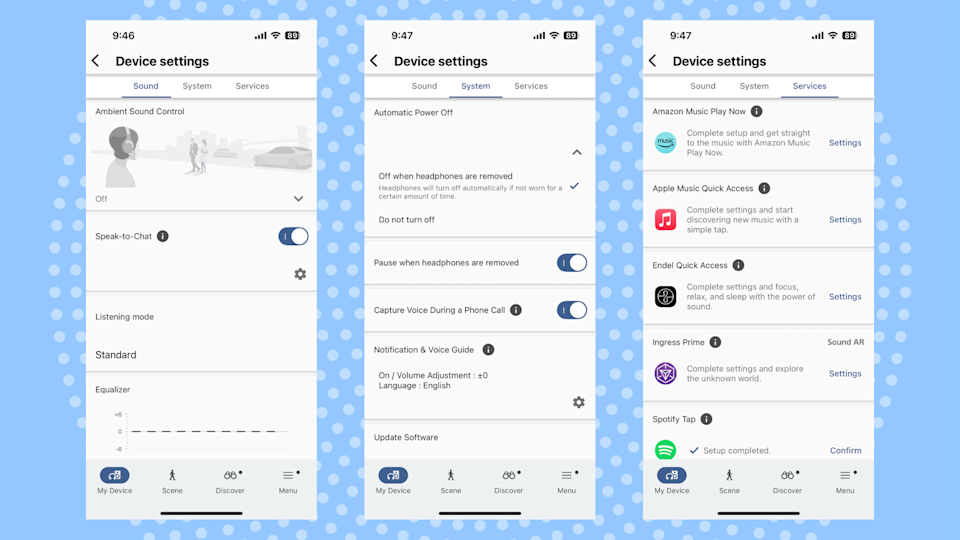
Screenshots from the Sound, System and Services pages in the Sony Sound Connect app. As you can see, some options have pull-downs, some have gear icons, some having nothing at all (see “Listening mode,” left). Whether you find this confusing or just annoying depends on your level of tech-savviness, but either way it’s unacceptable for a $450 headphone. (Rick Broida/Yahoo)
For example, in the Services menu, there’s something called Spotify Tap. I have a Spotify subscription, but I don’t recognize the “Tap” part. Sony’s little information-bug icon reveals this explanation: “Spotify Tap playback is music to play your ears [sic], quite literally.” Huh? It goes on: “Just tap on the headphones while you are putting them on or press the button on the speaker to play music directly.” Huh again? Tap where on the headphones? What button on what speaker?
It turns out Spotify Tap is a feature that instantly launches the service by way of the headphones, rather than having to manually open the Spotify app and start playback. (Think: Netflix shortcut button on your TV remote.) That’s cool, but Sony’s explanations left me scratching my head. For the record, this same Quick Access capability is now available for Amazon Music, Apple Music and YouTube Music as well.
Over in the Sound settings page, the UI gets even worse. The top section — Ambient Sound Control — has a little grayscale illustration, then the word Off in one corner and a tiny pull-down arrow in the other. Tap the latter to reveal buttons for choosing one of the three available modes. OK: ugly, but it works.
The next section, Speak-to-Chat, has a little “i” to tap for information, an on/off toggle switch and a gear icon to access that feature’s settings. Why a separate settings page for that and not a pull-down like for Ambient Sound Control?
Next is Listening Mode, which shows a rectangular box that’s completely empty except for one word: Standard. No button, no pull-down, no gear, no toggle. If you tap somewhere in the box, you get a page with mode choices. But do you see the problem here? There’s an almost hostile lack of consistency and organization across the UI, and an embarrassingly blah design to boot.
I could go on. I could ask why Sony has a setting called Capture Voice During a Phone Call, which sounds like something related to recording but is actually designed to make your own voice easier to hear. The point is, I’m a tech expert, and even I found myself getting confused fairly often while testing these headphones.
Am I being overly harsh about all this? I don’t think so, because this is a premium product from a major company. Headphones should be easy, not complicated, especially if you’re spending $450.
Note to Sony: Please hire a UX expert (and an editor) to fix your app. It shouldn’t be this bad.
Sony WH-1000XM6: How does it sound?
This is where I’ll remind you I’m not an audiophile; I don’t enjoy music any more or less because of “sound profiles” or “dynamic reach” or various other specifications. When I’m on an airplane listening to Billy Joel, Vivaldi’s The Four Seasons or the Hamilton soundtrack, I’m not interested in how many audio engineers collaborated to “optimize” the audio. I just want to be distracted from the fact I’m hurtling through the sky in a metal tube that’s barely staving off gravity.
That said, music played through the XM6 sounds exquisite — same as it did on the XM5 and XM4. Same as it does on the Sonos Ace and Soundcore Space One (products that earned spots on our list of the best noise-cancelling headphones). But there are so many variables at play, so much about audio quality that’s subjective, I don’t feel I can say the Sony XM6 has the “best sound of any headphone I’ve ever tried.”
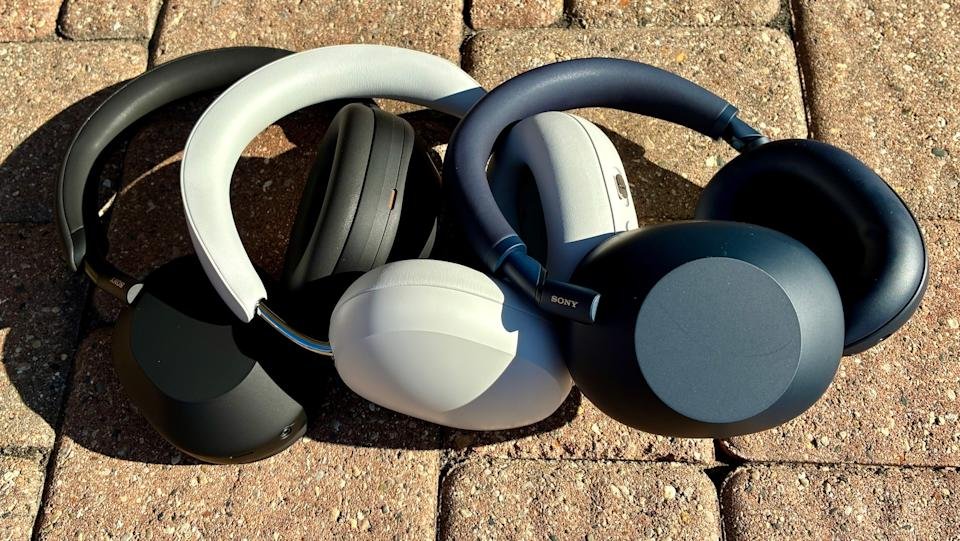
I tested the Sony XM6 (right) against its predecessor, the XM5 (left), and the Sonos Ace (center), which is currently our top overall pick for noise-cancelling headphones. (Rick Broida/Yahoo)
Indeed, I went back and forth, over and over, between the XM6 and Sonos Ace, trying to detect any real difference in the Vivaldi suite. I couldn’t. It sounded great in both of them. Maybe the soundstage — the headphone’s ability to simulate that “you are there” experience — was a little broader in the XM6? If so, it didn’t make me love or appreciate the Summer Concerto any more.
(For sake of comparison, I then switched over to my AirPods Pro, which I listen to almost daily. Now, there I really could tell a difference: While the AirPods sound amazing overall, the soundstage feels smaller, more “in my head” than outside it. Not bad or inferior, mind you, just different — which makes sense given that they’re earbuds and not full-size earmuff headphones.)
I’ll spare you additional discussion of this or that audio nuance. The Sony XM6 produces splendid sound; of course it does. But how is it at blocking external noise?
Sony WH-1000XM6: How’s the noise-cancelling?
A lot of the marketing behind the XM6 points to Sony’s new QN3 processor, which claims to be “7x faster” than the QN1 chip in the XM5 and capable of “superior” noise-cancelling, sound quality and call clarity. (If you’re surprised, like I was, that chip speed is a thing in headphones, remember that they’re mini-computers processing audio in real-time.)
I don’t have a lab for measuring any of that, but I can reveal some real-world testing — all of it done without any music playing, just the headphones with ANC turned on. First I stood in front of a loud air-conditioning unit, the kind you typically find in hotel rooms. The XM5 and XM6 performed very similarly here, though the XM5 produced an odd higher-pitched whoosh that I didn’t detect from the XM6. Then I put on the Sonos Ace: noticeable difference. It was without question the better of the three, at least for blocking that particular noise.
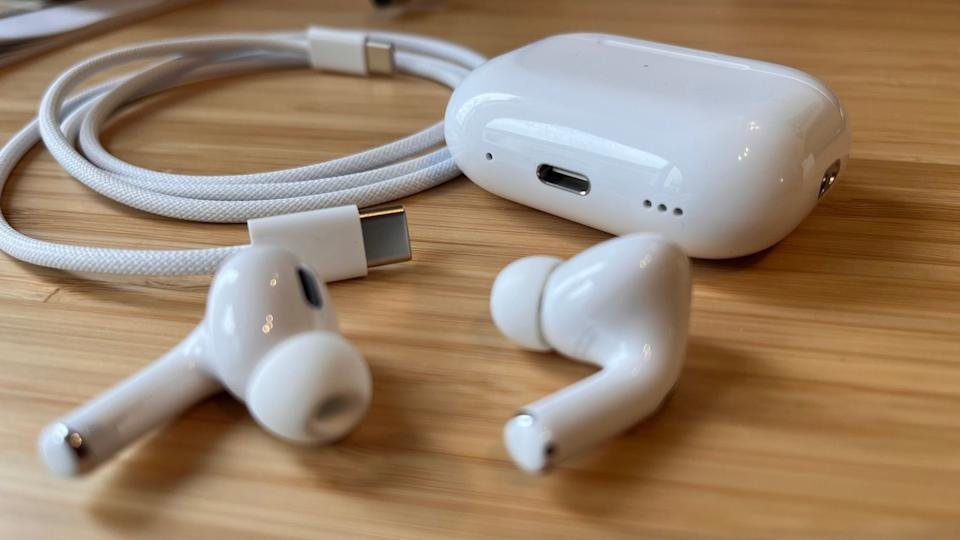
I cannot tell a lie: The Apple AirPods Pro 2 did a better job canceling noise than the Sony WH-1000XM6 (or any other over-the-ear headphone I tried). (Rick Broida/Yahoo)
Here’s the real surprise: My AirPods Pro 2 beat them all. It cut the sound to almost nothing. So much audio testing reveals subtle, almost imperceptible differences; this was very noticeable. And the same was true during a recent trip: On two separate flights, I pitted the XM6 against the AirPods. Once again, no audio playing; I just wanted to see which one did a better job muffling those deafening engines. And once again, AirPods for the win. Not by quite as much as with the fan, but definitely the stronger of the two.
Finally, I played a YouTube video consisting of nothing but lawnmower engine noise. The results were pretty much identical across the board: Sony XM5 and XM6 about the same (good), Sonos Ace better, AirPods Pro 2 markedly better than all three.
Again, these aren’t lab tests; they’re anecdotal ones. There may be circumstances in which the XM6 outperforms the challengers I enlisted here. But from my experience, the best ANC by far comes from earbuds with silicone ear tips — namely, AirPods Pro 2.
Sony WH-1000XM6: Spatial audio and other features
Sony has fallen way behind the competition when it comes to spatial audio, a feature I really love. It simulates a much wider soundstage (which some consider akin to “3D audio”), often pairing with head-tracking to create a kind of fixed focal point. Imagine, for example, that your phone is the concert stage; when you turn your head, the music will sound like it’s still coming from that direction. It works the same way with videos (via Netflix, HBO Max, etc.), making for a much truer cinematic experience.
The Apple AirPods Max, Bose QuietComfort Ultra and Sonos Ace all excel at spatial audio. (For the record, AirPods 4 and Pro do as well.) But Sony headphones lack head-tracking, and the anemic 360 Reality Audio feature works only with a handful of little-known services (Nugs, anyone?), not Spotify or Apple Music or anything else mainstream.
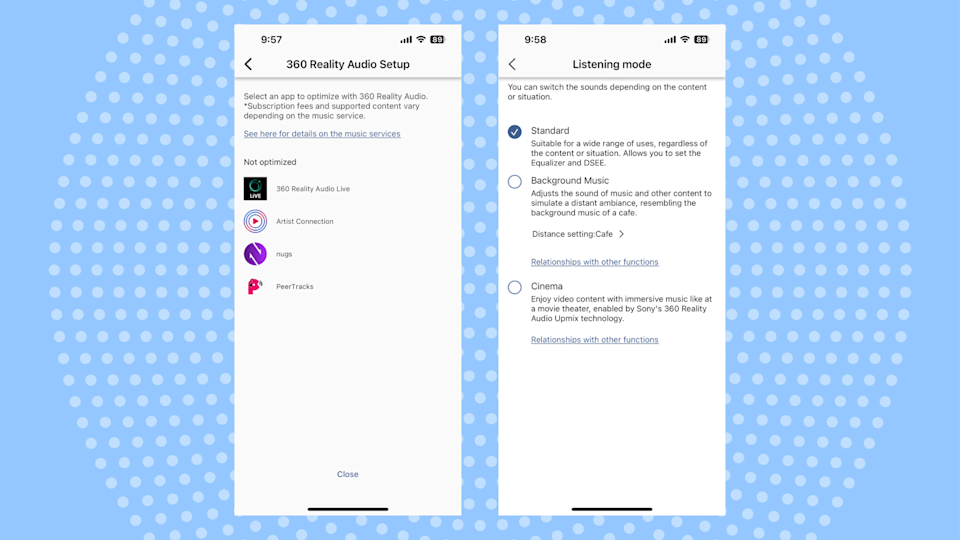
The XM6 offers just two spatial-audio options: 360 Reality Audio, which works with only four never-heard-of-’em services, and its new Upmix counterpart, which is designed specifically for video. Either way: no head-tracking, a real disappointment. (Rick Broida/Yahoo)
New to the XM6 is something called 360 Reality Audio Upmix, which is available in Cinema Mode — meaning it’s designed exclusively for video. True to its name, it aims to bring spatial audio to movies and TV shows. I tested it with Netflix and a couple other streaming services, and it works, broadening the sound so that it feels a bit more immersive. But I don’t get anywhere near the “wow” that comes from true spatial audio with head-tracking.
Not new to the XM6: Adaptive Sound Control, which lets you configure ANC depending on your actions and/or location. For example, it can automatically switch to transparency mode (here called Ambient Sound) when it detects that you’re walking, then return to ANC when you’re sitting or riding in a vehicle. You can create similar parameters for frequently visited locations (home, office, coffee shop, etc.) or those you input on map. It’s a cool feature; I just wonder how many people will bother with it.
There’s an equalizer, of course, but with some pretty odd presets: Heavy, Clear, Hard, Soft, etc. There’s something called DSEE Extreme, but I don’t know what that is, because although there’s a toggle for it in the app, there’s no accompanying explanation. (I do know it gets disabled if you use Cinema Mode; that much is made clear.)
Another source of confusion in an already-confusing app: Auto Switch, a feature that automatically routes audio from speaker to headphone and back again. I’m trying to envision a scenario in which that would actually be useful, but the real head-scratcher is compatibility: You’d think this would work with any and all Sony speakers, but it’s limited to exactly one, the bafflingly named Sony LinkBuds. (Later I learned Sony has a lineup of LinkBuds earbuds that also support Auto Switch.)
Sony WH-1000XM6: Should you buy it?
There’s an audience for the Sony WH-1000XM6, but I’m not it. If someone handed me $450, no strings attached, and said “Go buy headphones,” I’d continue to choose the Sonos Ace (which costs $399, by the way, not $450). I think it sounds just as good, fits more comfortably and does a slightly better job at noise-cancelling. It’s definitely better at spatial audio. As for the software, no contest: Sonos’ app is much easier to use and understand.
Ultimately, I don’t think the XM6 moves the needle that much compared to the XM5, or even the XM4. And you can find both of those older models for less — often considerably less, especially around big events like Black Friday and Amazon Prime Day. (Earlier this month, for example, the XM4 dropped to an all-time-low $183 during Prime Day. Much better buy, in my humble opinion.) And the day will come when the XM6 goes on sale for $399 or $349, maybe even less. My advice: wait for it.