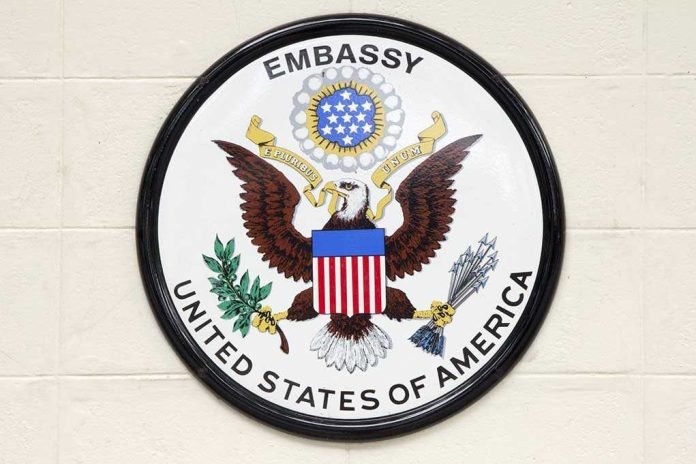
Forty-four small flags outside a U.S. embassy have turned into a large-scale test of whether allies still feel seen, respected and heard.
Story Overview
- Danish veterans placed 44 flags designating the fallen from the war in Afghanistan in front of the US embassy in Copenhagen on January 27, 2026.
- Embassy staff removed the flags the next morning, citing a lack of coordination and authorization.
- Public backlash and political condemnation led to a rapid reversal; the embassy said it would not have expelled them if it had understood the intent.
- The dispute followed remarks by President Trump suggesting that NATO troops were staying away from the front lines in Afghanistan.
A memorial made of flags and a safety landscape made of planters
The Danish veterans chose a simple visual: 44 Danish flags, each marked with the name of a soldier killed in Afghanistan, nestled in flower boxes in front of the American embassy in Copenhagen. The location mattered as much as the message. The sidewalk counts as public space, but the planters belong to the embassy and are part of the site’s anti-terrorism security system. This gray zone invited a predictable clash: commemoration versus control.
The embassy removed the flags on the morning of January 28 and initially framed the action as procedural: embassy staff had not placed them and no one had agreed to their display in advance. This explanation may seem reasonable to an American public raised with clear property boundaries and safety rules. The problem was the optics. When the object you’re removing looks like a memorial, you don’t win the argument by invoking protocol.
Why Trump’s ‘stay back’ comment struck Denmark as an insult
The flags were not a coincidence; it was a targeted rebuttal to a recent Trump interview in which he said NATO troops in Afghanistan were “staying a little behind, a little behind the front lines.” Denmark took this personally because its contribution was not theoretical. The country lost 44 soldiers, one of the highest per capita death tolls among NATO allies. Veterans heard this comment as a rewriting of their war, and they responded with names.
Readers over 40 remember how the memory of war hardens: not in speeches, but in funerals, folded flags and silent lists of the dead. This is why this story exploded in Copenhagen. The exhibition did not accuse the Americans of anything; it demanded recognition. Conservative common sense says that allied partners bleeding alongside you deserve basic respect, even when you’re discussing sharing the burden. Criticizing a government’s policy is fine. Don’t smear the men who carried guns.
The withdrawal became the story, then the reversal became the lesson
Copenhagen officials from all parties condemned the removal of the embassy. The veterans association called it unnecessary and provocative; City leaders called it disrespectful. The embassy then backtracked the same day, saying it would not have removed the flags if it understood their commemorative purpose, and the flags returned. In the afternoon, hundreds of small Danish flags appeared in front of the embassy, transforming a controlled line of planters into a public statement.
The speed of this reversal tells you everything about modern diplomacy: security teams can act in minutes, but public anger spreads faster. Embassy staff probably faced two pressures at once. First, the physical reality: planters also act as barriers and “unknown objects” around embassies trigger instincts. Second, the political reality: Denmark is a close NATO ally, and the cost of appearing callous toward fallen Danish soldiers outweighed any short-term benefits of strict enforcement.
What this incident says about NATO cohesion and American leadership
Denmark’s response was not limited to flowers and flags. It was a question of status within an alliance where smaller nations fear being treated as accessories. When U.S. leaders question allied contributions, they may target budgets and capability gaps, but the blast radius hits pride and sacrifice. NATO works because its members believe that partnership is reciprocal, both in protection and respect. If compliance fails, calls for more spending start to look like a reshuffle, not a strategy.
American conservatives often rightly argue that allies should shoulder more of the burden. The best version of this argument succeeds when combined with precision and gratitude: naming the shortcomings, but also the sacrifices. Trump’s critics in Denmark say his comments cross that line by implying cowardice, or lack thereof. The flag memorial forced a correction in public, because it’s harder to dismiss 44 names than a topic for discussion.
Next step: a silent march and a louder question hanging over the embassy
Danish veterans have planned a silent march on Jan. 31 from Kastellet to the U.S. Embassy, a choice that signals discipline rather than chaos. Silence places the burden on the powerful party to respond thoughtfully. The question now remains whether U.S. diplomats can rebuild trust with gestures that seem humane, not bureaucratic, while still protecting security. The flags remain, but the doubt they revealed will not disappear so easily.
Flags honoring Danish veterans killed in Afghanistan have been removed by staff at the US embassy in Copenhagen, sparking public outcry. https://t.co/UDNdJaH3t0
– Military Times (@MilitaryTimes) January 28, 2026
This incident will persist because it reveals an uncomfortable truth: alliances do not divide primarily because of tanks or treaties; they fracture over perceived contempt. The initial removal of the embassy felt like contempt, even if it was not intentional. The quick apology helped, but it also confirmed the underlying reality that symbols matter. Governments can discuss politics all day long. Veterans and families of the fallen judge you by whether you honor the dead without being forced to.
Sources:
US Embassy in Copenhagen removes memorial flags honoring Danish soldiers killed in Afghanistan
US Embassy in Copenhagen removes memorial flags honoring Danish soldiers killed in Afghanistan
Flags honoring fallen Danish soldiers removed outside the US embassy in Copenhagen
Chosun Ilbo, English-language global report on Greenland-related protests and US-Denmark tensions
US Embassy sparks outrage by removing veterans’ flags
Danish veterans gather in silent protest outside the US embassy
Source link