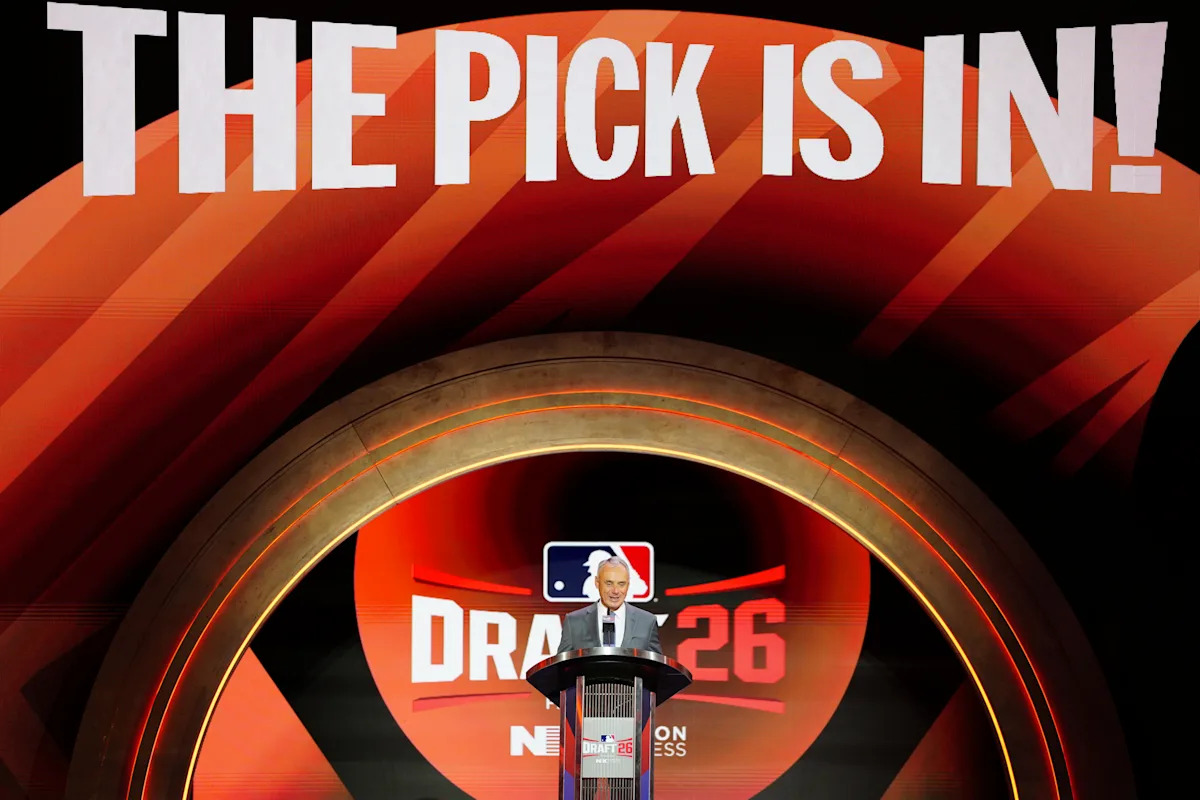
PHILADELPHIA — The 2026 MLB Draft began Saturday in Philadelphia, marking the sixth consecutive season that the draft has taken place as part of the All-Star festivities in July. An energetic crowd filled the Grand Hall at the Pennsylvania Convention Center to cheer as the next generation of baseball stars were announced as MLB draft picks (even though none of the players were actually in attendance).
Odd ambiance aside, it was a momentous day for all 30 major-league organizations as they added a wave of new talent to their organizations. Here are seven takeaways from Day 1 of the draft, which brought us the first four rounds. (Day 2, featuring rounds 5 through 20, will take place on Sunday.)
1. Dude said “Cholooski”
The draft proceedings began with an absolute stunner. Because while Roch Cholowsky going first overall to the Chicago White Sox didn’t catch anyone off-guard, commissioner Rob Manfred’s pronunciation of the UCLA shortstop’s last name certainly did.
Advertisement
“Cho-LOO-ski”
With that, baseball had its Adele Dazeem moment.
This is a tough, tough look for Manfred and the league. It’s one thing to stumble over a tricky surname later on in the draft, but bungling the first overall pick is downright unacceptable. Mistakes happen, sure, but the moment was a worthwhile reminder that the higher-ups at MLB don’t think particularly hard about the draft. It’s difficult to convince fans to buy into the event as a marquee All-Star attraction when the commissioner can’t pronounce the No. 1 pick’s name correctly. — JM
2. Roch reacts and the Sox add more talent beyond him
Cholowsky’s selection by Chicago didn’t come as a surprise, considering his status as the top prospect in the class for nearly the entire draft cycle. At the same, there’s a lot to be gleaned from Cholowsky’s emotional reaction to finally arriving at the goal he’d been working toward for three years, even if many viewed it as an inevitable conclusion.
Advertisement
It was no small decision for Cholowsky to forgo significant pro opportunities out of high school and head to college instead, demonstrating a bold belief that he could be more than a late first-rounder. After embracing that challenge, living up to the hype along the way and fending off a late push from some challengers for the top pick, Cholowsky’s reaction Saturday exuded a combination of relief and pride after accomplishing his longstanding mission. Of course, it marks just the beginning of his professional journey, but it’s already been quite the story for him to get to this point.
And Cholowsky landing in Chicago was just the beginning of a busy day for the White Sox. The night before the draft, the Sox swung a trade with the Pirates to acquire the 34th overall pick (competitive balance picks are eligible to be traded), giving Chicago an additional early selection to bolster its farm system. After taking a potential franchise cornerstone in Cholowsky — in turn passing on the chance to land a high-upside high school bat in Grady Emerson — the White Sox were able to land a pair of talented prep infielders with their next two picks, selecting Landon Thome from Illinois and Cole Prosek from Mississippi. Thome’s Hall of Fame bloodlines — Landon’s father, Jim, smashed 134 of his 612 career homers with the White Sox — make him already feel like a familiar face, and Prosek has long stood out as one of the more advanced lefty hitters in this year’s prep class.
In the third round, Chicago pivoted to the pitching class and selected Georgia right-hander Joey Volchko. He battled command issues for much of his college career but has some of the most electric stuff of any pitcher in the draft, which was on full display in his 15-strikeout complete game against Texas last month in the Men’s College World Series. Finally, to balance out a volatile arm such as Volchko, the White Sox used their fourth-round pick on Oregon State right-hander Eric Segura, one of my favorite sleepers in the college pitching class. He posted a 2.22 ERA in 73 innings with a 27.3% strikeout rate and an outstanding 58.7% groundball rate for the Beavers this spring. — JS
Advertisement
3. The top four picks are chalk
Manfred’s gaffe aside, the beginning of the draft unspooled exactly how many experts said it would. After Cholowsky went first to Chicago, Tampa Bay took Texas high school shortstop Grady Emerson, Minnesota selected Georgia Tech catcher Vahn Lackey and San Francisco scooped up UC Santa Barbara hurler Jackson Flora. No shockers there.
Emerson was the top player on Tampa’s board — they would’ve taken him over Cholowsky had both been available — so the Rays have to be pumped about how things played out. Minnesota had the easiest job in the entire draft: Take whichever of the consensus top three fell to them at No. 3. That was Lackey. He’s now a Twin.
Flora, it seems, existed in a tier all his own, slightly below the top three position players but ahead of everyone else. And the Giants didn’t pivot, taking full advantage of their highest pick since 2018. Flora is a stupendous on-mound athlete with the perfect combination of confidence and curiosity. Whenever he signs, he’ll immediately become the organization’s best pitching prospect. — JM
4. The Royals provide the first shocker
Kansas City’s scouting department has zagged before; their 2021 selection of Connecticut high schooler Frank Mozzicato at seventh overall is perhaps the most prominent example. Leading up to this year’s draft, there was some buzz that the Royals might go off-script once again, and that’s exactly what happened.
Advertisement
It’s not that Louisville outfielder Zion Rose is a bad pick or a bad player. He’s a superb athlete (he caught as a freshman) who could add meaningful in-game power if he learns how to hit the ball in the air more often. It’s also worth noting that Rose ran an impressively small 10% strikeout rate over his three years of college ball. But the swing needs some work, as do Rose’s routes and reads in the outfield. He might take a bit more time than your average college performer to develop.
In taking Rose over a bevy of more heralded talents, the Royals took something of a risk. They’ll probably use the bonus savings from that pick later on in the draft. It’s an interesting strategy, one with some good precedent (the Astros got both Carlos Correa and Lance McCullers in 2012) and some negative (the Royals’ Mozzicato draft is considered something of an epic botch). — JM
5. New regimes reveal their strategies
Each year, the draft offers a window into how teams differ in regard to organizational philosophy. What does a given club value? What are its core principles? Which types of players are prioritized? College or high school? Raw or polished? Pitcher or hitter? We can learn a lot from how a team drafts. That’s particularly true for franchises conducting their first draft under a brand-new baseball operations group. This year, that was Colorado, Washington and the Angels.
Advertisement
There wasn’t too much to glean from the Rockies’ first pick under new president of baseball operations Paul DePodesta and general manager Josh Byrnes. Kentucky shortstop Tyler Bell, a high-floor college performer with great on-base skills, simply fell in Colorado’s lap at 10th overall. He was the consensus best player available at that spot. It’s not a huge deviation from the previous Rockies regime, which leaned toward college players and position players. We’ll learn more from Colorado’s later picks.
Washington is a slightly different story. The Nats’ pick, Texas A&M infielder Chris Hacopian, was a slightly more polarizing selection. Evaluators generally believe in Hacopian’s bat, particularly after a strong junior year in the SEC after he obliterated the subpar Big Ten in his first two college seasons. But there are big questions about his defensive home; he struggled on the dirt in 2026 and might end up in an outfield corner. A recurring back issue only adds to the risk.
Still, model-driven teams loved Hacopian because of some stellar under-the-hood metrics. He doesn’t chase, he makes a lot of contact, and he hits the absolute snot out of the ball. It’s clear that the new Nats group, led by president of baseball operations Paul Toboni and AGM Justin Horowitz, felt that they couldn’t pass up what could be a needle-moving offensive player.
The Angels demonstrated the biggest year-over-year strategy shift. Long known for their preference for polished, fast-to-the-bigs college players, the Angels went with high school two-way player Jared Grindlinger in the first round. The Huntington Beach High School product has a massive ceiling but is going to need quite a bit of seasoning in the minors.
Advertisement
In other words, that’s the type of player former GM Perry Minasian would’ve stayed away from. Minasian was fired less than a month ago, replaced by longtime Cardinals head honcho John Mozeliak. Over the past few weeks, Mozeliak was forthright about his new team’s intention to take the best player available, regardless of big-league proximity. The Angels followed through on that promise, something that should provide a morsel of optimism for a down-in-the-dumps fan base. — JM
6. Pitcher picks prove unpredictable
One of the stranger subplots of the first few rounds was when all the projected top pitchers came off the board, plus a handful of arms who went way earlier than expected. It was always tough to gauge when pitchers would start getting plucked once we got beyond Jackson Flora at the top, but we had to wait a while for the next arm to hear his name called. Just one other pitcher ended up being selected in the top 18 picks (high school lefty Gio Rojas to Texas at No. 16) before a run of four arms in five picks unfolded from Nos. 19 to 23.
Advertisement
Then, just as I was expecting a run of pitchers from my Top 50 to come off the board, the New York Mets swerved hard at pick No. 27, drafting Arkansas right-hander Carson Wiggins. The younger brother of Cubs pitching prospect Jaxon Wiggins, Carson looked spectacular in a handful of outings as a freshman in 2025 but then got injured and needed internal brace surgery, wiping out his entire draft-eligible sophomore season. He threw at the combine last month and looked solid, but the Mets must have immense confidence that they can get him back to his pre-injury form — and that he can develop into a starting pitcher, which was hardly a guarantee even before he got hurt — to use a first-round pick on a pitcher with such a short track record.
Wiggins’ selection stood out even more considering the caliber of arms still on the board at that point. He was one of 12 pitchers taken (eight college and four high school) before the first college left-hander was selected, a surprising development considering that demographic looked likely to produce three first-rounders entering draft day. Instead, it wasn’t until the New York Yankees took Arkansas southpaw Hunter Dietz at No. 35 that the dam was broken, followed shortly thereafter by Arizona State’s Cole Carlon going to Toronto with its first pick at No. 38 and then USC’s Mason Edwards going to the A’s at No. 47. — JS
7. Giants load up on arms — and take a familiar name
It has been a disastrous season for the major-league team in San Francisco, but I loved what they did on Day 1 of the draft. They started the day by taking the best pitcher in the class, UCSB right-hander Jackson Flora. This would’ve been a great pick if Flora were from Maine, but it’s even more exciting knowing he grew up a Giants fan in nearby Pleasanton, giving the pick a sentimental flavor on top of his outstanding talent.
Advertisement
And San Francisco wasn’t finished adding impact arms, as the Giants spent their next two selections at Nos. 29 and 55 on two of the best prep pitchers in the class, lefty Carson Bolemon from South Carolina and righty Kaden Waechter from Florida. Bolemon was the second-highest high school pitcher on my Top 50, and Waechter was close to being included in the rankings but was ultimately left off due to the risk associated with his demographic. That said, San Francisco’s decision to select him just outside the top 50 certainly validates that he belonged in the mix. The Giants’ farm system has improved significantly over the past year, but most of those gains have taken place on the position-player side while the pitching pipeline has remained relatively barren. That immediately changes with San Francisco’s first three picks. This trio of arms will be awfully fun to monitor as they move through the system.
The caliber of pitching the Giants added was enough to make Day 1 feel like a success, but the vibes got even better in Round 3, when San Francisco used the 90th pick on Rutgers outfielder Peyton Bonds. He’s the nephew of that left fielder who hit some homers for the Giants a few years back. That’s right: Peyton is the son of Bobby Bonds Jr., the brother of the all-time home run king, and he has made a name for himself during his collegiate career, first at Campbell as a freshman and then in New Brunswick the past two years. Funnily enough, homers haven’t really been a big part of Bonds’ profile, as he launched just 16 across three college seasons, but that has more to do with how his right-handed swing currently works than a lack of raw strength. He’s an exciting center-field athlete who has untapped potential with the bat if he can make some tweaks at the next level. But most importantly, he’s a Bonds on the Giants. Pretty cool! — JS