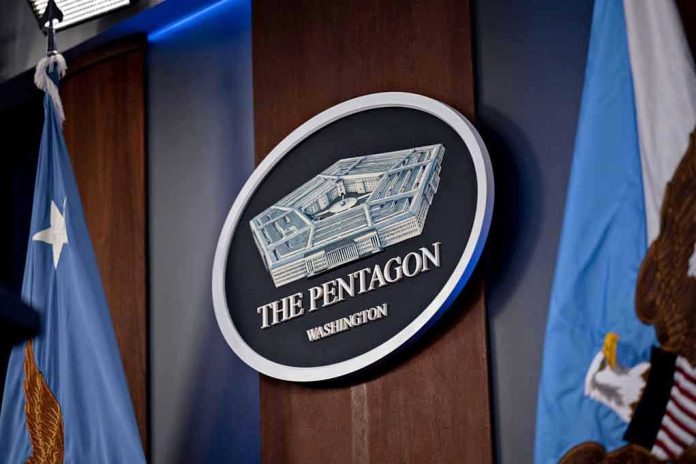
The Pentagon quietly turned its own press office into a classified area and expelled journalists, raising serious questions about transparency, constitutional rights and what the top brass don’t want the American people to see.
Story Overview
- The Pentagon has reclassified its press office as a classified zone and prohibited access to journalists.
- Officials say the change is necessary because speechwriters and staff there “routinely deal with classified material.”
- For decades, the press office operated as an open, unclassified center where journalists met with sources and gathered information.
- The move follows court battles and walkouts over press rules that critics say violate First Amendment protections.
The Pentagon transforms its press office into a classified area
Pentagon leaders have officially reclassified the Pentagon press office as a classified space, preventing journalists from entering the very office intended to serve as the nerve center for public information about the U.S. military. Defense officials say the change was driven by the presence of speechwriters who “regularly deal with classified materials,” arguing that stricter access is necessary to protect sensitive information from inadvertent exposure.[2] The new designation effectively converts a longtime media workspace into a forbidden government enclave.
Journalists who once used the press office as a routine stop to ask follow-up questions, clarify points of information and arrange interviews are now barred by security rules that treat the area as a secure intelligence center. For years, Pentagon guidelines acknowledged that press access would be controlled, but still allowed accredited journalists to move unescorted through limited, unclassified areas of the building. This balance has now tilted strongly towards restriction, with the press office itself no longer accessible for daily news gathering.
Decades of access reversed in a single policy change
Historical practice at the Pentagon shows that press access has always been structured but not closed, with accredited journalists operating inside the building through both Democratic and Republican administrations.[4] Comments from former defense officials indicate that although media access was tightly controlled when the building opened, it gradually evolved into a system in which registered journalists had a regular presence and direct contact with senior leaders.[4] This presence fostered a two-way relationship: the army explained its missions and citizens could examine policy through independent reports.[4]
Under recently adopted press rules, that relationship is under strain as journalists describe a series of new limits disguised as security measures.[1][4] An official Pentagon summary of updated physical screening measures shows how press movement is now confined to specific floors and rings, tightly limiting unaccompanied journalists’ access to unclassified spaces. In this context, the reclassification of the press office itself as off-limits appears to many observers as a further step towards consolidating control of messages inside the building.[4]
Court battles, walkouts and fears of government control
The fight over the press office follows a broader legal and political battle over the Pentagon’s press rules that began when new restrictions were put in place in 2025.[1] Those rules, issued by Secretary of War Pete Hegseth, included a detailed 21-page framework that significantly limited what accredited journalists could do inside the building compared to earlier, shorter guidelines.[1][3] A federal district judge in Washington, D.C., later declared key parts of the restrictions unconstitutional, ruling that they violated the First and Fifth Amendments and amounted to viewpoint discrimination and censorship.[1]
Journalists were also asked to sign a pledge promising not to collect or solicit information that had not been previously approved for publication, a requirement that media reports said was aimed directly at the core news-gathering activity.[1][3] Journalists warned that treating unrelated questions as an “inappropriate solicitation” could deter whistleblowers and punish journalists who uncover inconvenient truths about defense policy.[3] Several major media outlets responded by rejecting the rules and, at one point, surrendered their badges as part of a coordinated walkout against what they described as unprecedented interference with press freedom at the Pentagon.[2][3]
Safety justifications versus public right to know
Pentagon officials continue to present the press office’s new designation as simply a security update intended to prevent the accidental release of classified documents handled by speechwriters and staff.[2] They emphasize that the mishandling of classified information constitutes a crime and emphasize the need to protect the military by avoiding leaks that could compromise operations.[2] This argument echoes a long-standing trend in national security debates, where executive branch officials cite operational security while press advocates warn of rampant secrecy.[2][4]
The Pentagon press office was designated a classified space in the complex, with journalists removed from the area to make way for a new classified speechwriting area.
“The Pentagon press office has been renamed the Sensitive Compartment Information Center… pic.twitter.com/SnUuPmBvx9
– Epoch Times (@EpochTimes) June 2, 2026
Press freedom groups counter that the press office was never used to discuss classified information and operated for decades as an unclassified space where questions, not secrets, were exchanged.[1] Legal briefs filed against the Pentagon’s new rules argue that any access restrictions should be narrowly tailored, rather than broadly excluding journalists from spaces built to facilitate public communication.[1] They warn that, combined with previous unconstitutional rules and commitments, converting the press office into a classified area brings the department closer to controlling what Americans are allowed to hear about their own military.[1]
Sources:
[1] Web – The Pentagon defends the ban on journalists from the press office by transforming it…
[2] Web – Pentagon Rules for the Press, 2025 | The first amendment…
[3] YouTube – Pentagon journalists hand over access badges after refusing…
[4] YouTube – Pentagon Press Policy: Media Rejects New Access Pledge
Source link