
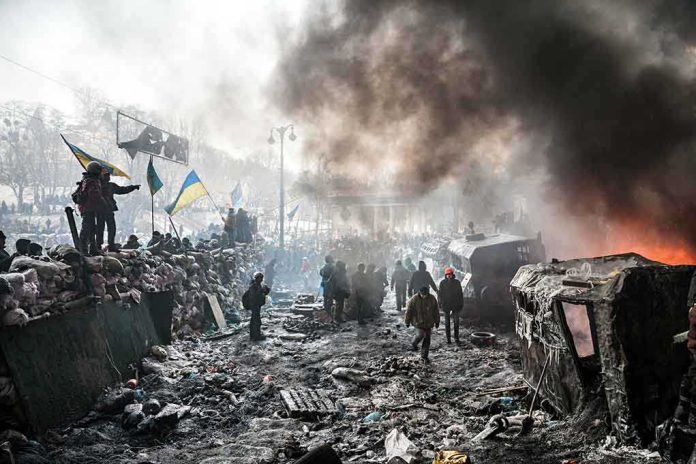
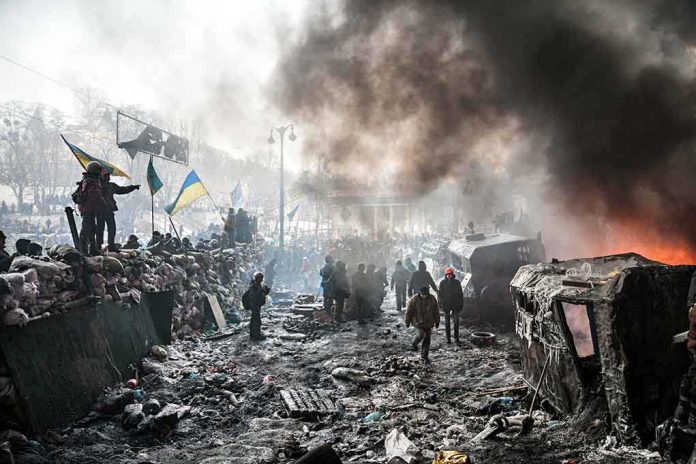
Russia’s new threat to “bomb kyiv’s decision-making centers” with hypersonic missiles is not just another battlefield headline – it is a warning shot to the West, foreign diplomats and US interests who are witnessing a dangerous game of nuclear-inflected chicken.
Story Overview
- Russia is threatening more massive strikes in kyiv, explicitly warning foreign citizens and diplomats to leave the city.
- Moscow views these attacks, including the use of the Oreshnik hypersonic missile, as retaliation for alleged Ukrainian “terrorist” strikes on Russian territory.[2]
- Ukraine denies targeting civilians and sees Russia’s speech as a pretext to intensify attacks that repeatedly hit residential areas and infrastructure.[2]
- The trend echoes years of Russian strikes against Ukraine’s power grid and cities, raising broader questions about Western deterrence, escalation and resolve.[5]
Russia’s new threat: ‘Leave Kyiv now, more strikes to come’
Russian officials and state-linked voices are now openly warning that foreign nationals and diplomats should leave kyiv immediately because “more massive strikes” are imminent against what Moscow calls the city’s “decision-making centers.” Social media and international coverage portray the warning as a signal that Kremlin planners want foreign embassies and aid workers out of the way before a new wave of missiles and drones hits the Ukrainian capital. These messages raise the stakes well beyond Ukraine’s borders, as they implicitly threaten the facilities and districts where Western personnel live and work.
Ukrainian President Volodymyr Zelenskyy has previously said that his intelligence services, along with information from US and European partners, had gathered information that Russia was preparing a strike on kyiv using the nuclear-capable Oreshnik intermediate-range ballistic missile.[1][4] According to this account, Ukraine believes Moscow is considering a combined barrage on Ukrainian territory, including in kyiv, using multiple types of weapons, with the Oreshnik designated as a key system.[1][4] The U.S. Embassy in kyiv separately issued a severe warning of a potentially significant air attack within 24 hours, urging U.S. citizens to prepare to take shelter.[1]
From the narrative of “reprisals” to the hypersonic reality on the ground
Russian forces have already moved from threat to action in recent days. The Ukrainian Air Force reported that Russia launched a massive barrage of around 600 drones and 90 missiles across the country overnight, killing at least four people and injuring more than eighty people.[2] Among the weapons used was the Oreshnik intermediate-range ballistic missile, launched from the Kapustin Yar missile complex, the deployment of which Moscow later confirmed.[2] The Russian Defense Ministry publicly called the strike “massive” and presented it as a response to what it called “Ukrainian terrorist attacks on civilian facilities on Russian territory,” while boasting that all designated targets had been hit.[2]
Russian leaders are leaning heavily on this retaliation scenario. Former Russian President Dmitry Medvedev, now vice chairman of the Russian Security Council, explicitly described the assault as revenge for long-range Ukrainian strikes in Russia.[2] Russian media and officials have also linked their threat of “systematic strikes” on kyiv to a recent Ukrainian strike in Russian-occupied eastern Ukraine, which Moscow said hit a dormitory and killed civilians.[5] This narrative echoes a well-established pattern in the broader war: Russia labels Ukrainian military operations as “terrorist” acts, then uses that label to justify large-scale missile and drone attacks that repeatedly strike civilian areas far from the front.[5]
Kyiv, civilians and a familiar pattern of infrastructure strikes
The Ukrainian authorities strongly dispute the version of events given by Moscow. kyiv insists it does not target civilians, and Ukrainian officials say their forces have struck military or security targets in the occupied territory rather than dormitories or other civilian sites.[2] Ukraine and many international observers say Russia’s language of “retaliation” serves as an ex post justification for a strategy that has long included terrorizing cities and destroying infrastructure. During the early stages of the war, Russia repeatedly attacked Ukraine’s power grid and critical infrastructure, notably in kyiv, with waves of cruise missiles and errant Iranian-style munitions, leaving millions of people without electricity and heat.[5]
Publicly available war chronologies document a long series of Russian strikes on kyiv dating back to the first weeks of the invasion. These include missile attacks on residential buildings, government quarters and energy facilities. Over the course of a single night in June, Russia reportedly fired more than four hundred drones and missiles into kyiv, including one strike collapsing a multi-story residential building. This history is important when evaluating current warnings: every time Moscow promises “precision” or claims to hit only military targets, the record shows constant repercussions on civilian neighborhoods, hospitals and infrastructure nodes that keep basic services running.[5]
Why this matters to Americans: escalation, energy and Western determination
For Americans watching from thousands of miles away, Russia’s latest threats highlight several hard truths. First, the Kremlin deliberately uses risk and fear as political tools, using language about decision-making centers and foreign nationals to pressure Ukraine and its Western backers. Analysts of the escalation of this conflict have noted that Moscow frequently engages in what experts call “risk manipulation,” where leaders hint at broader war or nuclear systems like the Oreshnik to make Washington and European capitals think twice about providing greater support. This strategy has not prevented long-range Ukrainian strikes in Russia, but it keeps Western governments cautious and their aid sometimes slow.
🚨 BREAKING: 🇷🇺 Russia urges foreign citizens and diplomats to leave kyiv immediately, warning more strikes are coming. pic.twitter.com/614F0cUovr
– The Current Sphere (@current_sphere) May 25, 2026
Second, the ongoing missile campaign highlights how European security and American economic interests are tied to what happens in the skies over kyiv. Russia has a history of targeting Ukraine’s energy infrastructure, and each new wave of attacks on power plants, fuel depots and network nodes reverberates through global energy markets.[5] Disruptions to Ukrainian transit routes and fear in European capitals are resulting in higher energy costs and greater volatility, consequences that American families have already felt at the gas pump and on their utility bills since the start of the war. Finally, the series of strikes and counterattacks tests Western resolve on fundamental principles: national sovereignty, protection of civilians and resistance to nuclear intimidation. For a United States that wants to project strength without descending into outright war, understanding Russia’s retaliatory rhetoric—and understanding through it when it masks attacks on cities—is essential to crafting a measured but firm policy.
Sources:
[1] Web – Russia launches heavy missile strikes on Kyiv after…
[2] YouTube – Russia hits Kyiv with hypersonic missile in massive assault
[4] YouTube – Russia uses Oreshnik missile on Kyiv in one of the largest…
[5] YouTube – Putin threatens to react after deadly strike in Russia-…
Source link