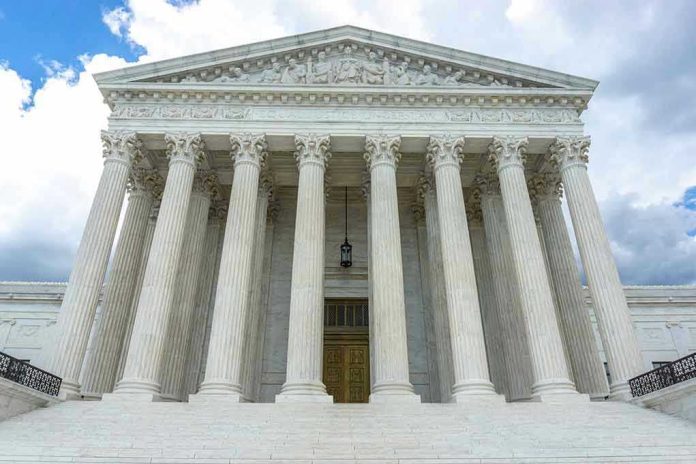
The Supreme Court just slammed the door on a project so brazen it seems like political fiction: A self-described progressive Democrat tried to infiltrate the Ohio Republican primary, got caught in the act, and still claimed constitutional protection.
Story Overview
- Former DNC presidential candidate Samuel Ronan disqualified from Ohio GOP primary after evidence revealed he was a Democrat falsifying party affiliation
- The Supreme Court unanimously rejected his emergency appeal without explanation, upholding the state’s authority to enforce “good faith” application requirements
- Ronan has publicly admitted his strategy of running Democrats in deep red districts to “mislead” Republican voters and “get a foot in the door.”
- Ohio Secretary of State Frank LaRose removed Ronan from the ballot under state law prohibiting fraudulent party reporting.
- The decision strengthens the power of states to protect primary integrity and could deter similar attempts at multi-party infiltration nationwide
The infiltration project is revealed
Samuel Ronan signed his Republican nomination papers under penalty of forgery, pledging allegiance to GOP principles as he ran for Ohio’s 15th Congressional District. The problem ? His own words betrayed him. Public statements and social media posts have surfaced showing Ronan openly discussing a calculated strategy to plant Democratic candidates in safe Republican districts. He did not hide his intentions from his fellow progressives, but simply from Ohio election officials. Republican voter Mark Schare compiled the evidence and filed a protest with the Franklin County Board of Elections, setting off a cascade of lawsuits that would expose the entire operation.
The evidence against Ronan proved overwhelming. His interviews and digital footprint revealed explicit admissions of Democrats disguised as Republicans to disrupt the primaries from within. This was not a nuanced political strategy or ideological shift. Ronan described his approach as misleading voters into deep red territory, creating Trojan horse candidacies designed to infiltrate rather than truly compete. Ohio Secretary of State Frank LaRose acted quickly, disqualifying Ronan under state law requiring candidates to run in good faith and genuinely subscribe to their party’s stated principles. The statement signed by Ronan was not a suggestion; it provided criminal penalties for falsification, making one’s false declaration potentially subject to prosecution for fraud.
Courts reject First Amendment defense
Ronan filed a lawsuit in federal court, claiming Ohio violated his First Amendment rights by punishing political speech. Chief Justice Sarah D. Morrison didn’t believe it. It ruled that while Americans enjoy broad free speech protections, those rights do not extend to lying on official government forms under penalty of law. Ohio’s interest in preventing fraudulent ballot reporting was an important governmental concern that outweighed Ronan’s claim to protect speech. The distinction mattered: Ronan could publicly say whatever he wanted about his political strategy, but signing a legal certificate falsely asserting his Republican affiliation moved from speech to fraud.
The federal appeals court agreed, rejecting Ronan’s request to reinstate the vote. His emergency petition to the Supreme Court represented a last-ditch effort before early voting began. Justice Brett Kavanaugh sent the case back to the Full Court, which dismissed it without providing reasons. This phantom denial follows precedent set by the Supreme Court allowing states to impose reasonable restrictions on ballot access, including party loyalty requirements. The Storer v. Brown’s 1974 recognized the power of states to protect the integrity of their electoral processes, including partisan primaries designed as intra-party contests rather than free contests.
Precedents and political implications
Ohio’s good faith requirement dates back to concerns about primary sabotage, including 2012’s “Operation Chaos,” when Rush Limbaugh urged Democrats to wade into Republican primaries to influence the results. State legislatures responded by codifying protections against insincere applications. Ohio Revised Code 3513.05 explicitly requires partisan candidates in primaries to honestly declare their party affiliation, recognizing that primaries serve as private association functions where political parties select their own standard bearers. Allowing opposition infiltration would turn primaries into preliminary races for the general election, undermining parties’ rights of association.
This case is not isolated. Nebraska recently disqualified Cindy Burbank, a Democrat, from the Senate primary after GOP complaints of insincerity, with Burbank planning to appeal to the Nebraska Supreme Court. The parallel cases suggest a potential trend toward multi-party strategic filings in safe opposition constituencies. The Supreme Court’s rejection of Ronan’s appeal sends a clear signal: States possess the power to control these borders. Federal courts will defer to state legislatures on ballot access rules designed to prevent fraud, even when candidates invoke free speech. The decision benefits Republican voters in Ohio’s 15th District, where incumbent Rep. Mike Carey now faces a primary without an established opposition candidate.
Why it matters beyond Ohio
Ronan’s disqualification establishes important barriers against electoral manipulation disguised as political innovation. Primary elections exist to allow party members to choose candidates who truly represent their values and policy preferences. Allowing opposition activists to infiltrate these elections under false pretenses would corrupt the entire nomination process, turning internal party decisions into opportunities for external sabotage. Ohio voters deserved candidates who truly believed in Republican principles, not progressive activists running bait-and-switch schemes. Courts have recognized this fundamental truth, prioritizing election integrity over a creative legal approach to constitutional rights.
Does the right do this?
Supreme Court REJECTS so-called ‘Republican’ candidate’s appeal after being denounced as a Democratic plant https://t.co/4UJsDXFVCE #gatewaypundit via @gatewaypundit
— Do you see that? (@canyouseethis) April 10, 2026
The broader implications extend to election law nationwide. States monitoring Ohio’s successful defense of good faith requirements could strengthen their own ballot access provisions or more aggressively enforce existing ones. The decision also reveals a worrying desire on the part of certain political actors to consider electoral rules as obstacles to be circumvented rather than as democratic standards to be respected. Ronan’s public statements about voter deception revealed a disregard for the electorate’s right to honest information about candidates. When political strategists prioritize victory through deception over competition over ideas, they undermine the legitimacy of democratic processes themselves. The Supreme Court’s rejection affirms that states can and should prevent such cynical manipulation.
Sources:
Supreme Court blocks nominee after alleged GOP infiltration scheme revealed
Supreme Court excludes former DNC candidate from Ohio GOP primary ballot
Burbank, Democratic U.S. Senate candidate in Nebraska, off ballot after case dismissed for now
Source link