
House Republicans moved Friday to further extend the six-week shutdown of the Department of Homeland Security, snubbing a bipartisan Senate bill that would fund the vast majority of DHS agencies through September and moving ahead with a plan of their own that stands little chance of becoming law.
All Republicans and three Democrats — moderate Reps. Don Davis of North Carolina, Marie Gluesenkamp Perez of Washington and Henry Cuellar of Texas — voted in favor of a temporary extension of all DHS funding through May 22, including immigration enforcement. The gavel came down on the 213-203 vote just before midnight Saturday morning, when the agency shutdown will become the longest funding lapse in U.S. history.
The measure will not pass the Senate, which has adjourned for a two week recess through April 13 with no imminent plans to reconvene.
Now confronting an impasse, Republican leaders in both chambers stare down the tall task of brokering a fresh compromise to end the shutdown without any obvious off-ramps.
House Majority Leader Steve Scalise signaled late Friday his chamber would be leaving town now, too.
“Obviously we’ve got to see what they do now. I mean, if they make changes, that’s part of the legislative process,” Scalise told reporters regarding the Senate, when asked if House GOP leaders would call back the House early from recess to negotiate an end to the shutdown.
“But right now, we’ve sent them a bill, and we’re going to be watching closely what they do,” Scalise continued. “And I hope they pass that bill to the president, because it makes sure that the department is fully funded at a time we’re at a heightened level of threat in America.”
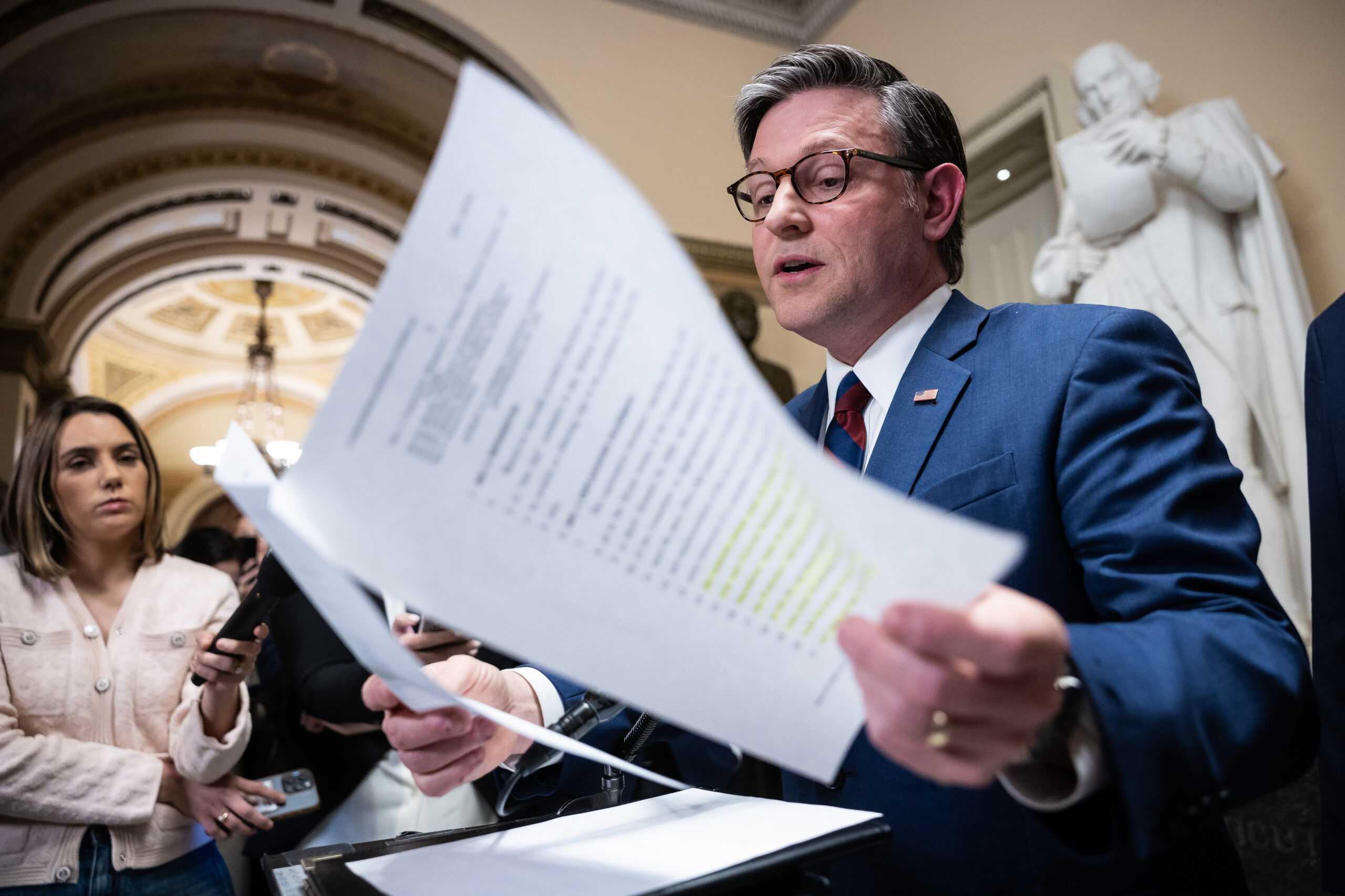
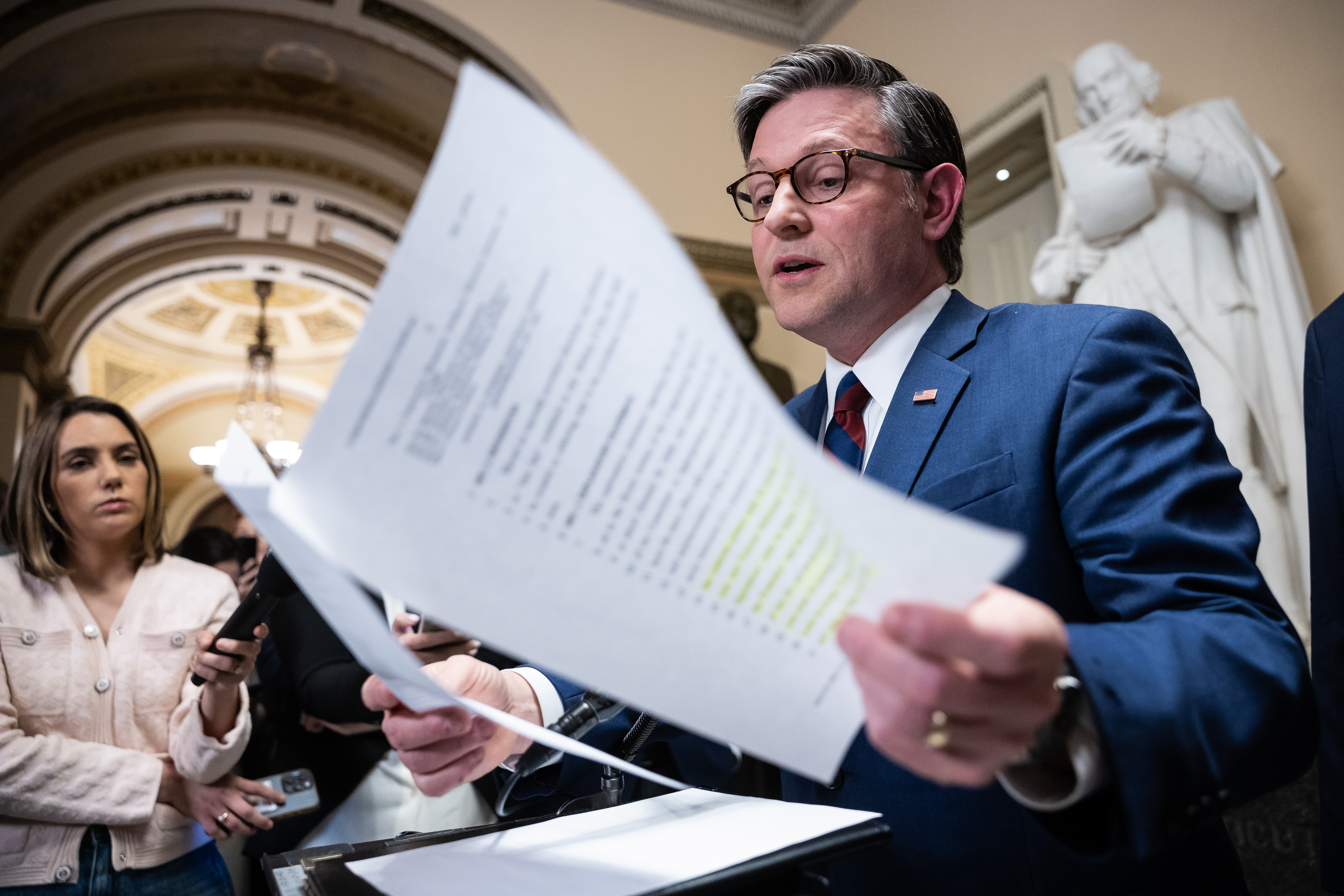
Speaker Mike Johnson put the gears in motion Friday morning, when he announced that House Republicans simplycould not swallow the Senate’s bill, which omits funding for Immigration and Customs Enforcement as well as Border Patrol and some other parts of Customs and Border Protection.
“The Republicans are not going to be any part of any effort to reopen our borders or to stop immigration enforcement,” Johnson said. “We are going to deport dangerous criminal illegal aliens because it is a basic function of the government. The Democrats fundamentally disagree.”
The move toward an eight-week stopgap creates a tactical gulf between Johnson and Senate Majority Leader John Thune, who called an end to weeks of abortive bipartisan talks Thursday and pushed through the funding bill in hopes of tacking on funding later for ICE and CBP in a party-line budget reconciliation bill. Those agencies are currently funded and operating under appropriations made in last year’s GOP megabill.
House Republicans spent Friday railing against the Senate’s “dark of night” voice vote to advance legislation funding most of DHS, saying it lacked transparency and bicameral collaboration.
“I think it was a deliberate act to exclude this chamber … and inappropriately done,” House Appropriations Chair Tom Cole (R-Okla.) said Friday afternoon, as the House Rules Committee met to approve the procedural rule allowing the 60-day stopgap to come to the chamber floor.
Tensions were running high during the meeting, with Republicans pointing fingers both at Democrats and at their GOP colleagues across the Capitol. Democrats blamed Republicans, too, and at times the debate broke out into an all-out shouting match among members of the panel.
With lawmakers eager to be seen doing their job but also head home for a previously-scheduled two-week recess, House leaders ultimately chose to fast-track their short term funding measure using a “deem and pass” provision. This tactic allows legislation to be passed by the House automatically once the procedural rule itself is adopted.
It means, after just one hour of floor debate and a vote on the rule, there will not be a subsequent standalone vote on the DHS spending bill itself before it is considered passed.
President Donald Trump has largely stayed out of the GOP infighting erupted on Capitol Hill Friday, keeping his criticism trained on Democrats. He ordered DHS to pay TSA officers Thursday as long security lines snarls more U.S. airports, and the administration said Friday that paychecks will be delivered as soon as Monday.
Johnson played down the split with his Senate counterpart, saying the Democratic leader there bore more blame for the impasse.
“I wouldn’t call John Thune the engineer of this,” he said. “Chuck Schumer and the Democrats in the Senate have forced this upon the Senate. I have to protect the House. … Our colleagues on this side understand this is not a game. We are not playing their games.”
Thune said early Friday morning he did not speak directly to Johnson in the final hours leading up to the Senate’s voice vote, but he said they had texted. He also acknowledged he did not know in advance how the House would handle the Senate bill.
“Hopefully they’ll be around, and we can get at least a lot of the government opened up again, and then we’ll go from there,” Thune said.
Johnson made his game plan clear with House Republicans on a private call just minutes before addressing reporters in the Capitol, according to four people granted anonymity to describe the call — underscoring the fast-moving nature of the day’s events and the extent to which House Republicans were caught off guard by the Senate’s actions.
The Louisiana Republican also warned his members on that call that a failure to advance the short-term DHS stopgap would upend GOP plans for a reconciliation bill, the people said.
He also suggested the Senate could quickly clear the stopgap measure once it passes the House. Johnson said the chamber could approve the House measure by unanimous consent at a planned pro forma session Monday despite most senators having already left Washington.
However, some House Republicans on the private call, including Rep. Carlos Gimenez of Florida, aired doubts that this short-term funding bill could pass the Senate, while some fellow GOP centrists argued that the House should just swallow the Senate bill and end the standoff.
In the absence of bipartisan or bicameral consensus on how to end the shutdown, Reps. Brian Fitzpatrick (R-Pa.) and Tom Suozzi (D-N.Y.) — co-chairs of the Problem Solvers Caucus — rolled out their own proposal Friday that would couple DHS funding with ICE reforms, including mandatory body camera use, a prohibition on masks and enhanced penalties for doxxing law enforcement officers.
Fitzpatrick said he would consider launching a discharge petition to force a House floor vote on the measure as a “last resort.”
“Of all these products floating around, not a single ICE reform in a single one of them, when that’s the whole reason we’re in this mess,” Fitzpatrick said, adding that his and Souzzi’s bill is the “only product” that both funds DHS and reforms ICE.
The House plan for a 60-day stopgap also quickly received a cold reception in the Senate, with even Republicans warning it will only prolong the partial government shutdown.
The plan is instead fueling frustration among both Republicans and Democrats who view House Republicans as essentially throwing temper tantrum. Three people granted anonymity to speak candidly each described the House as having a “meltdown.”
Schumer publicly slammed the House GOP plan Friday, saying it was “dead on arrival” across the Capitol, “and Republicans know it.”
A Senate GOP aide granted anonymity to speak candidly added that the quickest way to end the shutdown is for the House to pass the Senate bill.
Five people granted anonymity to comment on Senate dynamics said there was no possibility that Democrats would let the House GOP plan pass during the Senate’s brief pro forma sessions over the next two weeks. It would only take one Democratic senator to show up and object to any attempt to pass it.
The bill, according to the five people, also can’t get 60 votes in the Senate once the chamber returns. Democrats have previously rejected even shorter stopgaps, leaving some to privately question why House Republicans would ever think their plan would work.